Over the past few weeks, Rosie Click and Sareena Dubey interviewed Georgetown History graduate students about their summer experiences. The first interview about summer teaching experiences was published on September 5th, and the second interview about summer language programs was published last week. This interview features Georgetown History PhD student J. Alexander Killion and MAGIC students Jason Roeder and Tanushree Bhatia, who talked to us about their summer research.
Tell us about your summer!
J. Alexander Killion: I was in Vienna, Austria: not just for the summer, but for the entire academic year, [I was] doing research for my dissertation through Fulbright. I spent my time in archives and libraries, looking at old documents and just enjoying life in one of the most beautiful cities in the world.
[My dissertation is on] the administrative history of Vienna during and shortly after the first world war–it’s hard to do that anywhere else but Vienna. I’m really focusing on how [city government] responded to the numerous crises that arose from the first world war, [like] the Allied Blockade, the Spanish Flu, [and] the transitory period from empire to republic. [I also study] the implementation of socialist control of the city, the widespread construction of housing complexes–all the things that make up “Red Vienna” as we know it today. That’s when the seeds of Vienna [becoming] the most liveable city in the world were really laid.
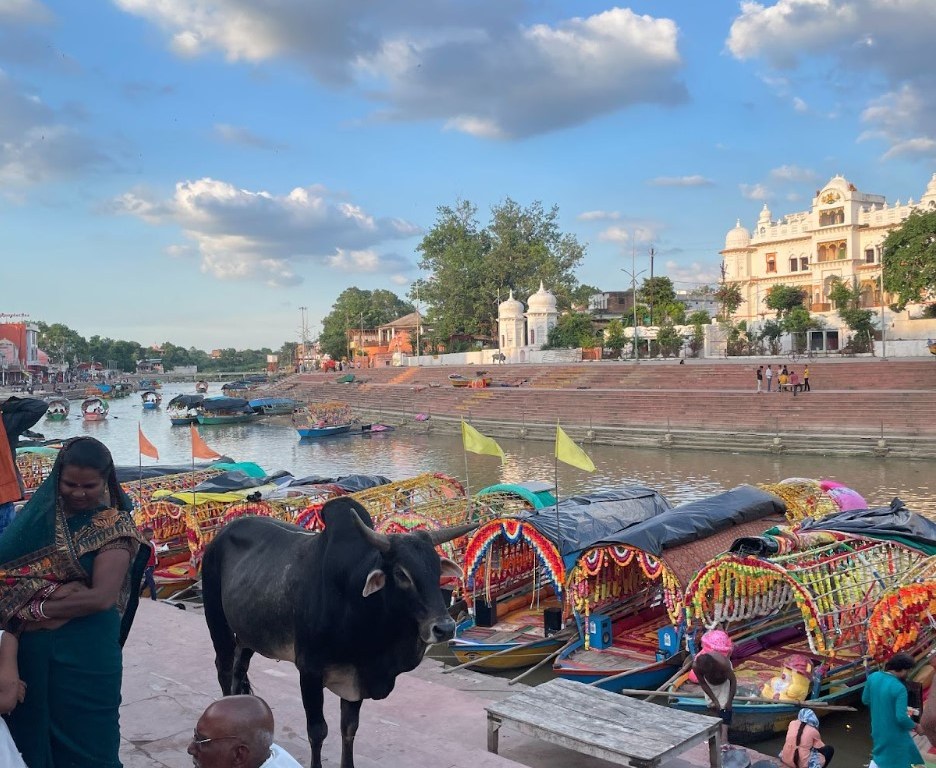
Tanushree Bhatia: I spent my time in a village in rural Uttar Pradesh called Bundelkhand working as a research assistant for Meera Jatav, the first Dalit woman journalist in the District. My experience was very useful in understanding the challenges faced by Dalit women activists in rural India and how difficult it is for them to conduct fieldwork. This experience was also helpful because I was able to access the archives of newspapers handwritten by two generations of rural women.
Jason Roeder: I went to Berlin and Frankfurt in May to collect archival materials on German cinema. In Berlin, I visited the Deutsche Kinemathek, which is the film museum there. I spent much of my time there looking at production notes, brochures, and film reviews. I then went to Frankfurt and visited the German National Library which unexpectedly had more film reviews than the film museum in Berlin. The library gave me a mountain of stuff including film reviews on microfilms, and production notes–more than I had time to sort through! I focused mainly on the film reviews which I copied so I could get a sense of how these movies were received at the time of their release.
How did you get funding?
JR: I applied for the MAGIC summer research grant which helped fund my trip. However, I left for the trip before the funding came through. So, the money helped support me after the fact.
TB: The collective I was working with funded my stay and transportation.
JAK: Technically the summer itself wasn’t funded, but I was living off of the money I had gotten from Fulbright throughout the academic year. I was [also] taking the non-service stipend for that academic year, so I had a pot of money from January that I was still living off. I [also] got a research grant from Georgetown University.
If you could give advice to graduate students earlier in the program about pursuing summer opportunities what would it be?
JAK: Ask around for opportunities. There’s stuff out there that you might not be aware of, but might be a good fit. [And] don’t dawdle on asking for letters of recommendation–that’s a big one. You don’t want to spring that on a professor, maybe midterms week, and say, “I need this in 36 hours!” They might be reluctant to [write a letter] the next time. I think two weeks is the standard, but if you know that you’re applying for something ahead of time, just make sure that you’ve got those [letters] down pat.
JR: Take every opportunity possible to learn the language! It is going to be frustrating at times when trying to communicate in a foreign setting, but try not to be too hard on yourself. You’re there to learn, and most people will try and accommodate that fact.
TB: Do something that is meaningful to you! Pursue something that helps you with your wider research but also is something you are passionate about.
What’s your best memory/favorite thing about your experience/biggest takeaway?
TB: My favorite memory was when I was sitting in a rickshaw while it was raining and instead of going to the destination, the driver gave us a tour of the entire village. We ate snacks together and bonded over the beauty of the landscape.
JR: Research-wise, I was really surprised and excited by the sheer amount of information available on the films I was researching from the German National Library in Frankfurt. It was incredibly accessible and easy to navigate. My favorite memory was when one of my close friends was able to visit me in Berlin. We were able to explore the city and hang out together. It was wonderful.
JAK: Just living the dream! It’s just so fortunate to be able to spend the whole year/summer sitting in archives and libraries, writing in Viennese cafes, and wandering from historic site to historic site. Normal people–not historians–can’t take a year off and do [that]. It’s a rare thing to be able to indulge in, even though it is part of the work. It’s also very easy to get lost [in]: “I need to look at X sources, I need to find this document, I need to write this many words.” Sometimes I had to force myself to take a step back and say “Look where you are, look what you’re doing.” I didn’t always succeed in doing that, but I was always very cognizant of “This is it, this is what I was hoping for.”
Image: Tanushree Bhatia, The Ramghat in Chatrakoot, 2023
J. Alexander Killion is a 5th year PhD candidate focusing on public policy in times of crisis, especially at the municipal level. He was a recipient of the 2022-2023 Fulbright-Mach Award for Doctoral Candidates, allowing him to spend a year doing archival research in Vienna, Austria. He also completed an MA in German & European Studies at Georgetown in 2021 as well as an MS in Public Policy & Management at Carnegie Mellon in 2019.

Image (bonus): J. Alexander Killion, Standing before the Austrian Parliament, 2023
Jason Roeder is a second year MAGIC student focusing on Post-war West Germany through the depiction of World War II in films. Through his research he hopes to understand the dialogue these films generated and the views they reflected in regards to the new values of the German army. He grew up in southern California and graduated from Chapman University with a BA in Film Studies and a double minor in English and Holocaust History. An explorer at heart with a passion for traveling and learning foreign languages, his goal is to earn his PhD and become a historian for 20th/21st Century Central and Eastern Europe.
Tanushree Bhatia is a second year MAGIC student who researches the intersections between gender and Hindu nationalism. She received her bachelor’s in Modern History at St. Andrews University.
 The Footnote