
Jenna Marcus
Halloween, with its enchanting blend of spooky and playful, is widely adored by millions across the globe. Yet beneath the familiar festivities lies a rich history that sheds light on the worldviews of our ancient predecessors and religious and political influences on cultural evolution.
The origins of Halloween can be traced back thousands of years to the ancient Celtic festival of Samhain, which translates to “summer’s end.” Samhain was celebrated around October 31st and November 1st, and marked the end of the fruitful harvest season and the coming of the dark, cold winter. The concept of liminality, or “the in-between,” was significant in ancient Celtic spirituality and mythology. During Samhain — a transitory period between two seasons — Celts believed that the barriers between the physical and spiritual worlds diminished, allowing the living and the dead to meet again.
Little is known about the original traditions of Samhain, as it was Christianized by the Catholic Church after the arrival of Christianity to Ireland in the fifth century. Based on the recordings of Irish monks and Christian scribes that detailed pagan rites, however, scholars believe that rituals included sacrificing animals, practicing divination, and discarding bones in communal bonfires. Communities also gathered for feasts and drinks and offered food outside villages and fields for spirits.
During this short window of time when spirits roamed among the living, people both eagerly awaited their departed loved ones and feared dark energies. In an attempt to ward off hostile spirits, they darkened their faces with ashes from the fires, which later evolved into wearing masks. When they felt the spirit of a loved one, they would remove their mask and reveal themselves.
Like many pagan festivals and traditions, the Church sought to Christianize Samhain. In the eighth century, Pope Gregory III moved All Hallows’ Day (also known as All Saints’ Day) from May 13th to November 1st. While his motivation is still debated, some scholars believe he did this intentionally to turn Samhain into All Hallows’ Eve. While All Hallows’ Eve would eventually become a night of vigil and prayer, old traditions were not entirely lost: bonfires were still lit, this time in honor of saints; the season’s changing was still observed, this time in the glory of Christ.
By the sixteenth century, the practice of “souling,” or knocking on doors to offer prayers in return for small cakes (called “soul cakes”), had become an integral part of All Hallows’ Eve for the poor. As it was believed that souls lingered in purgatory unless elevated by prayer and donations to the Church, those who could not afford to pay offered these cakes to neighbors in the hopes of helping their loved ones reach salvation.
The mass exodus from Ireland during the potato famine in the 1840s brought the observance of All Hallows’ Eve to the United States. From wearing disguises to going house to house for sweet treats, All Hallows’ Eve and ancient Samhain traditions can be recognized across modern-day Halloween celebrations.
Halloween represents one of the oldest traditions in the world. Every recorded civilization has some form of ritual observance centered around the transition between life and death, the afterlife, and how the living should honor the dead. The persistence of ancient Samhain traditions is a testament to a fundamental element of the human condition: a sense of connection to something greater than the self.
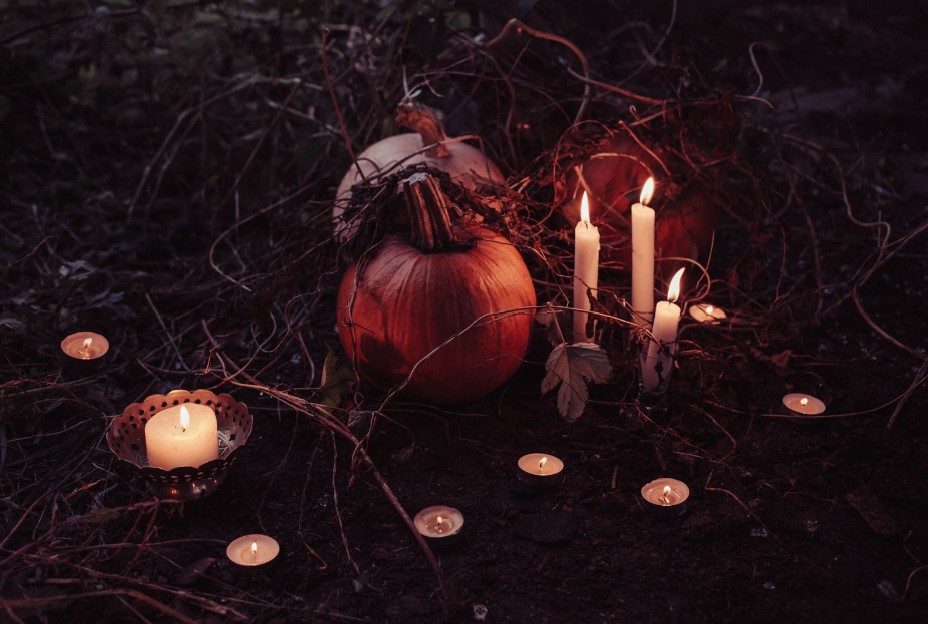
Image: Freestocks, Pumpkins between Lighted Candles, 2016.
Jenna Marcus is a first-year MA student in the Global, International, and Comparative History program. Her research interests include US foreign policy and transatlantic political history. She loves reading, writing, spaghetti, and her rambunctious poodle Sammy.
 The Footnote