
Victoria Saeki-Serna
On October 2nd, 1968, the Plaza de las Tres Culturas in Mexico City turned into a mass grave. At 6:10 pm on the cue of a red flare, soldiers and undercover agents sent by president Gustavo Diaz Ordaz rained gunfire on an assembly of university students and their allies gathered to protest the absence of political rights in the country. They blocked exits, arrested those they could not kill, and silenced and “disappeared” innumerable others, leaving a scar in the country’s collective memory that is still conspicuous today. The Institutional Revolutionary Party (PRI), which had monopolized the government for decades, preserved its rule by combining concessions with repression to neutralize dissidents. But they had never turned to outright massacre.
The tragedy came after months-long, violent attacks from the Díaz Ordaz administration to suppress the students had fallen short, and just days before Mexico City opened the Olympics as the first Latin American host in the history of the games. In the mass of studies of this fateful day, scholars regularly cite international pressure on Mexico to present itself as a revolutionary utopia at the Olympics as one of the principal reasons pushing Díaz Ordaz to resort to unprecedented violence. But as I have labored to develop an internationally angled assessment of the massacre, I have become increasingly skeptical of this explanation–for two key reasons I wish to expound on below.
Firstly, the international dialogue revolving around Mexico’s Olympics already set the nation up to fail. From the onset, those who opposed Mexico’s bid reiterated stereotypes–labeling it a “developing,” “third world,” and “bandit-ridden” country–to “evidence” the country’s inability to host such a prestigious gathering. In allowing Mexico to host despite these stereotypes, the International Olympic Committee (IOC) understood and accepted the risk of those preconceived notions proving true. Any disruption to the Olympics from student protests would have somewhat damaged Mexico’s image but would not have come as a total surprise to the international community–and may have, in fact, been tolerated to a degree as an natural element that came with Mexico’s role as host. That the United States nor IOC did not express concern over security as grounds for a potential cancellation until right before or after the massacre, respectively, evidences this point. The visibility of the massacre made international observers believe violence was getting out of hand–even if the Díaz Ordaz administration had months-long violent confrontations prior to October 2nd.
Secondly, in the years leading up to the Olympics–particularly under Díaz Ordaz’s predecessor Adolfo López Mateos–Mexico had arduously built its geocultural and diplomatic power to both combat negative stereotypes and to play a more active role in international politics. Recent showings at the World Fairs, the globally renowned national dance company el Ballet Folklorico de México de Amalia Hérnandez–whose popularity peaked during this time–and its leading role in developing and ratifying of the Treaty of Tlatelolco of 1967–which banned nuclear weapons in the Americas–all succeeded in building Mexico’s international position. These assertions of cultural and diplomatic power demonstrate that Mexico did not specifically need the Olympics to boost its international image. But more importantly, they are evidence that Mexico had a reservoir of political capital and soft power to bounce back from any damage to its reputation if protests interrupted the Olympics–which, as established in the previous paragraph, international observers would have tolerated to a notable degree. In short, these international appearances characterize Mexico as a dark horse in global politics, savvily building its influence in global geopolitics in large part on the basis of its culture.
Per my reading of events, cultural notions surrounding Mexico gave Díaz Ordaz both cover and capability of comeback to curtail any effects from violence on the eve of the Olympics. It is a grim realization to see how culture–a construct often associated with collective identity and peace–can be abused to enable authoritarianism and brutality. But this realization also calls attention to the immense influence of culture on diplomatic affairs–and its infinite possibilities. Instead of relying on the political capital amassed on the international scale to repress its own people, what if Mexico used it to advocate for them and improve international partnerships in the process? What if they used their power to engage in substantive dialogues–with meaningful cooperation with the United States and China on fentanyl trafficking–which would reduce violence across borders? Or to develop more creative economic collaborations–like the semiconductor plants set for construction in Jalisco and Baja California–which could generate jobs on both sides of the border?
Nonetheless, I have yet to see significant investments into this soft power from the Andres Manuel López Obrador administration. If anything, it appears they often deliberately sabotage the present and future use of this soft power. This past year, numerous athletes have denounced the Comisión Nacional de Cultura Física y Deporte (CONADE) for failing to give them their rightful scholarships to attend Olympic qualifiers, Pan-American games, and other international competitions. Those that have received stipends have reported reductions of up to 80%. They have taken to creating OnlyFans accounts, selling Tupperware, and auctioning memorabilia in a desperate search for funding. Being a professional athlete indeed requires a level of economic privilege; the investment into training and equipment to reach that level of performance is more than what most Mexicans can afford. But this administration does not realize that a failure to invest in the future of these athletes is not the statement against privilege it seeks. Defunding athletes only brings out their economic resourcefulness, a trait glorified in Mexican society. Rather, the defunding amounts to an assault on the nation’s soft diplomatic power–both present and future.
The legal drama surrounding the Cancun area park Xcaret provides another example. Earlier this year, in May, a judge ruled that Xcaret had to remove all park material utilizing or promoting Mayan culture. Xcaret has become one of Cancun’s the most emblematic tourist destinations, and has received multiple international awards for its preservation and promotion of Mexican culture. Among academic circles, it tends to be less controversial than the national dance company, el Ballet Folkórico de México, in debates on the balance between stylization and accuracy in performances of traditional dancing. This legal decision shuts down the entire mission of the park and leaves it inoperative (like the CONADE controversy), dealing a blow to the personal economic futures of the park’s artists and to Mexico’s soft power reservoir. International influence, especially through culture, is painstakingly slow to build. But these talented athletes and artists, who sit on the sidelines and wings, are eager to help build it. They just need the resources to do so.
Of course, I would not be a proper historian if I did not acknowledge my biases. As a folklórico dancer for fifteen years and counting, with a personal history with el Ballet Folklórico de México, I am instinctively inclined to advocate for Mexico’s athletes and artists. That I have other political disagreements with the current administration only makes my anger over the aforementioned situations that much greater. But it is precisely this position that also enables me to testify to the immense pride Mexican athletes and artists have both in their craft and representing Mexico, and the positive impact a single appearance can have on spectators’ views of Mexico. Some of Mexico’s most influential diplomats are not found in the halls of National Palace, or in the offices of the Secretary of Foreign Relations, writing memos for meetings or briefing the president. They are in gyms and studios–pushing their bodies and minds to the limit, pouring countless hours of preparation to perfect a single performance at a time.
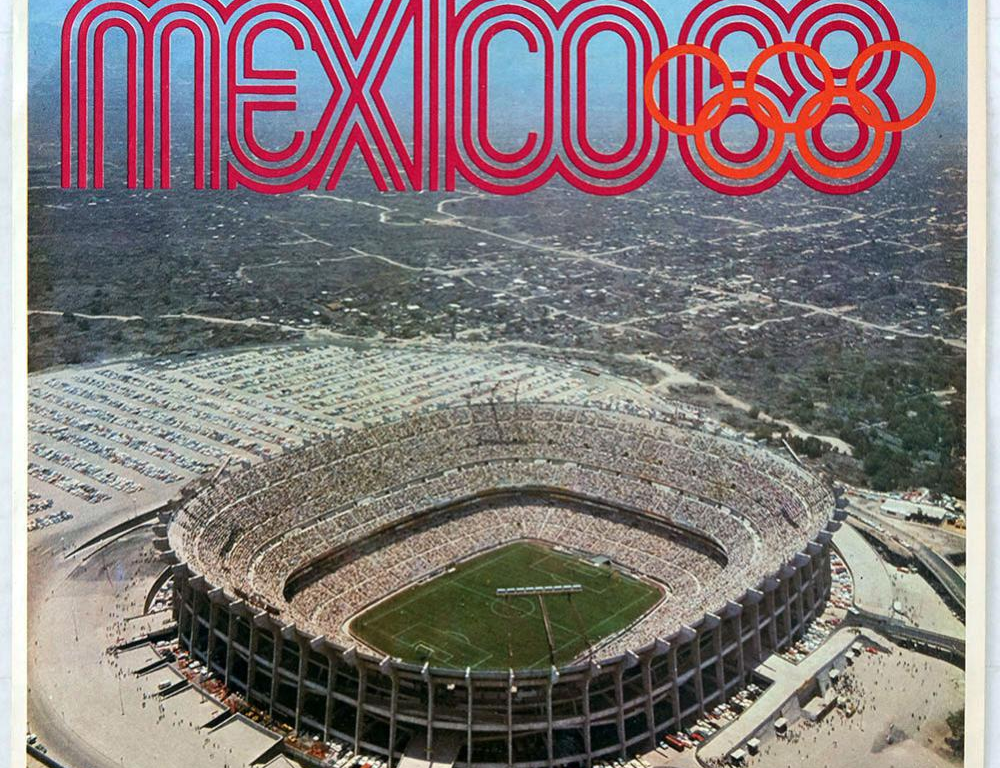
Image: Lot 334: Sport Poster Mexico 1968 Olympics Football Stadium Olimpiada XIX, https://www.invaluable.com/auction-lot/sport-poster-mexico-1968-olympics-football-stadiu-334-c-fd94d7eb37
Victoria Saeki-Serna is a recipient of the Ira and Patricia Gruber Award for Best Honors Thesis from Rice University for her thesis entitled “Negotiating Mexican Foreign Policy on Cuba: Between Domestic Interests and the United States: 1959-1964.” A Mellon Mays Fellow, Saeki-Serna is passionate about incorporating her Mexican identity and perspective into her research on US-Latin American Cold War relations. She is currently a second year History PhD Student at Georgetown University, where besides the 1968 Olympic protests, she studies how debates on democracy and drugs shaped US-Mexico relations.
 The Footnote