
Shawn Liu
In early February last year, Chinese internet users on the popular social media platform Weibo began voicing concern over pictures of Yaya, a Chinese panda at the Memphis Zoo in the U.S. The picture circulated online shows Yaya sitting against a bamboo pole, seemingly malnourished and emaciated. These users accused the Memphis Zoo of subjecting Yaya the panda, a sacred Chinese animal, to inhumane treatment. Some commentators asserted Chinese cultural and technological superiority, arguing that “In a country like ours, raising a panda is no problem at all!” Others critiqued the practice of “loaning” pandas for diplomatic purposes, arguing that it subjected them to potential neglect in foreign, particularly American, care. In a caustic response, one commentator questioned, “You rub your hot face against someone’s cold butt. They don’t care about it, so why send it away?” As such, these commentators not only reduced Chinese “panda-gifting” to the United States as diplomatic fawning, but they also suggested American deliberate mistreatment of Yaya.
Although netizens criticized the Memphis Zoo for their supposed inhumane treatment towards Yaya, Yaya still returned to China peacefully when her “loan” period concluded in April of 2023. In a twist of irony, the same cannot be said for two nearly-forgotten American musk oxen, Milton and Matilda, who faced a vastly different fate when they arrived at the Beijing Zoo over fifty years ago.
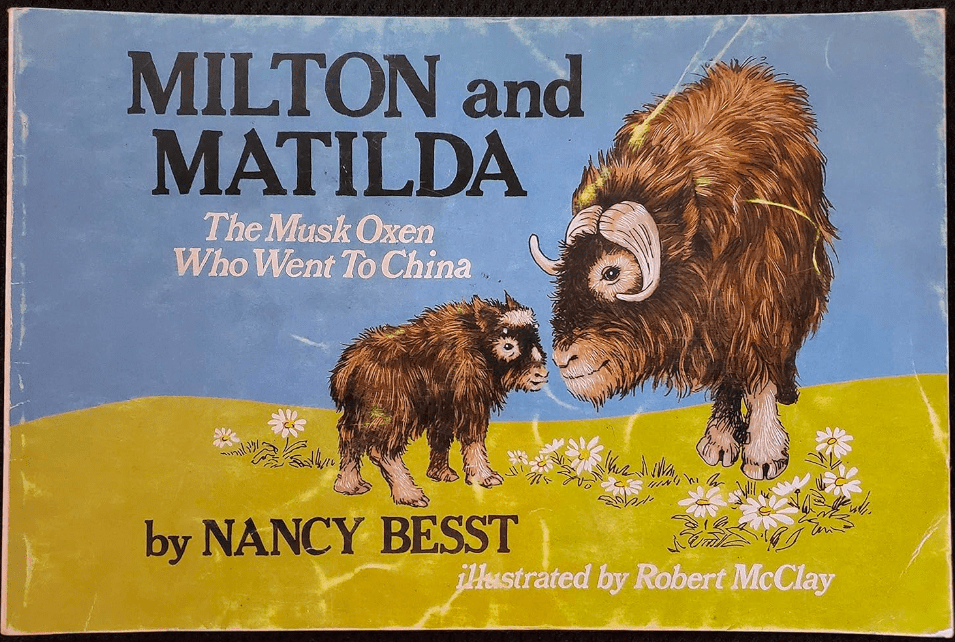
In 1972, President Richard Nixon offered two musk oxen, Milton and Matilda, to the Beijing Zoo to celebrate the newly rekindled friendship between China and the United States. In return, former Premier of the People’s Republic of China Zhou Enlai gifted two Chinese pandas, Ling-ling and Hsing-hsing, to the Smithsonian National Zoo in Washington, D.C. This made headlines in the United States, with Murray Schumach reporting in the New York Times that “with the intensity of politicians bargaining for presidential convention delegates, zoo directors are bringing every kind of pressure to get one of the furry clowns with the black-patched white bodies and the black-ringed eyes.” With this oxen-for-panda exchange in 1972, the U.S. joined an exclusive group of countries (the U.K., the Soviet Union, and North Korea) that could claim ownership of the giant panda in their national zoos. Interestingly, after receiving the pandas, the director of the U.S. National Zoo, Theodore Reid, felt slightly embarrassed by their initial “gifts” to China. Reid explained in 1972, “Frankly, I just don’t think musk oxen have the sex appeal pandas do. You like musk oxen, but pandas can steal your heart away.”
However, it was not long before the director of the Chinese Zoo would feel equally, if not more, embarrassed — not because of the nature of their gifts, but due to the challenges of maintaining the American animals. If social media existed in 1972, one might expect Americans to have reacted like the Chinese netizens earlier this year when it came to the weak state of Milton and Matilda at the Beijing Zoo. According to Theodore Reid, not only did Milton and Matilda suffer from poor skin conditions at the Beijing Zoo, but they were also “depressed.” Milton was suffering from “postnasal drip” and “a cough and falling hair” whereas Matilda was also reported to be “feeling poorly.” Feng Youqian, the third director of the Beijing Zoo, recalls that since these oxen were gifts from the United States, he could not sleep when Milton and Matilda refused to eat.
In 1975, The New York Times reported that Milton died of “hardware disease, which results from the swallowing of sharp objects.” With embarrassment, Feng stressed that the oxen were “gifted animals that represent the friendship between China and the United States… Chairman Mao ought to explain this to the American people.” To hide the embarrassment of Milton’s death, Chinese zookeepers prevented American diplomats from visiting the Beijing Zoo. George Bush, then Chief of the U.S. Liaison Office, wrote in one of his letters in 1975 that “we are speculating that the main reason for the failure to go to the zoo was either the condition of the zoo or possibly the dead musk ox. Probably the latter…” Within eight years, both oxen had passed away in the care of the Beijing Zoo. Milton and Matilda’s deaths, and the subsequent anxiety their deaths generated in the Beijing Zoo, effectively highlight the nuances of “animal diplomacy.” As this episode shows, animal diplomacy – conventionally understood as the exchange of culturally significant species – carries more profound implications beyond international goodwill. The success or failure of a country in caring for these animals is not only a reflection of convivial relations with other states but also a suggestion of its political stature and cultural competence.
After receiving confirmation of the deaths of Milton and Matilda, Bush started debating whether or not they should send another pair of oxen to China. Initially hesitant, Bush doubted whether people in the United States were “clamoring to send a replacement ox” to China. Furthermore, he believed that it might not be “appropriate for President Ford to bring an ox with him.” After much debate, Bush changed his mind and decided to send replacement oxen to the Beijing Zoo. Bush, in a later telegram, explained:
“The more I think on it the more I like the idea of having the Chinese receive another ox from the US. Milty is dead but a young and virile Bullwinkle could do a lot of good for relations (diplomatic relations, that is).”
In 1988, two more musk-oxen, Koyuk and Tanan, arrived at the Beijing Zoo. Zheng Jinzhang, chief veterinarian at the Beijing Zoo, explained, “we hope the animals will live better this time. And we hope there will one day be a baby.”
Not only did they not have a baby, but they too died shortly after. No other oxen had been sent to China since then.
From Nixon’s 1972 gift of oxen to China to the recent outcry from Chinese netizens over Yaya’s treatment in Memphis, these stories collectively illustrate the intricacies and potential pitfalls of “animal diplomacy.” They highlight subtleties in the concept of animal diplomacy, including the host country’s readiness and knowledge for animal care, the cultural humiliation they face when these animals fall ill, and the broader symbolism of maintaining foreign fauna. Ultimately, China’s failure to protect the lives of these oxen carries profound cultural and symbolic implications. The Beijing Zoo’s failure to sustain the lives of Milton and Matilda, and subsequently Koyuk and Tanan, reflects heavily on China’s international image and severely undermines the intended spirit of diplomatic goodwill. It is perhaps exactly this reason that the stories of Milton, Matilda, Koyuk, and Tanan are so obfuscated in Chinese history. These exchanges also highlight the ethical and practical dimensions of diplomatic gifting of animals, where living beings are reduced to readily exchangeable tokens of politics and culture.
In the complex dance of animal diplomacy, it seems both pandas and musk oxen ended up teaching China and the United States a lesson: caring for foreign fauna requires more than goodwill. It requires a blend of cultural understanding, expertise, and perhaps, a bit of animal instinct.
Image: Cover Art, Milton & Matilda: The Musk Oxen Who Went to China, Nancy Besst and Robert McClay, 1982. Image sourced from https://www.amazon.com/Milton-Matilda-Nancy-Besst/dp/0835109984
Shawn Liu is a first-year MA student in the Global, International, and Comparative History program. His research interests include Chinese intellectual history and Sino-American collaboration and competition in the polar regions. He loves listening to music and singing, and loves swimming or going on hikes with his friends! He also has a weird infatuation with horror movies and games.
 The Footnote