

Rosie Click
“See that building there? That used to be a women’s prison,” said my friend as we walked down a narrow street in the old walled portion of Cartagena, Colombia. The large, white building had peeling layers of white-ish paint and appeared abandoned. What was this doing in the middle of the most tourist-dense area of one of the most sought-after destinations in Colombia? At first, I thought it had some connection to the Spanish colonial days when Cartagena was one of the wealthiest cities in the Americas. Upon closer inspection, this structure was way too new to be from the colonial era. When I asked, I learned that it was a recently closed women’s prison…that had also been a restaurant. The incarcerated women had worked at the San Diego prison restaurant, named Restaurante Intero, as chefs, waiters, and dishwashers. Its mission was to give these women “training and productive spaces to prepare for their freedom.” The three-course menu cost 90,000 Colombian pesos, or about $23 US dollars.
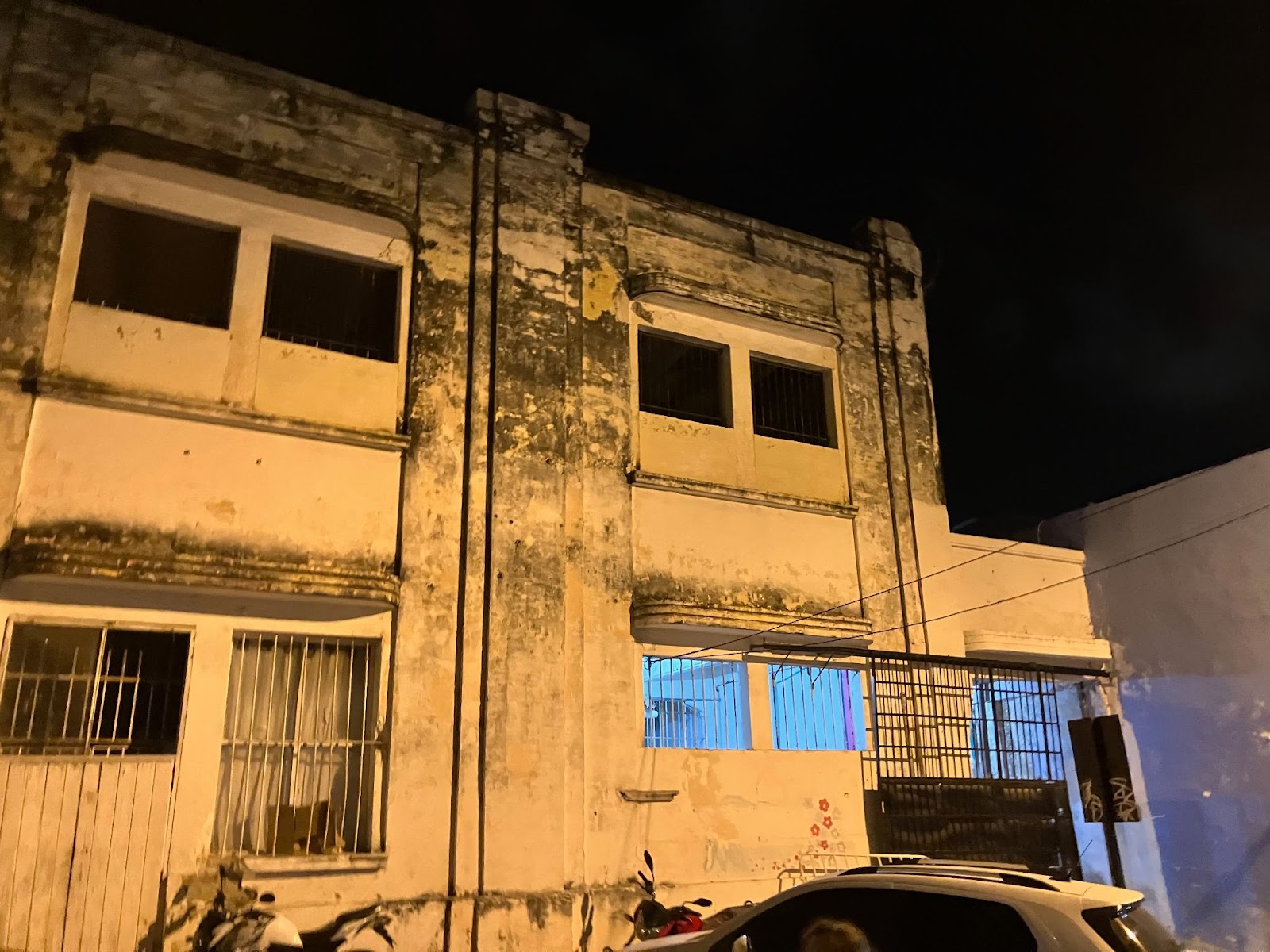
The former San Diego prison, taken by the author, January 2024.
In theory, Restaurante Intero sounded like a great thing for everyone involved. The incarcerated women could gain skills and interact with the public. The public could enjoy a unique dining experience and perhaps shed some of their preconceptions about people who are in prison. But something about the venture, which was named one of Time Magazine’s 100 greatest places in 2018, still felt off to me. In doing research on this site later, I saw a picture that made me similarly uncomfortable. In this image, one woman hands a plate of food to another from behind a barred door. I do not have all the context for this image (are both women incarcerated?), but I did gather some information that also troubled me. For instance, tourists often posed with the internos, as they are called, so there must have been some contact between them and the women behind the bars. Also, in lieu of wages, the women received six months off of their sentence for every year they worked at Restaurante Interno. Only the women deemed “low risk” and chosen by prison staff for “good behavior” were able to work there.
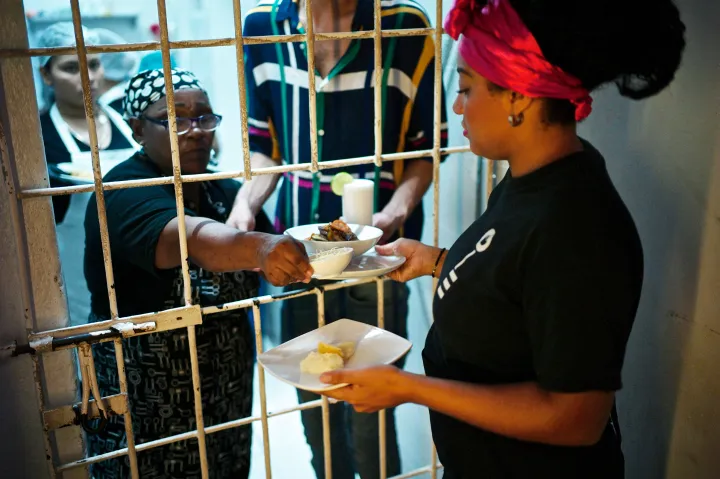
Kike Calvo-Redux, “Restaurante Interno,” Time Magazine, https://time.com/collection/worlds-greatest-places-2018/5366704/interno-cartagena-colombia/.
I finally figured out what made me so uneasy: the power dynamics. (Yes, Foucault strikes again.) There was the obvious issue with power between the prison staff and the incarcerated women–that at any moment, a staff member with a grudge might be able to deny a woman the opportunity to work off the time of her sentence. Of course, there is also the question of whether prison was even “right” for some (or any) of the women in the first place. However the aspect of this venture that stuck out to me in particular was the use of these women’s unpaid labor to cater to the mostly international tourist market of Colombia. An article in The Independent recommends it to their readers, claiming that “it’s definitely worth reserving your night behind bars.” I thought back to people posing for pictures inside of a cell at Alcatraz when I visited years ago–why does play-acting as an incarcerated person appeal to so many people?
The day after seeing the former women’s prison restaurant, we went to see the top tourist attraction in Cartagena: the Castle San Felipe de Barajas. This fortress, built by enslaved people in 1536, still stands on a hill high above the city. It is now filled with tourists, but it was once filled with soldiers, enslaved workers, and prisoners. The cells were deep within the walls of the castle. As we descended the stairs, the warm air and sunshine faded, and we were in a dimly-lit passage with cutouts no bigger than a typical cubicle. From informational signs, we learned that they were cells that held prisoners during the period of Spanish colonial rule. Some people posed for pictures, like at Alcatraz, while others carried on unrelated conversations, their laughter echoing through the narrow passages. I had to get out of there, and took the nearest stairs.
I can only imagine the existence of the people who spent hours, days, weeks, and years locked in those subterranean cells. The air was damp and stuffy, and the only source of light was the stairway opening–the perfect environment for a host of infections to spread. There was no waste management, so the imprisoned people would have been surrounded by filth and putrid smells. Instead of the chatter and laughter I heard while experiencing this space, they would have likely heard cries, screams, yells, or sounds of pain from fellow prisoners. The only human touch they would experience was their own, and the stone floors would provide little comfort when they tried to sleep. It must have been a miserable existence that many never saw end. Imagining their sensory experience only gives us a fuzzy notion of what they may have felt: fear, anger, desperation, sadness, resignation.
Cartagena is a lovely city for a vacation. The top-tier food scene, rich history, fragrant flora, and picturesque architecture make it an unquestionably lovely place to be a tourist. But besides all of this, many tourists make it up to Castle San Felipe to see where hundreds of people suffered as prisoners in despicable conditions. And until recently, they could stop by for a meal made by incarcerated people of today and chat about how trendy the restaurant was while posing for pictures in front of barred doors. This contrast can give the observer whiplash.
Dark tourism–at sites of suffering, torture, and death–is very common, and can include everything from touring a former concentration camp to visiting the grave of someone famous. While I believe that the two experiences related to prisons in Cartagena qualify as dark tourism, I’m not sure that all of my fellow travelers would agree. Is it only dark tourism if a tourist knows that it should be? Especially Restaurante Intero–the fact is that the women who made the food and served customers and cleaned their dirty dishes were actively being deprived of their freedom, whether you believe in the utility or fairness of incarceration itself. To me, that’s dark tourism because the tourist is enjoying an experience predicated on someone else’s current (or former, in the Castle’s case) status as incarcerated. But despite any ethical concerns with being a tourist at these sites, in my deep voyeuristic heart I wish I could’ve seen Restaurante Intero for myself.
So what occupies that former dark tourism hot spot now? An unmarked parking garage.
Cover Image: The Castle San Felipe de Barajas, taken by the author, January 2024.
Rosie Click is a second-year PhD student studying Latin American History at Georgetown University, advised by Dr. Bryan McCann. Click received an MA in Latin American Studies from Tulane University in May 2022, and a BA in Latin American Studies and English from Tulane University in May 2019. Her work explores US-Latin American and US-Caribbean relations, particularly through the lenses of power, imperialism, and tourism. She is also interested in public history, museum studies, Caribbean literature, and academic editing.
 The Footnote