
Mallory Page
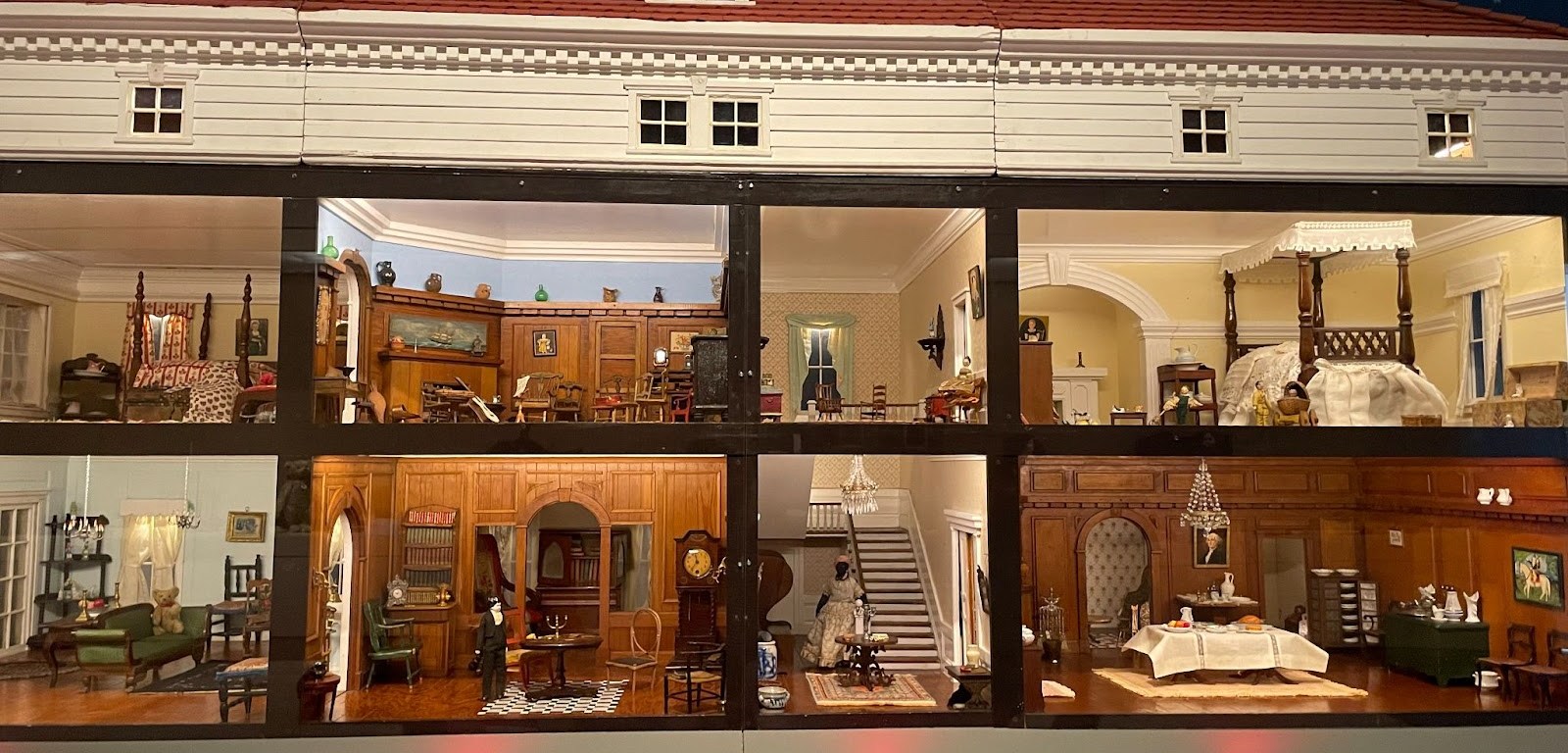
“Since the beginning of time, since the first little girl ever existed, there have been dolls,” Dame Hellen Mirren announces as the Narrator in Barbie.[1] While this quote may be hyperbolic, dolls are a pivotal part of many women’s childhoods. The success of Barbie this past summer points to the importance of dolls to modern culture. Long before the advent of the eponymous blonde doll starring in this hit blockbuster, 19th century children played with dolls and dollhouses. This essay researches a toy that predates the Barbie Dreamhouse by almost a century, analyzing a doll house at the Colonial Williamsburg Folk Art Museum. Analyzing this toy reveals details about the politics of the age as well as the architectural and décor trends of the family that owned it.
This toy exchanged several hands before being displayed at the Colonial Williamsburg Folk Art Museum. Prior to coming to the museum, the doll house was in the window display of F.A.O. Schwarz in Times Square. Colonial Williamsburg Folk Art Museum purchased the house from F.A.O Schwarz in 1969. A unique feature of the doll house is that the staircase is off-center, with two sets of rooms on the left side and one room on the right. Classic Colonial revival houses are symmetrical, so it is interesting that Colonial Williamsburg classifies this doll house as being inspired by a Colonial Revival house.[4] The furniture inside the house largely is in the Federal style, matching the Colonial Revival aesthetics of the exterior of the toy.
The style of the micro furniture is harder to determine, as successive generations of wee owners added pieces to the toy while it was in use. Adding to the problem, the curatorial team at the Colonial Williamsburg Folk Art Museum cheekily added mini replicas of artifacts found elsewhere in the museum to the diminutive domicile. Thankfully, the curatorial team identified on the placard the few objects they themselves added to the display, and they only added paintings.
Studies show children learn about their culture through a variety of means, including both formal education and play. Baxter explains children discover the world around them through both structured education and “more subtle transfers of information through everyday interactions among members of a household or a community.”[5] As a facsimile of the home, a doll house serves as a transformational site, amending children’s thoughts about their role and place in society. Every doll tea party or ball serves as an educational experience for small tots. Children play an active role in their own socialization, negotiating the “roles, attitudes, and behaviors relating to the social categories of childhood and gender.”[6] Their own interpretation of these constructs is continuously molded by children and the adults around them. A doll house serves as a stage to observe and practice day-to-day operations of a household and social visits. Socialization of children is a constant process, one in which children and adults participate, and the artifact introduces another vehicle through which children learn about their culture.
A doll house differs from other studies of the history of dolls because the doll is not the centerpiece of a doll house. Rather than acting as a caregiver, the child is a director, moving the doll from room to room and reading lines. The child completely removes themselves from the action, channeling their character into the figurine.
The intricate detailing and fine miniatures of the Long Island Doll House may perplex a modern audience accustomed to the neon plastic furniture of the Barbie Dreamhouse, but this mimicry of real furniture is intended to educate kids about proper decorations. Edith Wharton, the famed author and designer, described in her book The Decoration of Houses the importance of raising children to appreciate style: “As a matter of fact, children are quick to appreciate beauty when pointed out and explained to them, and an intelligent child feels peculiar pride in being the owner of some object which grown-up people would be glad to possess.”[7] A design bible for the old money crowd and those who aspired to break into their circle, Wharton and her co-author Ogden Codman, Jr. diligently detailed how Gilded Age families should decorate their houses, drawing inspiration from older European aesthetics. While Wharton’s principal concern was to instruct adults on developing taste, she nevertheless advised parents to train their children, starting from a young age, to appreciate fine art and design. As the Long Island Doll House existed prior to the publishing of The Decoration of Houses, Wharton did not invent these style guidelines, though she voiced them to a larger audience. The doll house’s adherence to Wharton’s aesthetics suggests that an old money family owned it and used it to teach their child to appreciate fine furniture and décor.
One miniature is a tall vase, and the other is a stout and wide bowl, but both are in the same blue and white pattern characteristic of chinoiserie. As Timothy Brook explains in Vermeer’s Hat, this blue and white lacquered porcelain originated in China and inspired imitations in Delft. A child most likely did not think about the global networks that resulted in them having miniature chinoiserie in their toy, but the inclusion nevertheless symbolizes the interaction and fascination with Asian art and pottery. As Kristin Hoganson explains in Consumer’s Imperium, American consumers—notably women—viewed other cultures as commodities to be purchased, believing showcasing foreign furniture would portray their wealth and status as part of an emerging world power. While chinoiserie had been available to wealthy Americans since before the Revolutionary War, consumption of Orientalist art skyrocketed during the post-Civil War period.[8] The dishes are unfortunately too small to thoroughly analyze and determine whether they mimic the Dutch delftware or authentic Chinese designs, but either version represents this tangled history of Europeans and Americans incorporating Asian aesthetics into their homes during this period.
Over a century and a half after the genesis of this doll house, dolls remain a staple for children. The dolls may look different than those in the Long Island Doll House, changing to reflect American society’s evolving attitudes and styles, but the mechanics of play have stayed the same. The success of Greta Gerwig’s Barbie reminded the world of what young girls already knew—dolls and doll houses matter. Dollhouses allow children to explore and act out their understanding of adulthood and domestic life in a safe and risk-free way. When I visited the museum and saw the artifact in person, two little girls stood mesmerized in front of the toy, dazzled by the miniature furniture and tea sets. After a century and a half, kids and adults still love doll houses.
Image: Mallory Page, “Long Island Doll House,” 2022.
Mallory is the Social Media Director and a second-year Master of Arts student in Global and International History (MAGIC). She studies 18th and 19th century Japanese cartography and its ties to imperialism. In her free time, Mallory enjoys knitting sweaters and hanging with her cat, Mabel.
 The Footnote
I’ve always loved doll houses. I enjoy seeing them in museums.
LikeLike