
Philip LaRue
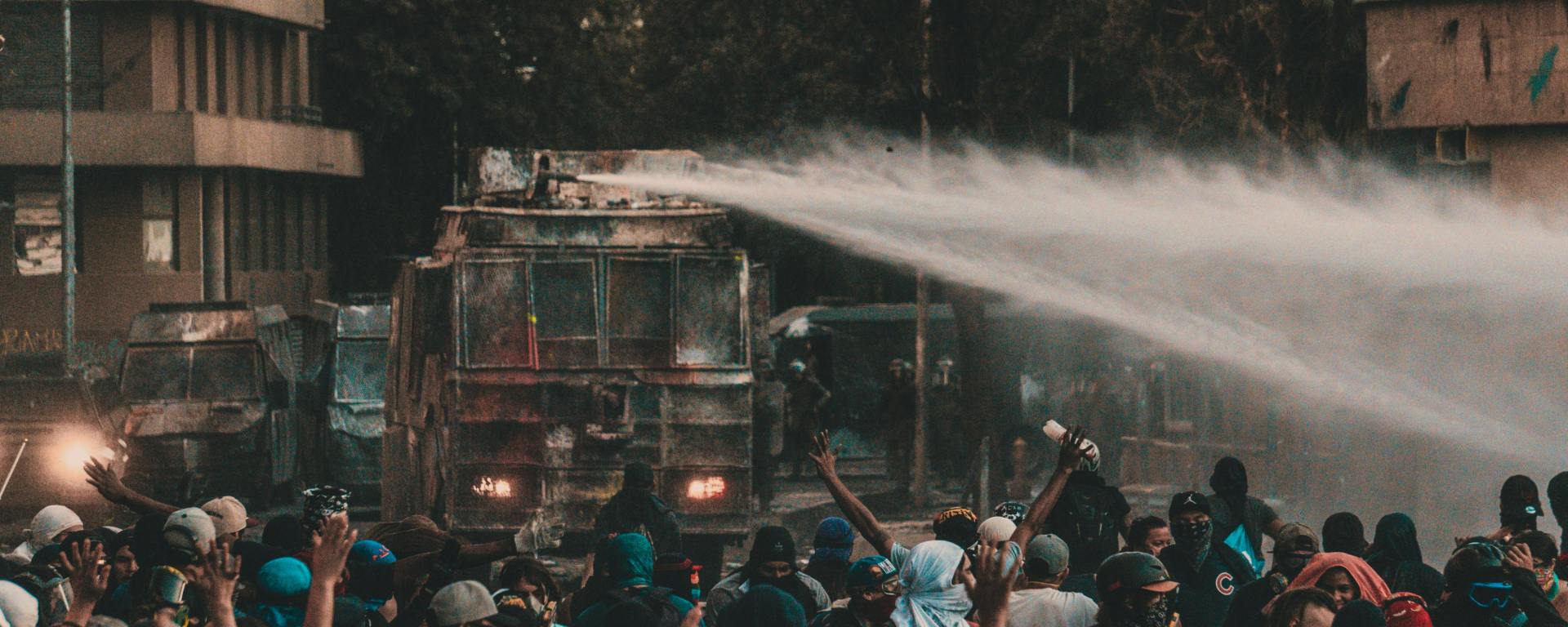
It was the “mass protest decade”—not the “long 1960s,” but the “long 2010s,” beginning with 2008’s global financial crisis. Journalist Vincent Bevins traveled the globe in search of lessons from the past decade’s global street revolt in 2023’s If We Burn: The Mass Protest Decade and the Missing Revolution. Bevins argues that “by taking a truly global approach, we can see which factors were common [to 2010s-era popular uprisings] and which were crucially different.” Yet precisely how global was the “we” burning in Bevins’s study? Adroitly linking far-flung protests from Tunisia, Egypt, and Turkey to Ukraine, Brazil, and Hong Kong in his lookback, Bevins largely omits major Euro-North American counterparts in his otherwise excellent treatment of why street rebellions, aided by new communications technologies thought revolutionary, mostly failed to achieve their goals. The choice of focus is unfortunate: risings in Ukraine or Brazil were not part of some extended global “there” observed—with pity or scorn—from the safety and security of a rich world’s “here.” An extended detour into several historical works on U.S. history during the “long 1960s” suggests the value of a more integrative approach.
Matthew Connelly’s 2000 article “Taking off the Cold War Lens: Visions of North-South Conflict during the Algerian War for Independence” urges scholars to revisit Cold War-era contest in the decolonizing peripheries of falling European empires with an eye for multidirectional exchange. Fearful of the “rise of the rest”—a rise bound to come with or without Soviet interference—U.S. leaders like Eisenhower, Dulles, and Marshall uneasily threaded the needle between support for traditional European allies and “the little people all over the world.” Western academics and development experts like Daniel Lerner, Karl Deutsch, Walt Rostow, and others watched with equal parts excitement and fascination as ideas of “modernity” spread through “exposure to new popular media”; witnessing Western messianic predictions on the redemptive power of new media recalls Bevins’s account of commentariat reactions to social media organizing in Tunisia and Tahrir Square sixty years later. Like the radicals of Bevins’s time, however, those featured in Connelly’s article failed to neatly conform to elite expectations.
Inspiration to and from risings in the Global South, of course, reached far beyond State’s corridors and the heights of traditional academe. As Robeson Taj P. Frazer finds in his “Thunder in the East: China, Exiled Crusaders, and the Unevenness of Black Internationalism,” rising activists among marginalized peoples in the United States drew great inspiration from “Third World” revolutionaries—who in turn drew inspiration from them. Logistical and ideological support flowed in both directions, as exemplified by the case of Mabel Williams and Robert F. Williams’ extended sojourns in Cuba and China. Through “Radio Free Dixie,” broadcast for a time from Castro’s Cuba, the Williamses pushed their message into radio sets throughout the segregationist South. Much as young people using Twitter to organize in Hong Kong were, on a purely technological level, little different from those using it to organize in Zuccotti Park, there are striking parallels between the Williamses’ use of radio and its emergence as a subversive technology in Algeria during the same period.
Moreover, the worlds of “elite” and “subaltern”—domestically and globally—could, and did, collide via new and old mass media alike. In Cold War Civil Rights: Race and the Image of American Democracy, Mary L. Dudziak highlights the case of Jimmy Wilson, a Black farmhand sentenced to death in Alabama in 1958 over the alleged theft of $1.95. Panicked diplomats thrust newspaper reports on Secretary Dulles’s desk and forwarded angry letters from business and political leaders in the “Third World” with dire warnings that Wilson’s sentencing only made communism’s job easier. In Dudziak’s account, Dulles, for his part, seems to have taken notice, calling the case “a matter of prime concern to the foreign relations of the United States.” The episode points to another potentially worthwhile expansion to Bevins’s look at the “long 2010s”—immersed in several protest movements himself, Bevins spends comparatively less time looking at how their actions played in the halls of power, both locally and globally, possibly missing some key insights.
“I am not a historian,” Vincent Bevins announces at the start of his book. He can be forgiven for that. Bevins’s detailed treatment of 2010s street revolutions shines new light on the shortcomings of contemporary protest politics, and for that fact alone, his book is well worth the read. Nonetheless, he errs in largely leaving off movements with Western origin stories and elite reactions to the global uprising. Both the “long 1960s” and “long 2010s” featured new advancements in telecommunications and mass culture, allowing global discontent to find voice—whether in Occupy Wall Street or in the Egyptian and Ukrainian square. In both cases, elites in the rich world and beyond held—ultimately misplaced—hopes that technologies in the right hands alone would peacefully usher in a new era of equity, only to find those hopes dashed. As we look to our own recent past, historians should take note from the global 1960s. “If we burn,” as Bevins would say, we all burn together.
Photo by Jorge Soto Farias
Philip LaRue is a second-year M.A. student in the Global, International, and Comparative History program. His primary research focuses on the experiences of Richard T. Greener, U.S. Commercial Agent to Vladivostok from 1898-1906. He loves reading—to himself and his son—hiking, and the occasional video game.
 The Footnote