
Megan Emery
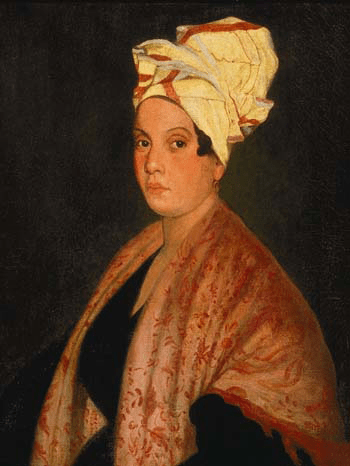
For those who haven’t watched American Horror Story season three, I highly recommend firing up your Hulu subscription. For those who’ve watched it, this article addresses one of the season’s most beloved and feared protagonists—the Voodoo Queen, Marie Laveau. American Horror Story frequently takes artistic liberty with real historical figures. Season three includes Madame Delphine LaLaurie, a New Orleans socialite who tortured her enslaved property in her French Quarter New Orleans mansion. While the real LaLaurie died in 1849, in the show, she is one of many victims cursed by Marie Laveau—buried alive for eternity. Throughout the franchise, various actors and actresses play the roles of H.H. Holmes, Elizabeth Short, Jeffrey Dahmer, and John Wayne Gacy. Yet, unlike any of the other historical perpetrators and victims in American Horror Story, Marie Laveau was black. Why does American Horror Story’s characterize Marie Laveau as a malicious Voodoo Queen? Is the misrepresentation of Marie Laveau and Voodoo racist?
The term “Voodoo” has been used to categorize dolls, doughnuts, and even economics; yet its etymology couches racism. In Danielle Boaz’s Voodoo: The History of a Racial Slur, she argues that the term “Voodoo” has historically been “a mechanism for prejudiced individuals to invoke all their anxieties and stereotypes about people of African descent” (ix). In a single word, “Voodoo” encapsulates the racist view that black people are hypersexual, uncivilized, cannibalistic, and superstitious. American Horror Story does nothing to counteract this biased depiction of Voodoo. Throughout season three, Marie Laveau summons the undead, hangs an entire family, and sacrifices a stolen baby to Papa Legba—the Voodoo spirit of death.
While the archival records documenting Marie Laveau are scarce, no evidence exists to suggest that she held supernatural powers or committed nefarious deeds under the guise of Voodoo. As a matter of fact, Laveau practiced both Voodoo and Catholicism in a syncretic harmony. Laveau, rather than seeking revenge against white slave owners (as illustrated by American Horror Story), joined a common-law partnership with Charles Glapion—a white slave owner. American Horror Story depicts both Voodoo and Marie Laveau wrongfully. To do proper justice to Marie Laveau, I detail what Voodoo really is and who Laveau really was.
New Orleans Voodoo originated as an outgrowth of Haitian Vodou, which had been influenced by French colonial Catholicism. Vodou traces its roots to Africa, and Haitian Vodou incorporates belief systems from the West African Fon, Yoruba, and Central African Kongo people. Christian religious symbolism dominates Haitian Vodou, and practitioners worship a supreme being similar to the Christian God the Father, and several lesser deities, lwa, who are typically syncretized with at least one Roman Catholic saint. Thus, Voodoo and Catholicism are not dissimilar. The theatrical rituals performed in American Horror Story would be foreign to real practitioners of Louisiana Voodoo.
Marie Laveau used her role as a free woman of color to become a pillar in her community. Born in 1801, Laveau came of age in a society undergoing drastic cultural changes. From 1803-1812, the Louisiana Territory was no longer a French colony but not yet an American state. In 1809, when 10,000 refugees fleeing Saint-Domingue disembarked in New Orleans (a third each white, enslaved, and free black), a unique cultural milieu emerged. New Orleans was now saturated with free people of color who brought transgressive racial norms with them from the French Caribbean. For the first several decades of the nineteenth century, free women of color held immense cultural capital; they could own property (including enslaved property) and participate in common-law partnerships (plaçage) with wealthy white men. Most importantly, they could use their status to mediate between the enslaved black community and white community, between slavery and freedom. Through the dual practice of Voodoo and Catholicism, Laveau became one of the most prolific intermediaries in her community.
As Ward nicely captures in her chapter “Catholic in the Morning, Voodoo by Night,” Laveau was famous for balancing her dedication to Catholic beliefs and customs and following suit with her practice of Voodoo. Marie’s intimate relationship with the church stemmed from her own beliefs and her relationship with Père Antoine—the lead religious authority at St. Louis Cathedral. Père Antoine was a Capuchin priest known for his tolerance of interracial partnership and benevolence toward the enslaved. Antoine’s legacy, according to Ward, was creating a “positive dialogue between Voodoo and Catholicism” and identifying an individual to make this exchange persist—Laveau (27). Père Antoine encouraged Laveau to bring more community members to the cathedral on Catholic holidays and feast days, especially Voodoo practitioners. As Laveau ascended the ranks in the Voodoo community, she remained committed to her worship in St. Louis Cathedral, attending mass on a daily basis. Even those who did not practice Voodoo sought Laveau for advice because of her recognition in the Catholic church and her commitment to the Catholic religious community. These exchanges encouraged the continued practice of interracial and interreligious mixing for the free and the enslaved until around 1840.
Despite a rich documented history, New Orleans free women of color continue to be misrepresented in popular culture. American Horror Story fails to reveal much of the truth. While it is easy to point a finger at the show for its prejudiced representation of Laveau, it is hard to blame them. Most popular histories of Marie Laveau are at least as fanciful (if not more) than American Horror Story. Robert Tallant’s 1956 The Voodoo Queen remains one of the most prominent and accessible biographies of Marie Laveau. Nevertheless, it is largely responsible for introducing the nonsensical myths about her life. Somehow a work of fantasy morphed into nonfiction. By using evidence, historians can alter how Marie Laveau is remembered. Marie Laveau’s truths shed light on how free women of color used the resources available to them to combat oppression.
Image Credit: Wikimedia Commons
Megan Emery is a second-year PhD student studying the Haitian Revolution and the diaspora that ensued in its wake. Megan loves all things New Orleans, peanut butter, and dogs!
 The Footnote
.png)