
Maddie Densmore
My interest in genealogy began well before I became a historian. In fact, it began well before I fully understood what it even was.
As a child, I found myself watching a documentary show with my mom from time to time — “Who Do You Think You Are.” Adapted from a British version of the same name, it follows celebrities as they team up with historians and genealogists to uncover their family histories. In one episode Matthew Broderick discovers his ancestors who fought in World War I and the Civil War. In another, Gwyneth Paltrow finds out she has roots in Barbados.
Seeing these stories prompted me to begin asking family members about our own histories. These questions remained fairly surface level when I was still young — what year did my great-grandfather come over from Scotland; what village in Czechoslovakia was this branch of the family from. As I grew older and more passionate about history, I began navigating census and immigration records in online archives and databases. I wanted to piece the paper trails of my family histories together, and over the course of six years, I’ve managed to uncover hundreds of ancestors and relatives.
Ancestry and genealogical research have gained new levels of popularity in mainstream culture. Everyone seems to be taking a 23andMe test or signing up for an Ancestry.com or FamilySearch account. For Americans especially, ancestry has taken on a new meaning as the confrontations with problematic aspects of our country’s founding and origins have become pressing historical and cultural questions. Jaya Saxena describes ancestry research as a “forced reckoning” with history in her New York Times article, a statement I feel encapsulates what the process represents for me. While some branches of my family have only arrived from Europe within the past century, others have been here since before the United States gained independence — which means ultimately coming to terms with the role my ancestors played in the colonization and exploitation of the country and its Indigenous inhabitants. To assume otherwise would be naive. It means recognizing what we inherit from our ancestors and how to define what a legacy represents.
My training as a journalist and historian has been crucial while navigating archives. Records on websites like Ancestry.com, helpful as they may be, can easily be distorted and lead people to believe they’re directly descended from people like Anne Boleyn or Jesus, two impossible situations. Elements like spelling, birthplace, and dates are especially prone to being muddled while passing down through generations. Standardized spelling for first and last names wasn’t common practice until the 20th century, and much documentation relied on self-provided information. Verifying an ancestor on my family tree therefore entails a meticulous process of cross-checking and a healthy amount of skepticism, along with the knowledge that this is not likely an entirely accurate portrayal of them. Still, there have been some ancestors in my tree that do have a healthy amount of documentation and some fascinating life stories. One of the most prominent is the story of the Bliss family, whom I’m related to through my paternal great-great grandmother, Marion Bliss. Their presence in the United States dates back to the 1630s and my tenth great-grandaunt (an actual title, I’ve discovered) Mary Bliss Parsons, who was faced with two accusations of witchcraft.
Mary Bliss was born sometime around 1628 in England. Sources differ regarding her birthplace, some placing her family as living in Gloucestershire while others claim Northamptonshire. Several branches of the extended Bliss family emigrated to New England among the waves of Puritans fleeing persecution known as the Great Migration. Mary, her brother — my direct ancestor — Lawrence, and their parents Thomas and Margaret are documented arriving in Boston in the autumn of 1636, and eventually settled in Hartford, Connecticut.
By the 1650s, Mary had married Joseph Parsons and moved to newly-established Northampton, Massachusetts. The family was very well-off financially and active members in the community, with Joseph being a successful merchant and owning the first tavern in Northampton. The Parsons’ arrival in Northampton coincided with that of another family, James and Sarah Bridgeman.
According to a written history of the Northampton area, Parsons was a woman who made her presence known. She was described as “a proud and nervous woman, haughty in demeanor and inclined to carry things with a high hand,” with “forcible speech and domineering ways.” The exact origins of the Parsons-Bridgeman feud are uncertain, but local historians believe it had to do with the fact that the Parsons’ son Ebenezer was Northampton’s first recorded birth in 1655, while the Bridgemans’ son James was the first recorded death. Before her son fell ill, Bridgeman claimed to hear a knocking at her door and see two women in white passing by, despite the fact that her daughter said no women were present. It was after this episode that James “changed” and ultimately passed away. Bridgeman believed Parsons was somehow responsible, as the two families held neighboring properties.
Rumors that Parsons was a witch consumed the town the following year. One family, the Hannums, claimed their daughter fell mysteriously ill after they forbade her from accepting a request to work for the Parsons family. William Hannum also claimed Parsons reprimanded him for supposedly abusing oxen he’d borrowed from her brother and that she “went away in anger”; three days later his own ox was bitten by a snake and died. The Bridgemans additionally swore their eleven-year-old son claimed he frequently saw Parsons followed by “a black mouse.”
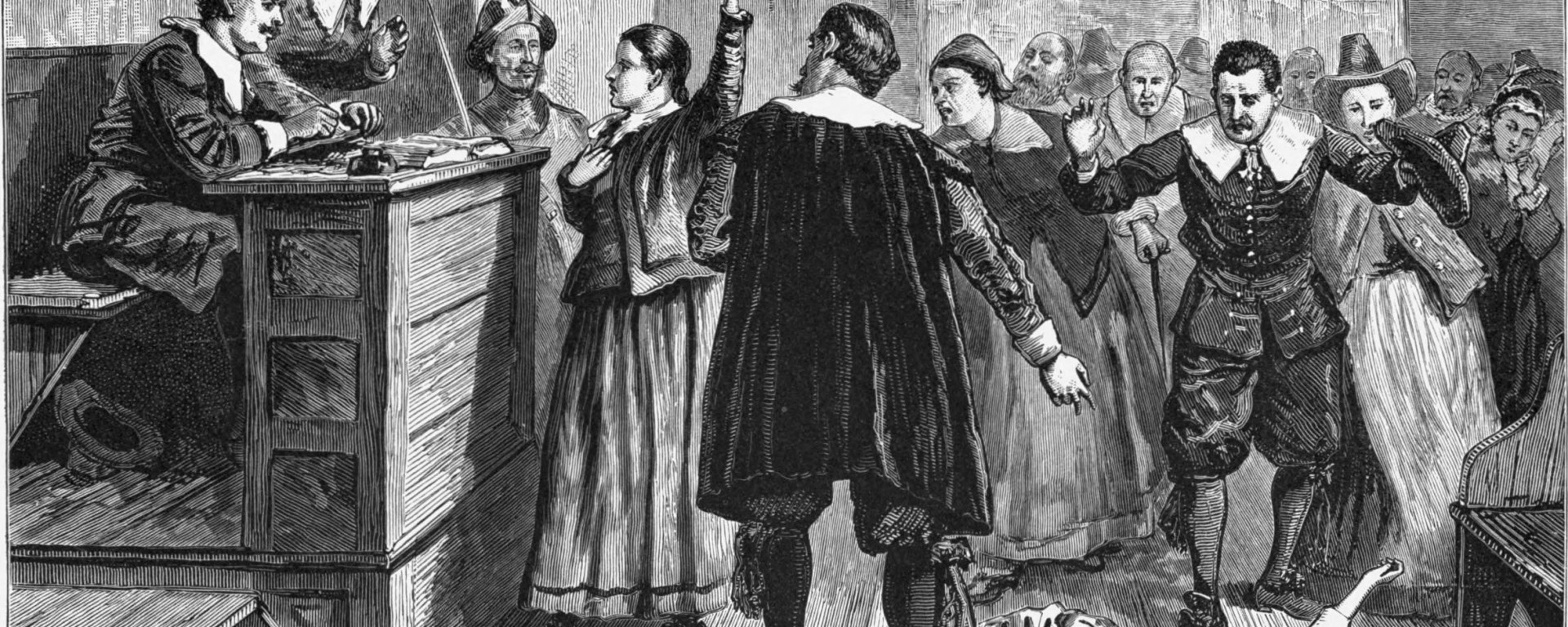
Joseph Parsons brought the matter to the courts in October 1656, filing a slander charge against Sarah Bridgeman. Residents testified both for and against Parsons during the trial. Some claimed they’d seen Parsons enter a river without getting wet and that she dealt with the devil; others claimed the Bridgemans’ infant son had been sick from birth and that Sarah’s jealousy was well-known. Parsons’ mother, my eleventh great-grandmother, also testified on her behalf.
The trial ultimately concluded in Parsons’s favor, clearing her of any title of witch and forcing the Bridgemans to pay a fine. However, rumors would continue to circulate around the Parsons family for the rest of Mary’s life, with one of the Bridgemans’ sons even bringing the accusations to a Boston court in 1674, sparking another trial in which she was acquitted. She died in 1712, living through the witchcraft hysteria that swept Massachusetts during the infamous Salem trials in 1692, though her children and grandchildren were viewed with some suspicion. I find it frankly surprising that Parsons evaded guilty verdicts twice in such a highly religious and accusatory society, one that jumped at the chance to place blame upon women. However, her social standing within Northampton and connections through her husband may have played a significant role in her acquittals.
The story of Mary Bliss Parsons would eventually recede from mainstream memory, paling in comparison to the Salem trials. But now that I know of my distant relations to her, I think of her story from time to time, an interesting embodiment of the prejudices and uncertainties that surrounded early colonial America.
Image: Wikimedia Commons
Maddie Densmore graduated from the University of Missouri in May 2023 with degrees in journalism and political science. Currently a second-year MA student in the Global, International, and Comparative History program, her research interests include eighteenth-century women’s political clubs and gender laws during the French Revolution. She loves reading, writing, indie and alt music, and her cat Marty. Maddie hopes to enter a career field combining journalism and her history research.
 The Footnote
