
Archit Mehta
In Fall 2023, Archit authored “Decoding Systemic Racism in the Artifact ‘Slaves Build Capital and White House’ at the National Archives Museum” for the Critical Discourse Analysis class at Georgetown University’s MA Communication, Culture and Technology. Since then he has presented this work at the 2024 annual conference of the Association for the Study of African American Life and History (ASALH – the founders of Black History Month in the US). Through this open letter he seeks to build a community who want to challenge narratives within museums that normalize racism, especially enslavement.
To Dr. Colleen J. Shogan,
Archivist of the United States
National Archives and Records Administration, Washington DC
Respected Dr. Shogan,
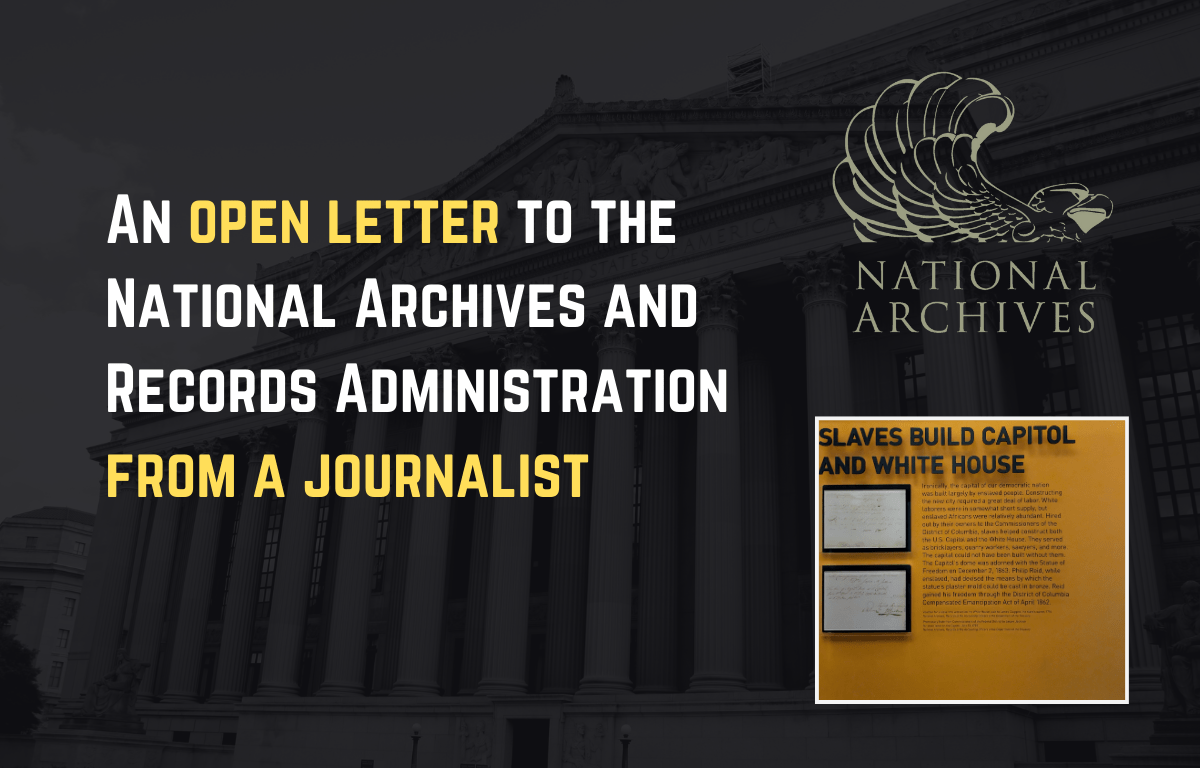
My name is Archit, and I am a graduate student in the MA in Communication, Culture, and Technology program at Georgetown University. This is an open letter regarding the artifact ‘Slaves Build Capitol and White House’ at the ‘Bending Towards Justice’ exhibit in the David M. Rubenstein Gallery at the National Archives Museum. The artifact in question undermines the history of slavery in the United States. I recommend a complete rewrite of the artifact as the first step towards decolonizing and recentering voices of people of color at the National Archives Museum and all museums nationwide.

Image 1: Photograph of the artifact superimposed on ‘Slavery in Democracy’ subsection
I researched this artifact for a class called Critical Discourse Analysis (CDA) taught by Professor Tyrel Campbell in Fall 2023. CDA, an interdisciplinary research methodology, focuses on the use of language to construct knowledge, ideology, and power. My final paper — “Decoding Systemic Racism in the Artifact ‘Slaves Build Capital and White House’ at the National Archives Museum”— forms the basis for this open letter. I was fortunate to have the opportunity to present my findings at the Columbia School of Journalism this past summer and more recently at the 2024 Association for the Study of African American Life and History (ASALH) annual conference. The overwhelming feedback I received about the artifact is that it needs to be written better.

Image 2: Screenshot a poll taken in Columbia University where 20 people voted.
For my final paper, I had coded (annotated) the text into subject, verbs, and compliment. For my most recent 20-minute presentation of this paper at ASALH, I recoded the sentences into two categories for more effective communication: manipulative (sentences undermine slavery through backgrounding the practice of enslavement or usage of verbs that undermine the historic exploitation of those enslaved) and mis/disinformation (for demonstrably false statements, I have deliberately used mis/disinformation because establishing the motive or lack of motive was beyond the scope of the paper). For the sake of brevity in this letter, I would like to focus on two main themes.

Image 3: (Left to Right) Sentences in the artifact coded into two categories, Visual representation of the coding
Missing Reparative Terms: As per the National Archives and Records Administration’s (NARA) website, it is making efforts to support reparative description. Yet the very first word of the artifact is “slaves”. The other non-reparative term in the artifact is “their owners” — instead of enslaver. The 1:1 ratio between non-reparative and reparative terms highlights the ongoing national discourse about embracing reparative terms

Image 4: Highlighting reparative and non-reparative terms in the artifact.
Representation: Since 2014, the David M. Rubenstein Gallery has hosted the Records of Right exhibit, which has many sub-sections. In the same year, NARA posted a video on YouTube where curators from each section talked about their exhibition. Jennifer Johnson curated the ‘Remembering the Ladies’ section, while Michael Hussey was the curator for ‘Bending Towards Justice’— where the artifact is located. Here, we must laud NARA for assigning a woman for ‘Remembering the Ladies’ and at the same time ask, why wasn’t a black curator chosen for ‘Bending Towards Justice’?

Image 5: Screenshot from NARA YouTube channel
Mis/Disinformation in Museums: The following sentences from the artifact have false information: 1) White laborers were in somewhat short supply, but enslaved Africans were relatively abundant; 2) The capital could not have been built without them; and 3) Philip Reid, while enslaved, had devised the means by which the statue’s plaster mold could be cast in bronze.
Both the White House (I personally liked its original title, President’s House or the Executive Mansion), and the Capitol were built between 1790 and 1830. As per the oldest national census data, the population in Washington DC, was largely white between 1800 and 1830 (about 69%). Thus, the narrative that white laborers were in short supply does not ‘add up.’ The same narrative is propagated in a caption for Jacob Lawrence’s work in MoMA, New York — The Negro was the largest source of labor to be found after all others had been exhausted. The exhaustion of white labor is an imaginary narrative propagated to normalize the history of slavery in the United States. It must be rejected by every institution in the United States.
This normalization has led to systemic gaslighting about the harms of racist technologies. In her 2019 book, Dr. Ruha Benjamin presents “the concept of the ‘New Jim Code.’” She shows how a range of discriminatory designs encode inequity by explicitly amplifying racial hierarchies, by ignoring but thereby replicating social divisions, or by aiming to fix racial bias but ultimately doing quite the opposite.
Upon reading the second sentence, I asked myself if the white laborers were subjected to the exploitation endured by those enslaved for centuries… would the capital have not been built just as well? At least for those who think that the Capitol could have been built without enslavement of black people, the statement is false. The well-intentioned sentence gives “credit” to enslaved people who were exploited to build the capital. But it also normalizes the usage of slavery when the sentence implies it was the only way the project could be completed. This language demonstrates a lack of a critical view of our history. It perpetuates economic fallacies surrounding compensation and availability of labor that privilege the wealthy, rhetorically suppressing the realities of the situation. Essentially, the text reinforces everything that Bending Toward Justice would be assumed to be seeking to correct. Thus, it has no place in the museum.
Now, the most crucial sentence of the artifact, in my opinion: “Philip Reid, while enslaved, had devised the means by which the statue’s plaster mold could be cast in bronze.” While discussing Reid’s enslavement before sharing his technically significant contribution, the sentence undermines his true achievement. The artifact omits the fact that Reid and others produced “the first bronze statue ever cast in America” (Architect of the Capitol). How many Americans know that? I would reckon that it is much lower than the number of people who know “who built the capitol.” Over the years, there have been many reports on this phenomenon. Just two years ago, Voice of America published a report titled “Everyday Things Created by Black Inventors.” In a day and age where Claudine Gay resigned after “plagiarism” allegations, how can we stop giving black inventors their due?
Despite all the good intentions behind the creation of the artifact, I hope you will recognize its shortcomings and act urgently to improve it. In the 2015 book Between the World and Me, Ta-Nehisi Coates writes — “The point of this language of ‘intention’ and ‘personal responsibility’ is broad exoneration. Mistakes were made. Bodies were broken. People were enslaved. We meant well. We tried our best. ‘Good intention’ is a hall pass through history, a sleeping pill that ensures the Dream.” It is the same good intention that has made the indiscriminate killings of Palestinian children and the modern-day lynching of Marcellus Williams systemically possible.
Image 6: Pie-chart made on Flourish by Archit, showing deaths of protected groups in Ukraine and Palestine in the first nine months of Russian and Israeli occupation, respectively.
The US-backed Israeli occupation in Palestine, as per the United Nations, has killed more children than from four years of world conflict. In the second week of October 2023, Israeli historian Raz Segal and the Associate Professor of Holocaust and Genocide Studies and Endowed Professor in the Study of Modern Genocide at Stockton University called this a textbook case of genocide. Since then, over 43,000 people in Palestine and about 3000 people in Lebanon have been killed by Israel. Yet far-right and liberal governments across the world have silenced Palestinans and student-led global pro-Palestine protests.
Toni Morrison wrote an essay attacking artists’ silence in times of dread for The Nation. The Howard alumni wrote, “This is precisely the time when artists go to work. There is no time for despair, no place for self-pity, no need for silence, no room for fear. We speak, we write, we do language. That is how civilizations heal. I know the world is bruised and bleeding, and though it is important not to ignore its pain, it is also critical to refuse to succumb to its malevolence. Like failure, chaos contains information that can lead to knowledge — even wisdom. Like art.”
Dr. Ruth Wodak, Emeritus Distinguished Professor at Lancaster University, has made significant contributions to the study of racism, xenophobia, and anti-Semitism through her work in Critical Discourse Analysis (CDA). She argues that language, both in speech and writing, is a form of social practice. According to Wodak, language does not merely reflect social realities but actively shapes them. Her research demonstrates that headline-making events are not only influenced by the situations, institutions, and social structures that frame them but also play a role in shaping those very structures.
The NARA has a mission to drive openness, cultivate public participation, and strengthen our nation’s democracy through equitable public access to high-value government records. I hope my letter encourages you to reconsider how you foster reparative dialogue within your museum when discussing those records.
In conclusion, I recommend NARA recruit a black curator to not just improve the artifact I have highlighted but to lead a comprehensive effort to recontextualize and verify all Black history covered in the one and only National Archives Museum. Additionally, such a step by NARA could lay the foundation to build a committee or community of practice that specifically examines the language surrounding museum artifacts. Transforming these narratives within museums will lead to a more complete understanding of history among those who visit.
Thank you for your time and consideration. I look forward to hearing from you and providing any assistance needed from my side.
Sincerely,
Archit, MA Communication, Culture, and Technology
Images: Archit Mehta, National Archives and Records Administration
Archit is a MA student in the Communication, Culture, and Technology program at Georgetown University. Prior to this, he was working as a journalist. Please visit their website to learn more about their work or connect with them. His handle on X is @ArchitMeta.
 The Footnote