
Tyler Isgar
“Between 1730 and 1735,” wrote Voltaire in his Dictionnaire Philosophique, “nothing was spoken about more than vampires — how they were hunted down, their hearts torn out, and their bodies burnt. They were like the martyrs of old; the more of them that they burnt, the more of them they found.”
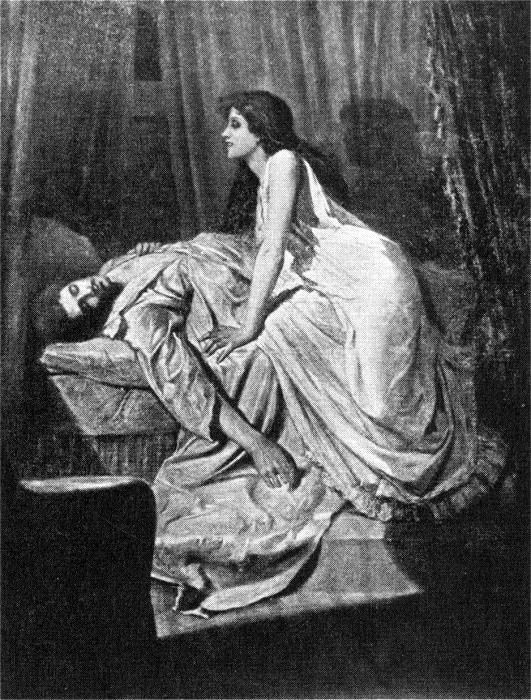
The popular culture craze for vampires from the turn of the twenty-first century to the early 2010s was by no means the first time the figure of the vampire captivated the public. More than a century and a half before the publication of Dracula, the vampire jumped from Balkan folklore into wider European culture and into the enduring literary figure that still fascinates the world today.
The word vampire itself remains a bit of a mystery. In his article about the “vampire problem” in southeastern Europe, Peter J. Braünlein notes that most scholars of the subject view the word’s origins as “obscure,” probably Slavic with some Turkish influence. The word was loaned into German, and from there into the languages of Western Europe, sometime in the early eighteenth century. The obscure origin of the name for what a helpful Austrian archivist glossed in 1756 as Bluthsauger [sic] or “blood sucker” underscores the fact that the Vampyrus Serviensis, the Serbian vampire, was a figure of the frontier. It lingered on the limits between the modern Enlightenment and the archaic, between life and death, and between Europe and the shifting, uncertain edge of “the Orient.”
If you were to ask someone about the foundational works of vampire fiction, chances are they would go back to the late nineteenth century with works such as Bram Stoker’s Dracula and its titular count in Transylvania. At the time when Stoker was writing, Transylvania was part of the Habsburg Monarchy, and in the early eighteenth century the domain of the historical Vlad Dracula came back into the dominion of the Habsburgs and into the orbit of Western Christendom. In the 1718 Treaty of Passarowitz, parts of Wallachia — the principality of Dracula — and a region known as Banat or “the Temesvar Banat” were added to the Habsburg domains, and with them came the vampire.
These new territories had been under Ottoman rule for generations, and the region would become the heart of the Habsburg Military Frontier which provided a buffer zone in the perennial conflict between the Holy Roman emperors in Vienna and the Ottoman sultans in Istanbul. The region, which was sparsely populated pastureland at the beginning of Habsburg rule, was envisioned as a new settled, agrarian space according to the budding Enlightenment ideals that were taking root in Vienna. Catholic German settlers were encouraged to move to the region, and Orthodox Serbs and Wallachians who lived in the region were encouraged to settle on free land promised to them in exchange for unpaid militia service. In doing so, these pastoralists would become bulwarks of the Habsburg Monarchy and in time become good, rational subjects of the increasingly bureaucratized state, while the border between the European Modern and the shadowy, irrational Orient would be pushed backward. In the meantime, however, the Military Frontier persisted as a place where the irrational and the unenlightened could persist in the periphery of the eighteenth century.
Beginning in the mid-1720s, a spate of deaths tore across the Serb and Wallachian villages of the frontier. The mortality struck Orthodox villages, particularly “Serbian… and Wallachian customs-officials, cattle-rearers, and mountain folk” while German settlers were unaffected. These deaths were attributed to locals as the fault of vampires, resurrected corpses who could be identified by the fact that their bodies had not putrefied and the fresh blood around their noses and mouths. The Governor-General and the military bureaucracy situated in Belgrade were not equally convinced of the supernatural nature of what they termed an “epidemic disease.”
In 1725, nine deaths in eight days led to the dispatch of Kameralprovisor Frombald to the town of Kisolova, where he reported the exhumation of the recently-deceased Peter Plogojovic and the subsequent staking and burning of his body by an angry mob of villagers. Frombald’s lurid account was reproduced in the Viennese newspaper Wiener Diarium, but was otherwise archived without note. Notably, the Kameralprovisor offered no medical answer to the events.
Seven years later, another rash of deaths were reported by the militiamen of the town of Morowa to their commander who, fearing the start of an epidemic, dispatched a “contagions-medicus” named Glaser to the town. Unable to find any infectious disease, Glaser attributed the deaths to the strict Orthodox fasting practices. After pressure from the villagers, he had the bodies exhumed and requested permission to have the corpses destroyed as the peasants were threatening to abandon the area.
Unsatisfied, the military administration sent the surgeon Johann Flückinger and two journeyman surgeons to the village to perform “surgical inspections” on the dead. Flückinger went even further. In addition to autopsies on the thirteen dead, he also investigated the lead-up to the spate of deaths, thoroughly interrogated the villagers’ beliefs, and investigated their family connections into what amounted to a thorough ethnographic examination of the case. Glaser and Flückinger brought the skeptical, rationalist lens to the situation: either the vampire was false, and a production of the villagers’ backwardness, or it was real and could be understood through empirical science.
Answers were readily available. The figure of the vampire jumped from the Military Frontier to academic circles and, worse, the newspapers. The epidemic physician Glaser’s father was the Viennese correspondent of the medical weekly Commercium Litterarium where his son’s report was reproduced. In 1734, the German pastor Michael Ranft published his Tract on the Gnawing and Chewing of the Dead in Graves on the phenomena.
Vampyrus Serviensis became a continental phenomena, with stories copied across the continent in multiple newspapers. Even monarchs had opinions: the burgeoning science of “vampyrology” convinced King George II of Great Britain of their scientific existence. Viennese circles whispered that Princess Eleonore von Schwarzenberg was secretly a vampire, and King Louis XV of France had his envoy to the Habsburg Monarchy report any news of the vampire craze.
Amidst the increasing rationalism of the Enlightenment, even when the officials involved were surgeons, scholars, and military men, the idea of the vampire captivated European audiences. The fluctuating frontier space between the Habsburg Monarchy and the Ottoman Empire remained a place dominated by superstition and ignorance in the minds of those same surgeons and scholars, and so could hide such impossibilities as blood-sucking revenants that could no longer survive in the coalescing West. At the end of the nineteenth century, when Bram Stoker set Dracula in Transylvania, the Danubian principality still remained at the edge of Europe as a cultural space.
The vampire craze of the early eighteenth century is not so different from the modern fascination. Even today, the idea of the vampire remains captivating because at the edge of the modern rationalist mind there remains the fascination that something lurks in that peripheral space just out of sight. If we are not still obsessed with the physical possibility of the vampire, the cafe newspaper-reader of the 1730s would still definitely find much to talk about with the twenty-first century watcher of vampire media from Buffy to Twilight.
Image: Wikimedia Commons
Tyler Isgar is a second-year MA student in the Global, Comparative, and International Studies program. His research interests include the treatment of religious and ethnic minorities in the Ottoman and Habsburg Empires in the Early Modern Period. Outside of his career, Tyler is interested in poetry, scary movies, and oversized novels.
 The Footnote
