
Tyler Isgar
The world has always been ending.
This is to say that throughout history, different societies have often been convinced that theirs was the last generation before the imminent end of the world. Today is no different. Anxieties around climate change, the lingering impact of the COVID-19 pandemic, political instability, and a fragmented world order all contribute to an air of “doomerism,” a general anticipation of social decay and collapse. Social media and the Internet have made news travel more rapidly than ever before, meaning that most people receive a barrage of information that would have been unthinkable less than a lifetime ago.
Despite a change in how we receive information, apocalyptic discourse has been popular for millennia. As far back as Ancient Egypt, writers portrayed the time of chaos and uncertainty that they found themselves in to be the prelude to a conclusive confrontation between good and evil, after which justice and peace would be restored. This literature was also almost always politically charged, condemning the current ruling authority of the author’s home as illegitimate at best or serving a cosmic evil at worst.
In the late Ptolemaic period of Egypt, when the region was ruled by the Greek-speaking Ptolemies and following a long occupation by the Achaemenid Empire, a native Egyptian writing in the Demotic language around 150 BC scribed the Oracle of the Potter. The Oracle paints the rule of the Greek “beltwearers” from their city of Alexandria as godless and foreign to Egypt. The Ptolemies and their intruding god Sarapis are opposed to ma’at, the Egyptian conception of universal order and justice. However, the Oracle promises that the age of misrule is limited, and that soon enough the gods will right what has been wronged. The city of Alexandria, emblematic of Greek intrusion, will be laid waste and the kingship will be returned to Memphis where it belongs. This sort of writing was by no means new to Egyptian literature; in the Middle Kingdom, some thousand years prior, a work known as the Prophecy of Neferti written in much the same style presented a similar narrative to make sense of the collapse of the Egyptian Old Kingdom.
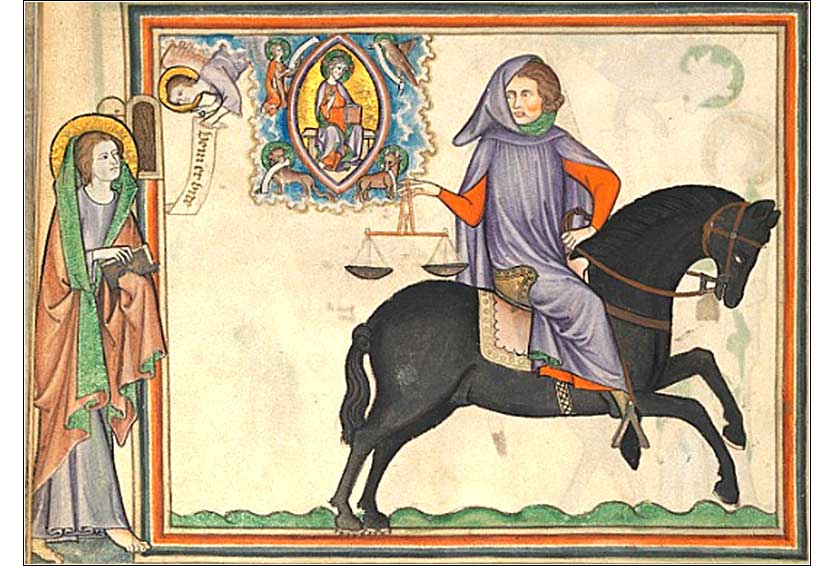
Ancient apocalyptic works such as the Oracle of the Potter are important because they come out of a similar Eastern Mediterranean milieu of conquest and subjugation that also influenced the Jewish apocalyptic environment from which Christianity emerged. In the Biblical period, Jesus’s proclamation that “the kingdom of God is at hand” could be understood not only as a religious statement, but as a real political stance that the Roman domination of Judea was at its end and a physical Kingdom of God would take its place. The Book of the Apocalypse, also known as the Book of Revelation, recorded in the New Testament fits within this same tradition, promising the demise of the Roman Empire and an end to its persecution of Christians.
The apocalypticism that developed from Christian tradition was used through the medieval and early modern periods to cope with the world much like other eschatologies but also became a way to legitimize one’s rule. On the cusp of the eleventh century, apocalyptic fervor gripped much of Western Europe. The chaos that followed the disintegration of the Carolingian Empire and the proliferation of Viking raids prompted the clergy of France to promulgate what was called the Peace of God, which attempted to wield religious threats against the abuse of secular nobility. This domestic distress was coupled with other signs interpreted as apocalyptic, such as the destruction of the Church of the Holy Sepulchre by the Abbasid caliph or the proliferation of heterodox theologies. Here, the apocalypse was not a way to understand foreign domination but instead a way to understand domestic instability.
Later, the apocalypse was deployed by two of the most powerful men in the world to legitimize their rule. The concept of the Last Roman or World Emperor, first found in the seventh-century Syriac Apocalypse of Pseudo-Methodius, made the end of the world into something that could support a ruler. The Last World Emperor would precede the end of the world, bringing it under the dominion of the true religion (whatever that may be) in order to prepare it for the kingdom of God. The Ottoman sultan Sulayman the Magnificent and the Holy Roman Emperor (and later King of Spain) Charles V alike utilized the legend of the Last Emperor to further their agendas both domestically and abroad. Especially as the Spanish Empire in the Americas grew and the Ottomans drew closer to the heart of Europe on their way through the Balkans, many expected a final showdown between the two contestants for the prophesied world ruler to precede the final end of the world.
Modern anticipation of the apocalypse comes in many forms that historical apocalypticism did not. Whether the end of the world comes by nuclear war or by climate collapse, the end of the world has become something humanity inflicts on itself rather than a righting of the cosmic order. It no longer expects that we will be rewarded for our endurance through the horrible, and instead purports to embrace a kind of nihilism. However, buried deep within these anxieties remains a kernel of optimism. Like all historical apocalyptic ideas, the allure of the end of the world is that what is cruel and unjust about the world we live in will be swept away. What intends to take its place, however, remains ambiguous.
Image: Wikimedia Commons
Tyler Isgar is a second-year MA student in the Global, Comparative, and International Studies program. His research interests include the treatment of religious and ethnic minorities in the Ottoman and Habsburg Empires in the Early Modern Period. Outside of his career, Tyler is interested in poetry, scary movies, and oversized novels.
 The Footnote
.jpg)