
Shawn Liu
The Taiping Rebellion is infamous for being one of the bloodiest civil wars in history, but it was also an ecological catastrophe. While historian John Fincher has described the conflict as a “heavily saturated topic” in historical scholarship, its ecological dimensions remain strikingly underexplored.
Beyond the well-documented clashes of ideologies and armies, another form of destruction took place, one measured not in human casualties but in collapsed dikes, deforested highlands, and desiccated riverbeds. At the heart of this devastation was Jianbi Qingye—“fortify the walls, clear the fields” Qing Dynasty’s strategy to suffocate the Taiping insurgency. As I show in this article, what began as a military doctrine became an ecological wrecking ball, stripping the land of its resilience and leaving behind an empire scarred by war’s environmental toll.
By the mid-nineteenth century, the Qing Dynasty was at war with itself. The Taiping forces, composed of radical rebels led by Hong Xiuquan, swept through the empire and proclaimed a new Heavenly Kingdom, razing imperial infrastructure wherever they went. In response, the Qing revived Jianbi Qingye, a military doctrine first used during the White Lotus Rebellion. On the surface, this tactic seemed pragmatic: fortify key strongholds while depriving rebels of sustenance. In practice, it was ecologically devastating.
Jianbi: Fortifying Walls
The strategy required the mass construction of forts and defensive structures, transforming entire regions into garrisoned landscapes. Villages were gutted for timber, highland forests stripped for stone, and rivers redirected to serve military logistics. Forts, built rapidly with local labor and resources, became environmental sinkholes. The Taiping, facing this entrenched defense, responded in kind—building their own fortifications, seizing resources, and in many cases, burning everything in their retreat.
The Qing’s emphasis on fort-building came at a cost beyond what they could afford. Funds that might have maintained dikes, canals, and irrigation systems—essential for protecting farmlands from floods and drought—were redirected toward military efforts. In one instance in Qianjiang County, a dike repair fund was repurposed to recruit local militias. By 1853, war had so completely shifted priorities that the existing hydraulic system was left to decay. When the inevitable floods came, they came with the fury of a neglected landscape, washing away not just the earth but any illusion of control the Qing still had over it.
Qingye: Clear the Fields
Where walls were built, fields were destroyed. The second pillar of Jianbi Qingye—clearing the fields—was as much an ecological assault as it was a military tactic. Anything of use to the enemy was obliterated. Crops were torched, villages abandoned, and entire regions depopulated to deny sustenance to the Taiping. The result was famine—not the kind dictated by nature, but the kind engineered by men.
Yet the land did not burn in isolation. The fires that reduced rice paddies to ash spread further, consuming forests and drying out the soil. In the wake of retreating armies, a wasteland remained. Zeng Guofan, the Qing general at the heart of the counterinsurgency, saw this destruction not as collateral damage but as a tool. He understood that if the fields became barren, the rebels would be like “fish out of water.” Starvation was not just a consequence of war, but a tactical weapon.
The Taiping also embraced fire. As they withdrew from Jiangkou in 1851, they left behind a city in flames. When they abandoned Thistle Mountain, they burned their homes before leaving, ensuring that the Qing could not use what remained. Fire was both a tactic of resistance and a sign of desperation. But in a landscape where everything from homes to forts was built with wood and straw, it was also a death sentence for the environment.
Dike Warfare
If Jianbi Qingye gutted China’s landscapes, its war on infrastructure sealed its fate. The rebellion turned water into a weapon, both through negligence and intent. During the conflict, dikes were not only left to crumble but were actively destroyed for strategic advantage. In 1854, as the Taiping attacked Jingmen, locals deliberately breached a sluice gate to drown their advance. In 1855, the rebels themselves sabotaged the banks of Sha Lake to flood Qing-controlled territories.
These tactical moves wreaked havoc on the already fragile hydrology of the region. The Han River, already stressed by deforestation and soil erosion from fort-building, became a highway for disaster. Increased sedimentation blocked outlets and exacerbated floods. When droughts arrived, they were longer, harsher, more absolute. The land had lost its ability to regulate itself.
By the early 1860s, what was once Anhui’s fertile farmland had become a barren “wasteland.” The Qing general Bao Chao, surveying the damage, recorded a chilling absence: “not a blade of grass.” The earth had been emptied.
Conclusion
The Taiping Rebellion ended in 1864, but its environmental repercussions lingered far beyond its military defeat. The Qing, triumphant but exhausted, now had to govern an empire where nature itself had been reshaped by war. Rebuilding meant more than restoring governance—it meant reimagining a land that had been pushed past its limits and purposefully destroyed.
As a military ideology, Jianbi Qingye had achieved its goal—securing the Qing’s survival—but at a price too great to ignore. The hydrological systems, once capable of supporting China’s agrarian heartlands, were irreparably damaged. The forests that had provided timber and protection for centuries were reduced to bare hillsides. Entire regions that had once been thriving agricultural centers became desolate wastelands.
This rebellion reveals something profound about war: it is never just about people. It is about landscapes, ecosystems, and infrastructures. It is about the forests that no longer grow, the rivers that no longer flow, and the farmlands that will never again be fertile. The Taiping Rebellion was a war of faith, of politics, of blood, but it was also a war on the environment, one whose battle scars remain etched in the soil.
So when we talk about the devastation of the Taiping Rebellion, let us not forget the silent casualties—the drowned fields, the charred forests, the desolate plains. Long after the armies disbanded and the bodies were buried, the land still bore witness to a history written in fire and flood.
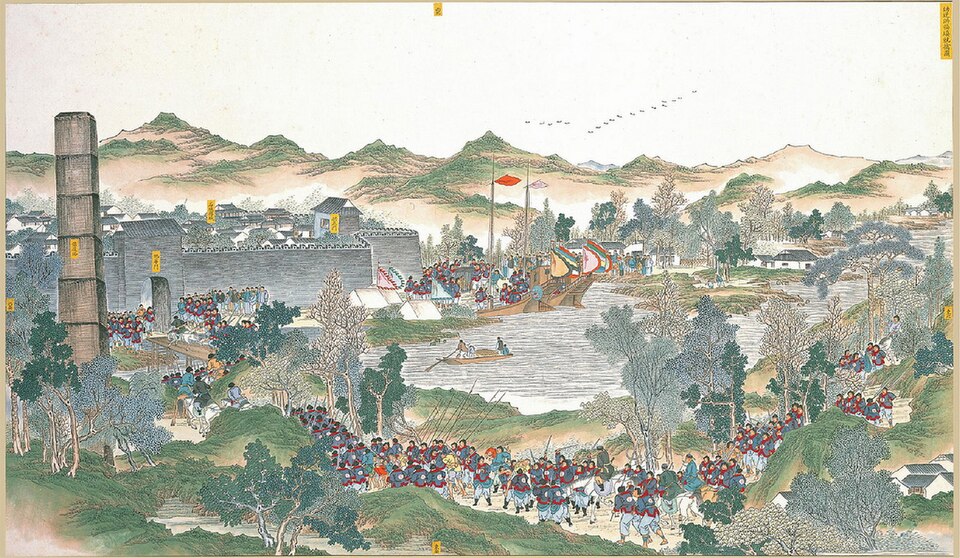
Image: Wikimedia Commons
Shawn Liu (MAGIC/MSFS) graduated from Northwestern University in Fall 2022 with a major in History and Cognitive Science. Currently enrolled in the MA/MSFS dual degree program at Georgetown, he is interested in Chinese environmental history as well as Sino-American competition and collaboration, with a specific focus on their policies regarding the polar regions. He hopes to enter a doctoral program or enter the public sector working in international development after completing his dual degree at Georgetown. Outside of his career interests, he also enjoys listening to (and occasionally dancing to) classic rock, running, and traveling with his friends!
 The Footnote
