
Aidan Pritchard
From its humble beginnings as an unnamed language in 1887, to the forefront of the League of Nations’ debate on auxiliary languages, Esperanto – meaning ‘one who hopes’ – has aimed to promote global peace and cooperation. The artificial language’s inventor, Ludwik Zamenhof, had grown up in Bialystok, Poland, a city populated by Poles, Russians, Germans, and Jews. The city’s linguistic barriers exacerbated ethnic tensions, dividing “the human family into enemy parts.” Before long, he had resolved to enact change through language. At the time, no constructed languages had yet come to prominence, and various natural languages dominated different fields: French in diplomacy, English in economy and trade, and German in science.
In the years that followed the publication of Zamenhof’s initial book Lingvo Internacia –in which he introduced the language and outlined its grammar and vocabulary– the Esperanto movement saw rapid growth, and by the League of Nations’ founding following WWI, Esperanto activists were present around the world. Hoping to facilitate the dialogue for world peace, organizations and individuals began contacting the League about Esperanto from its inception. While the League entertained the idea for a few years, its inconclusive discussions ended in 1924. Support for the language grew increasingly divided along national lines thereafter, which greatly hindered Esperanto’s growth. At the most extreme, Hitler denounced Esperanto as a tool for Jewish world domination, and subsequently banned all Esperanto organizations in Germany.
As I will similarly argue, Carolyn N. Biltoft’s comprehensive exploration of Esperanto within the League asserts that such rising nationalism, paired with an inefficient bureaucracy, prevented Esperanto from gaining prominence in the diplomatic world. Ian Rapley likewise writes that the League’s early debates formed “the most high profile Esperanto moment worldwide.” Humphrey Tonkin concludes more pointedly that it is precisely Esperanto’s universality, which challenged the ties between great powers and their national languages, that ultimately led to its defeat as it was overshadowed by the nationalistic rivalry between English, French, and German. In another work, he argues that, as English has come to possess a monopoly on international discourse post-WWII, and despite Esperanto’s benefits and noble goals, the need for compromise has become increasingly unrealistic. Robert Patterson and Stanley M. Huff concur, positing that the language’s lack of practicality ultimately caused its downfall. Arika Okrent remains skeptical, but argues that the primary importance of Esperanto is independent of its popularity, rather, it is the will of its supporters to advocate for the end of violence. However, Alenka Divjak maintains that Esperanto continues to have the potential to benefit today’s world in fields like tourism if given proper support.
This article, the first of two, aims to explore the question of how nationalism and bureaucracy in the League of Nations between 1919 and 1924 led to the sidelining of Esperanto as an international auxiliary language. It argues that nationalism within the League led to outsized importance being placed on the views of powers like the UK and France at the expense of smaller and non-European nations. Moreover, the League’s cumbersome bureaucracy proved a hindrance to the movement’s efforts as well, delaying its discussions and obscuring the complete picture of Esperanto that may have led to its adoption.
In an April 1920 letter, the President of the Universal Esperanto Association, a notable early advocate, highlighted Esperanto’s unique capacity to include even the “popular masses” in the League’s proceedings. It was easy to learn, widely used in international conferences, and would not limit the possibility of mutual understanding to the League’s “leading elite,” unlike the primary national languages. His choice to write to the Secretary General, a British diplomat, in French, rather than English, reflected the dominance of the former language in diplomacy at the time. The Secretary General’s response demonstrated the limitations of the League’s bureaucratic system, explaining that he “prefers to wait before adopting an opinion on the matter.” He “hoped” to send a representative of the Secretariat to the 1920 World Esperanto Congress in the Hague, though “only to remain informed of the question.” The verbose, yet vague nature of the League’s response was likely intentional to shield the institution from losing face.
From the first assembly, delegates from Persia, India, Japan, Haiti, and South Africa supported the universal teaching of Esperanto in schools. However, as this report later summarized, “The First Assembly considered that it was premature to open a discussion on this subject, and it was the Second Assembly which took up these conclusions, instructed the Secretariat to undertake the suggested enquiry, and decided to put the question of the teaching of Esperanto in schools on the agenda of the Third Assembly.” Therefore, the Assembly did not take any definitive action on the status of Esperanto for almost a full two years after the question was initially raised. While thorough research may have been necessary, a delay of two years reflected nothing but excessive bureaucracy rather than logistical constraints.
In an initial September 1921 report, Dr. Nitobe Inazo, after attending the Prague Esperanto Congress, labelled the League’s current bureaucratic system based on national languages a “grave handicap,” noting that 231 translations would be needed if all members were to speak in their national language. Unlike the delegates of powerful Western Europe, he recognized that the Esperanto movement was supported by multiple national governments, political parties, and trade unionists.
As Dr. Inazo prepared the Secretariat’s 1922 Report for the Third Assembly, the Director of the International Telegraph Union (ITU) informed him that no telegraph administration of any of its members had yet designated Esperanto as a language “appropriate for international telegraphic communication.” However, a prior proposal to allow the use of Esperanto had received 10 responses in favor and 13 against. Notably, non-European nations like Egypt and China had largely supported Esperanto. In contrast, 11 of the 13 nations opposed were European. The UK, its Scandinavian allies, and Germany clearly sought to protect their linguistic advantage provided by the status quo. As the ITU’s Director noted in a June follow-up letter, the sole contemporary choices remained English, Spanish, French, and German. For those outside of Western Europe, French had long been an imperfect and cumbersome solution, fueling desires for Esperanto to secure equality in international communications.
The negative impact of the League’s bureaucracy on the Esperanto movement remained evident during the second meeting of the Committee on Intellectual Co-operation in August 1922. M. de Torres Quedevo proposed that the Committee discuss the question of an international language, but the Chairman quickly declared that the Committee “would be going beyond its competence in taking up the question of Esperanto,” as it had already been submitted to the League’s assembly. In addition to delaying their research into the language for many months, the Committee’s reluctance to analyze Esperanto simultaneously with the Assembly on the principle of following bureaucratic processes may have cost them multiple informative opportunities during a period of Esperanto organizations’ heightened efforts to promote the language. This initial indifference to Esperanto certainly influenced their ultimate decision to decline to recommend its adoption by member states’ national schools.
The detailed report of the General Secretariat to the Third Assembly included annexes from the International Conference on the Teaching of Esperanto in Schools, the British Board of Education, and the Commercial Educational Committee alongside the Paris Chamber of Commerce. It noted that the International Conference of Educational Authorities accomplished in three days the amount of work for which an ordinary conference using several official languages would need ten. Esperanto, which, “it may… be stated with perfect truth… is eight or ten times easier than any foreign language,” would seem to be the ideal language for the League to promote, or even adopt in its own proceedings.
Many smaller European nations likewise supported the adoption of Esperanto as a method of leveling the proverbial playing field. In July 1921, for example, the President of the Pola Esperantista Societe wrote that “no other Institution” was in a “better position to decide the question of the Universal language” than the League. He asserted that the Polish government supported establishing a universal language that could address Eastern Europe’s linguistic diversity, and the increasing time spent studying languages, which undermined the acquisition of scientific knowledge. But, the countries “most adapted to influence the…civilised world” needed to support the initiative too.
Esperanto is a language of many strengths. Its universality offered an unprecedented possibility for smoother international cooperation across business, education, and diplomacy. However, the excessive bureaucracy of the League of Nations greatly hindered its dissemination. The second part of this article will explore how, despite enthusiastic backing from Japan and many smaller European states, the fervent opposition of France and the UK further contributed to Esperanto’s dismissal as a viable candidate for an auxiliary language within the League.
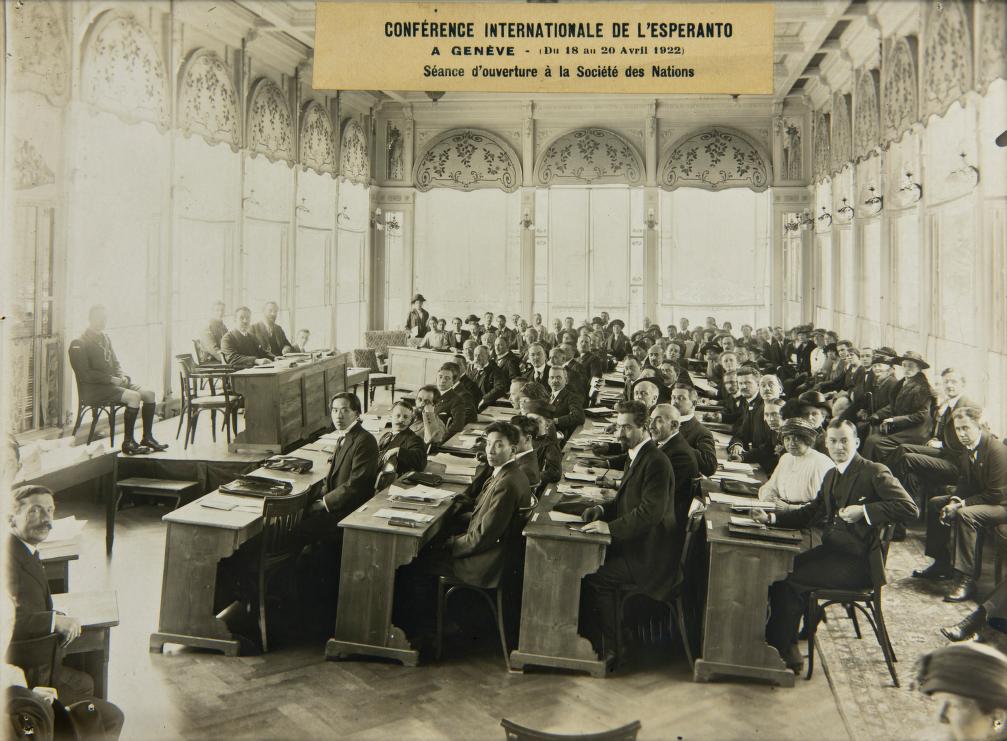
Image: World Digital Library
Aidan Pritchard is a second-year student in the College of Arts and Sciences at Georgetown University. Passionate about international policy, diplomacy, and cross-cultural communication, he is pursuing double majors in Government and East Asian Languages & Cultures. Outside of his academic interests, he loves singing and acting, learning languages, and discovering new places with friends.
 The Footnote