
Rosie Click
Donald Trump spoke about transforming Gaza into the “Riviera of the Middle East” in a joint press conference with Israel in February of this year. His idea for the “redevelopment” involved forcing Palestinians to leave Gaza while hotels, casinos, beachside resorts, and restaurants were built, presumably by foreign companies. Later in the month, Trump posted an AI-generated video to his Truth Social account that showed him, Israeli PM Benjamin Netanyahu, and Elon Musk enjoying Vegas-like amenities in a fully rebuilt Gaza. The creators of the video, who are not affiliated with the Trump administration, later clarified that they meant the video to be satire.
People on both sides of the political spectrum in the US as well as many in the international community responded critically to Trump’s declaration that the US would redevelop Gaza into some kind of tourist paradise, but interest around this story died down after a few days. That is certainly part of the Trump strategy, to bombard people with so much news that people can hardly keep track or organize around any single issue. However, this story is worth remembering and contextualizing, because the idea of developing a tourism economy in a colonized place isn’t new to the US at all, and it’s currently happening in the US colony of Puerto Rico.
You may have seen the “Live Boricua” campaign ads on TV or social media. It’s a recent campaign by Discover Puerto Rico, a conglomerate of governmental and private organizations all focused on driving foreign tourists to Puerto Rico. The word “foreign” is doing a lot of heavy lifting here, because the main target of the promotional campaign is US citizens. However, as you can see in this image from their promo video, “no passport required for US citizens” is stamped in the corner. The promoters clearly realize that US Americans need to be reminded that Puerto Rico is in fact, not a foreign country. In one of the court cases that decided Puerto Rico’s odd status within the US empire (part of a group of early 20th century Supreme Court decisions called the Insular Cases), one of the opinions stated that Puerto Rico and other newly acquired territories were “foreign in a domestic sense” to the US. The person who wrote that line? Justice Edward Douglass White, who had been a student at Georgetown when he left to fight for the Confederacy.
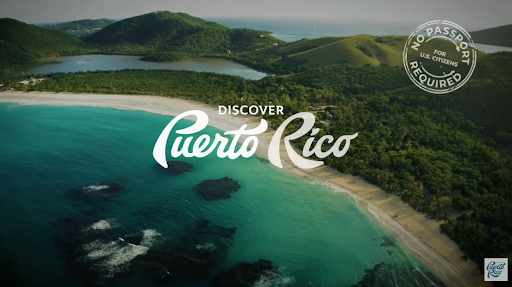
As the video explains, boricua is another name for someone from Puerto Rico or with Puerto Rican ancestry but also refers to “a state of mind and joy for life that is embodied by the Puerto Rican people and shared by all who visit.” The approach is quite like past and present tourism promotion in Hawai’i related to “aloha” and the “aloha spirit” (and I’m not the only one who thinks so; user @JOSERODRIGUEZ-khxzm commented under the video “QIE POCAVERGUENZA….NOS VENDEN COMO SI ESTO FUESE HAWAII” (“What a shame….they sell us as if this were Hawai’i.”) The idea in both cases is that a tourist can experience a culturally specific attitude towards life just by visiting, even for a short period (also captured in a comment by user @louElis456: “You cannot ‘live boricua’ you could never understand the love and suffering we’d have of our lives in our island”). This fiction that a tourist can transcend mere cross-cultural understanding and actually embody another culture permeates tourism promotion in colonized spaces.
Tourism development by the US in its overseas colonies started long before the “Live Boricua” campaign. Since the Spanish-American War, the US has sought to build up tourist markets in a variety of places. This includes Cuba, which was not formally governed by the US after 1902 (except, of course, in two subsequent occupations related to protected US investments from 1906-09 and 1917-22). Starting in the 1920s, US-based firms started building up hotels, restaurants, and bars to cater to wealthier tourists from the US who were looking to escape prohibition for a booze-filled trip. Others visited Cuba for sex tourism, linked to colonial fantasies of exotic women who were sexually open. Cruise lines also started running more regular service from ports like New Orleans and New York to Havana. After WWII, as more US Americans could afford to travel, tourism to Cuba grew even more, with certain hotels and beaches closed off to Cubans, unless, of course, they were employees.
During this period, the sovereignty of the Cuban people in their own country was so diminished that US tourism promoters even alluded to it in their promotional material. One brochure from 1953 invited US tourists to take a “trip abroad” to Cuba—with “trip abroad” in quotation marks. US tourists and promoters alike thought of Cuba as essentially part of the US at this time—or perhaps, like Puerto Rico, as “foreign in a domestic sense.” Ultimately, dissatisfaction with this imperial idea and the economic marginalization of Cubans that accompanied it drove Cuban revolutionaries, especially those in Havana, to reject the US-backed government and support Fidel Castro’s revolution in 1959. The Cuban Revolution was (in part) a fight to achieve the deferred dream of sovereignty that had been denied in the aftermath of the War of 1898.
What does any of this have to do with Trump’s proposal for Gaza? Both early 20th century Cuba and 21st century Puerto Rico turned to tourism to economically recover after a disaster, just as Gaza would be doing in Trump’s plan. The Cuban War for Independence was brutal in Cuba; before the US joined the war in 1898, the Spanish had locked thousands of Cubans in concentration camps, and lots of Cuba’s industry had been damaged over years of fighting. Many elite Cubans and US investors saw foreign investment as the answer to rebuilding Cuba, and tourism development was part of that. In Puerto Rico, the “Live Boricua” campaign took off after Hurricane Maria in 2017, when surveys revealed that most news coverage of Puerto Rico was negative. Many Puerto Ricans contended that the negative coverage was keeping people from the island.
It’s also significant that both Cubans and Puerto Ricans have been displaced by tourism development, just as Palestinians would be should Gaza undergo a similar process. Cubans resisted this displacement during the Cuban Revolution and took back control of foreign-owned private properties. These days, land dispossession is a major issue in Puerto Rico because of high demand for tourism properties and tax breaks for wealthy US Americans who move to the island. For instance, the median home price in San Juan is $905,000. To put that in perspective, the average income for a Puerto Rican household is about $40,000. Various comments on the “Live Boricua” video express anger at this phenomenon, with comments like “Locals are being displaced. This ad invites more of that. Nope” (@Luiggie_OD) and “ONCE AGAIN, WE ARE NOT FOR SALE” (@LouElis456).
There are certainly benefits to foreign tourism, and many people are engaged in decolonizing the tourism industry in meaningful ways. But proclamations about remaking disaster-stricken places (whether that disaster is natural, human-caused, or both) into tourist paradises has its roots in a colonial mindset that ultimately does not respect the sovereignty or rights of the people who live there. Most people reading would not support these kinds of development plans, but I’d also implore you to be conscious of how you travel–especially to colonized or formerly colonized places– in order to avoid inadvertently supporting those efforts. A few suggestions:
- Support local hotels and businesses rather than foreign-owned ones.
- Seek out tours led by locals that respect the privacy and space of those who live in the place you’re visiting.
- Learn about the culture and history of a place before you take your trip.
- Pick up a few phrases in the local language before you go–with “thank you” at the top of the list.
These may be micro-level impacts, but it’s someone we all can do. The privilege of being a tourist should never supersede someone else’s right to live with dignity.
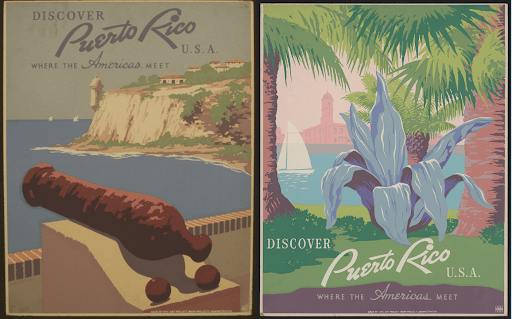
Cover Image: Nicholson, Frank S., Artist, and Sponsor Federal Art Project. Discover Puerto Rico U.S.A. Where the Americas meet. Puerto Rico, None. [Nyc: nyc art project, works projects administration between 1936 and 1940] Photograph. Open access, https://www.loc.gov/item/98518614/ (flower) and https://www.loc.gov/item/98518608/ (cannon)
Rosie Click is a third-year PhD candidate in the History Department at Georgetown University. Her work explores US-Caribbean and US-Pacific relations, particularly through the lenses of imperialism, education, and power. She is also interested in public history, museum studies, and academic editing.
 The Footnote