
Patrick Grey
On September 30, 1919, Black sharecroppers throughout Phillips County, Arkansas convened in a church in the town of Elaine to discuss fairer cotton prices for the fall sale and plan how to increase Black land ownership among Black farmers. Armed guards stood just outside of the church while white police officers were in a car parked nearby. Not long after the meeting began, gunfire erupted, and the church where the Black farmers convened was attacked. In the aftermath of this event, local state and federal authorities organized a large white posse to put down the supposed Black insurrection in Elaine.
After four days of rampant violence, several hundred Black residents of Phillips County were murdered and hundreds more were jailed. The Elaine Massacre, as it would later be known as, was one of the deadliest lynching events in American history.
This event did not happen in a vacuum. The Elaine Massacre was part of the Red Summer of 1919, which saw widespread white-supremacist terrorism across dozens of cities in the United States. Richard Wright describes the fear that created silence amongst survivors of lynching in Elaine in Black Boy (1943). In Wright’s memoir, he writes that successful Black farmers and businessmen, like his uncle Silas Hoskins, were massacred in Elaine and when he tried asking his mother why his community did not fight back, “the fear that was in her made her slap [Wright] into silence.”
During this period, the Ku Klux Klan became active in rural, majority-Black areas of Arkansas to suppress Black communities. Ida B. Wells-Barnett’s important pamphlet, “The Arkansas Race Riot,” revealed an important aspect of this massacre: anti-Black violence (including by the KKK) was used to prohibit Black union activities and keep the Black communities of Phillips County from becoming more economically successful.
Following the massacre, Black land ownership drastically dropped despite Elaine being a majority-Black town. Descendants of the survivors of the massacre who still live in Elaine and its surrounding areas continue to feel the long lasting impacts of 1919. Back in July 2023, I interviewed William Quiney III, a descendant of the massacre and community leader, who said he began to see Elaine deteriorate over his lifetime when the city got rid of its school and when local farmers could not compete with large landowners with better equipment.
After the centennial anniversary of the Elaine Massacre, a monument was erected to honor the victims. However, the monument was not built in Elaine where the massacre took place; instead, the monument is located twenty-five miles up the Mississippi River in Helena, AR. In an oral history interview with Mr. Quiney, he comments on the placement of the monument, saying , “it made perfect sense for [the monument] to be built in Elaine… it shouldn’t be there [in Helena].”
Mr. Quiney stresses the importance of history and telling the real story of the massacre as well as the importance of the Elaine Legacy Center and Museum in the community. The Elaine Legacy Center’s purpose is to research, preserve, and share oral narratives of the Elaine Massacre. The Legacy Center and Black community leaders also collaborate with outside organizations, like the Samuel Proctor Oral History Program (SPOHP), to further our understanding of the massacre outside of the Mississippi Delta. Dr. Paul Ortiz, organizer, and labor historian at Cornell’s School of Industrial and Labor Relations, began the Mississippi Freedom Project at SPOHP in the University of Florida. The Mississippi Freedom Project gave an opportunity to undergraduates and graduate students to engage with these histories, conduct oral history interviews and fieldwork, as well as develop relationships with communities like Elaine based on mutual solidarity.
“I had known about the Elaine Massacre for many years,” said Ortiz, “but nothing prepared me to get the call in 2019 from the Elaine Legacy Center.” The Center wanted to commemorate the centennial anniversary of the massacre and have wider discussions about Black land loss and reparations. It was through the telling of the story of community members with oral history that allowed for these discussions to take place. SPOHP has archived hundreds of oral history interviews with veterans of the Civil Rights Movement and community leaders throughout the Mississippi Delta. The program has also made these interviews publicly available via YouTube.
Oral history provides a way to begin the process of healing. Krystin Anderson, 2023 Mississippi Freedom Project coordinator, reflects on her formative experience in the Delta. “SPOHP is the first place that I got to engage with oral history with living history and see how history is so active in people’s lives,” said Anderson. Adolfho Romero, former Assistant Director of SPOHP and current graduate student industrial and labor relations at Cornell, has conducted interviews throughout the Mississippi Delta and has offered advice to students interested in engaging with oral history.
“Oral history is not about collecting—it’s about connecting. The Mississippi Delta is rich with stories of survival, love, and resistance. Listen more than you speak, and let the community guide the work.” Romero goes on further to say, “ask yourself: Am I honoring this person’s dignity with how I’m telling their story? If the answer is yes, you’re on the right path.”
Unfortunately, Mr. Quiney passed away in March 2024, about two years after I had the opportunity to interview him. As a prominent member of his community, he was proud of his history and his community’s resilience despite systemic suppression over several generations. His story tells us about the power of oral history and the yearning for a better future.
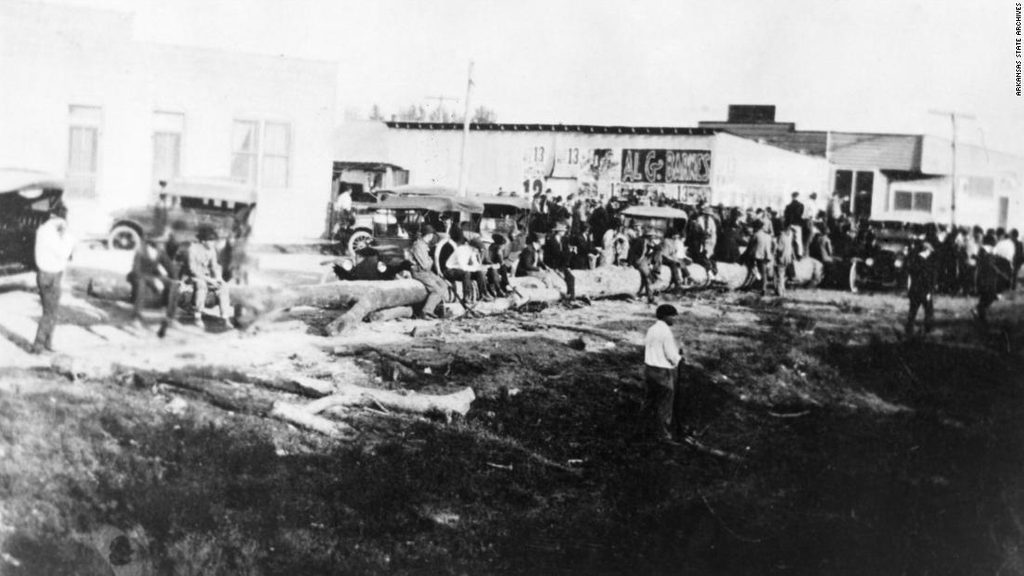
Image: Crystal Bridges Museum of American Art and Arkansas State Archives
Patrick Grey is a first-year Ph.D. student in the Department of History at Georgetown University. His research focuses on the histories of the African diaspora in the Americas, as well as that of marronage and fugitivity in the eighteenth and nineteenth centuries. Grey is a proud first-generation college graduate and an alumnus of the Samuel Proctor Oral History Program.
 The Footnote