
Madi Campbell
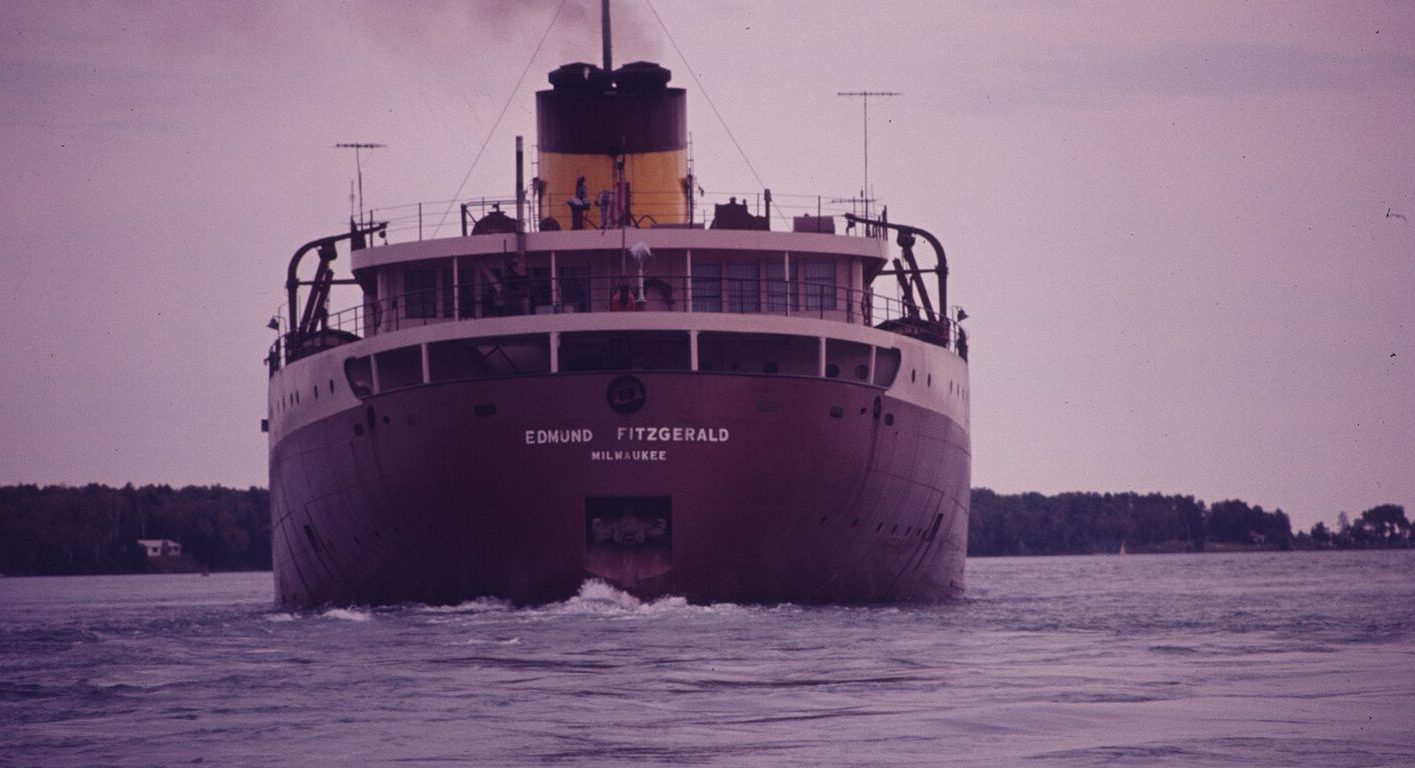
November 10, 2025, marks the 50th anniversary of the sinking of the SS Edmund Fitzgerald, and its legacy undoubtedly continues to haunt Lake Superior. Once the largest Great Lakes freighter, the doomed ship was famously immortalized in Canadian folk singer Gordon Lightfoot’s 1976 song “The Wreck of the Edmund Fitzgerald,” solidifying its status as a folk symbol. Each year, communities around the lake gather for ceremonies honoring the 29 men lost in the wreck and revel in the lingering uncertainty of the circumstances surrounding its sinking. Out of all the ships to sink in the area of Lake Superior known as the “Graveyard of the Great Lakes,” why has the Edmund Fitzgerald remained so embedded in the cultural fabric and memory of the Region?
The aptly named largest of the five Great Lakes, Lake Superior spans over 31,000 square miles, reaches 1,332 feet at its deepest, and contains approximately 1/10 of the earth’s fresh water. Every autumn, brutal storms locally nicknamed the “Witches of November” blow across the Great Lakes and are capable of producing hurricane-strength winds and thirty-foot waves. The deadliest Great Lakes storm occurred in 1913, during which shipwrecks were reported on four of the five Great Lakes (the exception was Lake Ontario). Between November 8 and 10, 1913, at least 250 sailors were killed on the Great Lakes. It was in a similar storm, exactly 62 years after the “Big Blow of 1913,” that the Fitzgerald met her demise; however, the exact details leading up to its sinking remain largely unknown. I will begin by recounting what is confirmed about the incident before delving into the theories and contested details.
On November 9, 1975, the Fitzgerald left Superior, Wisconsin, bound for Detroit, Michigan, on what was most likely its last run before winter due to deteriorating weather conditions. The Fitzgerald made an average of 44 round-trips across the Great Lakes each season, during which it was responsible for the third stage of the steel-making process: The ship would haul taconite ore from Minnesota to Toledo or Detroit, which would then be transported to Ohio and Kentucky to continue the steel-making process. Gale warnings were issued by the end of the first day of the five-day trip, which were elevated to storm warnings the following morning. In 1975, meteorological equipment and technologies were certainly not archaic, nor were the weather conditions uncommon for November; however, freighters were typically underequipped and forced to rely upon ships ahead of them for accurate weather reports.
As the Fitzgerald entered the storm, Captain Ernest McSorley began communicating with Captain Bernie Cooper of the SS Arthur M. Anderson, traveling approximately 15 miles away. What is confirmed about the ship’s sinking comes largely from the transcribed communications between Captain McSorley and Captain Cooper, which continued periodically until the Anderson eventually lost contact with the Fitzgerald. At 3:30 pm on November 10, Captain McSorley radioed Captain Cooper that he had sustained damage on board to a gate and two vents, lost its radar, and had developed a list—meaning the ship was tilting to one side, most likely as a result of taking on water. Captain McSorley then requested that the Anderson stay close by until it reached Whitefish Bay, positioned between Ontario and Michigan, where the inlet would provide relief.
The Anderson’s last communication with the Fitzgerald came at 7:10 pm: Captain McSorley, when asked how the ship was weathering the storm with its problems, replied, “We are holding our own.” Just minutes later, the Fitzgerald disappeared from radar and never reappeared. The Anderson repeatedly called the Fitzgerald and received no reply; later, as visibility improved, the Anderson could see ships in the distance but could not locate the Fitzgerald. It was at this time the Anderson informed the United States Coast Guard that the Fitzgerald may have been lost. Despite search efforts by both the Canadian and American Coast Guards and other freighters, the SS Edmund Fitzgerald would not be located until six months later, on May 20, 1976, 535 feet below the surface and split in two.
It is almost unfathomable that such a massive ship could sink so quickly that it was unable to deploy lifeboats or send out a distress signal. As a result, the cause of its sinking remains undetermined, but leading theories have emerged. Damage sustained by the ship cannot give evidence as to what happened, as it is impossible to differentiate between damage sustained as the Fitzgerald landed on the lake floor and damage sustained before its sinking. The U.S. Coast Guard’s incident report concluded that the most probable cause of the sinking was the “loss of buoyancy resulting from massive flooding of the cargo hold,” due to ineffective hatch closures. Conversely, Captain Cooper insisted he saw the Fitzgerald pass too close to the Six Fathom Shoal near Michipicoten Island, damaging the hull and causing the ship to slowly take in water. Further, scientists have attempted to recreate the storm utilizing meteorological readings from ships on Lake Superior that night, in an attempt to pinpoint whether rough seas and winds led to the freighter’s sinking. One such study from 2006 concluded that the location where the Fitzgerald sank was, in fact, suffering the most severe weather conditions of the storm at its approximate time of sinking. Still, it is impossible to conclude which factor—or combination of factors—decisively led to its sinking.
Thousands of passengers have faced Superior’s waters over the centuries, from the Ojibwe and Noquet peoples to French voyageurs to commercial sailors. Yet the sinking of the Edmund Fitzgerald is a tragedy that has transcended state and national borders, as well as disciplines, in trying to solve its mystery. It was an American ship that sank in Canadian waters; while it largely docked in Minnesota, Wisconsin, too, claims it as the state’s costliest shipwreck, despite the Fitzgerald only docking in Milwaukee a single time. Monuments honoring the ship stand around Lake Superior, in towns where its 29 crewmembers were from, and remembrance ceremonies are held across the region on each anniversary. The use of oral histories and tradition in remembering the Edmund Fitzgerald has contributed to its enduring legacy in the Great Lakes Region. From Gordon Lightfoot’s song, to the sharing of personal histories and memories of the crew, to debates surrounding what brought the ship down, the freighter’s memory remains alive. As new evidence and theories routinely emerge, the Edmund Fitzgerald’s status as a living legend of the Great Lakes Region is even further solidified and becomes reinforced in the cultural fabric. While we may never conclusively know what caused its demise, the legacy of the Edmund Fitzgerald will undoubtedly remain a specter of remembrance and mystery as the skies of November turn gloomy.
Image: Greenmars, CC BY-SA 3.0 https://creativecommons.org/licenses/by-sa/3.0, via Wikimedia Commons
Madi Campbell is a first-year MAGIC student originally from the Chicago suburbs. Before coming to Georgetown, she completed her undergraduate studies at Northeastern University, majoring in History and minoring in German and Cultural Anthropology. Her research interests center on the rise of fascism in interwar Austria and the post-war Vergangenheitsbewältigung (coming to terms with the past). Outside of the History Department, she enjoys baking, bar trivia, and crying over her Chicago sports teams.
 The Footnote
