
Ariel David Greenberg
Just as Latin American history has been influenced by broader shifts in the field of history towards subjects such as the study of family, epidemics, and science, the field of Latin American history is increasingly being shaped by systems theory in analyzing the first genuinely global highways and institutions. It analyzes and interrogates the networks that operated as the highways of the first genuinely global economic, biological, and political system. Those networks—courts, postal routes, agronomic institutions, and other administrative organs—the empire’s nerves, formed a vital artery through which the foundations and paths of this global system we inhabit were shaped by this initial encounter. These highways are controlled, regulated, and dominated by later European powers and, in the present, by the U.S., the global hegemon, and its chief challenger, China.
Roots of Preeminent Journals of Latin American History
History journals principally emerge in reaction to global crises. This includes two of the most preeminent journals in the field: the Duke University Journal of Latin American History, founded in 1918, and The Americas magazine, founded in 1944. The present scholarship focuses on medicine, food, and epidemiology, examines different anxieties commencing in the present using scholarship applying, tracing back and analyzing different facets of these issues and institutions of the global order. A key trait of recent scholarship is its examination of indigenous resistance and counter-networks in response to the emergence of these powerful global forces shaping their fate. Most importantly, by centering history on these forgotten figures, we expand the possibilities of the past and help people imagine different futures.
These journals have a clear emphasis on analyzing the webs that initially flattened the world, creating a mercantilist world order that facilitated global capitalism and the modern hyper-globalized world we live in. This world system—initially posited by Immanuel Wallerstein in the seventies—has roots in this initial encounter, and the subsequent efforts to strengthen and cement this system as more than an encounter but rather a series of growing encounters and integration that facilitated this modern, hyperconnected world system. By applying this global analysis as historians, we can see the roots of the ills and structures of the present global system.
This is only possible through examinations of the roots of the development of the first global highways and systems—those belonging to the Spanish Empire. These networks allowed for both new foods and old diseases to reemerge from slumber to shape the settlement and colonization of plants, animals, and human beings of the Americas by Europe. The renewed focus on the transmission of European diseases, plants, and animals in the wake of multiple global crises—including the recent Covid-19 pandemic—underscores the relevance of this historical past for contemporary scholarship.
The Role of Imperial Networks in Shaping Latin American History
Agriculture and medicine played essential roles within the broader imperial system, forming vital links in the chain of exchange and governance across the Spanish Empire. These sectors were intrinsically connected to the expansive networks—or “historical highways”—that facilitated the movement of ideas, documents, and knowledge. These highways not only shaped the regions they touched but were themselves continually shaped by the flow of information and resources.
As demonstrated in Martin Bowen’s article, “‘We Distrust the Whole Universe’: Long Distance Communications, Emotions and the Transformation of the Public Sphere in Chile, 1790-1812”, scholarship has focused on dissecting the nerve centers of the Spanish imperial system. Such studies delve into the mechanisms and institutions that comprised the Spanish imperial machinery, revealing the multitude of ways texts and information were created, transmitted, and interpreted throughout the empire.
Through thorough examination of these imperial institutions, historians are uncovering new avenues for understanding how the Spanish Empire’s infrastructure, including its administrative, agricultural, and communication systems, engineered the global movement of material wealth, people, and ideas from Europe and Africa to the Americas, and vice versa. These networks also had significant consequences for indigenous populations, as the same systems that enabled exchange and governance also facilitated the spread of Old-World diseases to the Americas.
The development and proliferation of histories examining labor and systems traditionally deemed not authentic history are increasingly examined as history. In the May 2025 edition of the Hispanic American Historical Review, this is reflected through a focus on articles examining indigenous religious practice and their intersection with uprisings, as shown by the inclusion of an article on domestic workers in Brazil’s National Assembly. One paper that stood out was a paper concerning an article on domestic workers in Brazil’s National Assembly by Meg Weeks—”No Longer Part of the Family: Domestic Workers at Brazil’s National Constituent Assembly, 1987-1988.”
Weeks’ article explores the intersection of racial history, sexism, and indigenous history, focusing on the lived experiences and ongoing struggles of domestic workers. It examines the fight of domestic help during the era of the military dictatorship to challenge age-old bourgeois conceptions of the help as fully recognized workers, rather than being relegated to the status of “members of the family,” a designation that essentially translated into modern slavery. Through this analysis, the article highlights how domestic workers, often marginalized by race, gender, and indigenous identity, confronted systemic barriers and social attitudes that sought to erase their labor’s value and their rights as workers. Women’s work has traditionally been ignored by legal regimes that disenfranchised women—and even more so women of color. The narrative details their demands for legal recognition and fair treatment, emphasizing the broader historical context of exclusion and resistance that has shaped their journey toward dignity and justice.
This legal victory reflected hundreds of years of conflict, violence, and worker organization in response to these assaults on the right to be recognized as a worker. It reflects global and international patterns inherent in this legal-cultural history, which analyzes, defines, and measures progress in the reverse direction of early archives, thus uncovering and crediting contributions of people erased from history. This provides visibility, recognition, and worth within the Latin American historical narrative. The system of modern chattel slavery was made possible principally by this collision between the Old and New World. Through remembering and conveying these forgotten stories, we not only open conversations about the past, but we also unveil new pathways and visions for the future, including Latin America and the broader networks it has been historically influenced by and historically influenced.
Conclusion
The last five years have been profoundly politically, epidemiologically, and psychologically difficult for the world. Latin America has served as a critical source of minerals, food, and ideas has laid the foundation for the immensely globalized world we inhabit. Only with the wealth of the Americas, the theft of its natural resources, and the fusion of flora and fauna between the Old and New World could Europe come to dominate and establish the hyper-interconnected world of the present
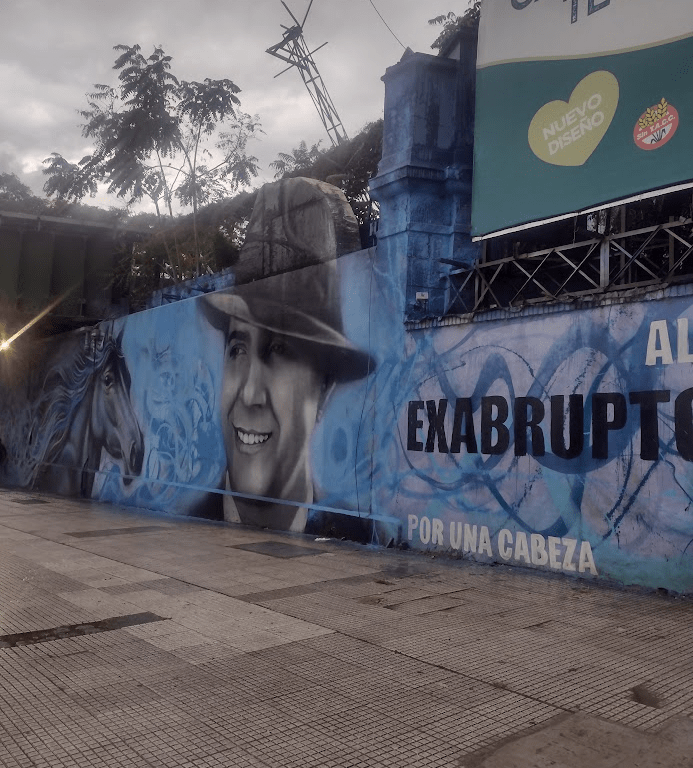
Image: Argentine icon Carlos Gardel, Ciudad de Mendoza, Mendoza City. Taken by the author in January 2025 during a hike along La Cordillera Mendosina.
Ariel David Greenberg (MAGIC) is a graduate of Bard College (2023), where he majored in Historical Studies. He is currently enrolled in Georgetown University’s MAGIC program and has academic interests in Latin-American, Russian, and Soviet history, with a particular focus on the impact of competing Cold War ideologies on societies and environments. Mr. Greenberg intends to pursue either a PhD or a law degree, aiming for eventual work in economic development or as a researcher or lecturer within academia. His personal interests include hiking in natural settings, listening to Greek and classical music, and playing tennis on occasion.
 The Footnote