
Tim Esau
Historians have long shirked moral judgements in their studies, favoring epistemological conservatism. Many fear the unavoidable presentism of moral judgements, thereby appealing to moral subjectivism. Thus, historians dread the damage done to “objective history” by bias or personal preference. One does not need to be an academic to recognize the contemporary preference towards epistemological conservatism which arose after the existential debates over objectivism in the 1970s and 1980s.
Despite this contemporary consensus, nuclear historians clearly make judgements. Was the bombing of Hiroshima justified? No, answers Andrew Rotter in his 2008 monograph The World’s Bomb. Rotter contributes to the scholarly discourse of the bombing by asserting that Hiroshima was an “episode in international history” as opposed to “solely the consequences of wartime hatreds [between the Japanese and Americans]” (6). Therefore, Rotter places the bombs in a transnational framing as opposed to the traditional nation-centric one. Yet he frequently departs from this strictly scholarly pursuit. In his conclusion, he clarifies his personal moral perspective: “‘Do not do evil that good might come of it.’ That would seem to be easier said than done” (303).
His second chapter brings air power and bombardment to the table as an example of how the international community enabled the “disastrous possibilities of science and technology run amok” rather than the bomb being an American peculiarity (33). By World War I, both sides made extensive use of air campaigns against civilians. Yet this trend was amplified under Churchill in WWII, fully forsaking the “fiction that the bombers were attacking military objectives” (52). He effectively argues that many actors placed both strategic bombing and atomic bombing into the same category—producing “fear of death” and “destruction” to damage morale and end war quickly. Through this argument, he tries to de-exceptionalize the atomic bombing as a singular event.
However, his attempt to de-exceptionalize by putting the bombings into a historical context also makes Rotter’s personal opinion readily apparent through his derisive rhetoric. According to Rotter, the “possibility that [air bombardment] attacks were unethical tugged only slightly at” air-power enthusiast Arthur Harris. He further quotes a German civilian on British bombing campaigns: “one feels as if he is no longer human…this is no longer war, but murder.” Rotter follows with his own remark: “Murder it may have been, but the air war had developed a relentless logic” (47). Absent the diction of “slight tugging,” the tragic impact upon German victims in WWI, and Rotter’s assertion that air bombing campaigns constituted “murder,” his undeniably important intervention loses no argumentative strength. Rotter normatively loads his rhetoric, never abandoning an absolute deontological moral framework.
Such a bias is not unique to Rotter. As grotesquely extreme an event as Hiroshima, absolute rejections of air campaigns abound in scholarship. Therefore, I hope to complicate that perspective by emphasizing the perils of adherence to strict historical deontology. In the second part, published separately, I will highlight the subaltern voices of Southeast Asia to foreground the importance of contextualizing historical debates.
How feasible is a purely deontological view of air bombing? The United Nations’ International Court of Justice (ICJ) certainly does not subscribe to one. Fearing a repeat of the 1995 Bosnian Genocide in Kosovo by Serbian president Slobodan Milošević, NATO embarked on an air bombing campaign across Yugoslavia. According to Human Rights Watch, NATO killed upwards of 600 civilians in this campaign. Yet, after Yugoslavia filed a complaint in the ICJ against NATO, the court dismissed the case on jurisdictional grounds, tantamount to an endorsement of NATO’s actions. These actions, according to the Belgian delegation, fit the alleged right of “humanitarian intervention.” Notably, they also led to the indictment and imprisonment of Milošević. Ultimately, the ICJ failed to condemn the campaign despite hearing the Yugoslavian delegation’s claim that the bombing constituted “acts [which] deliberately [constituted genocide]” through “civilian targets [being] attacked… such as… [hospitals, radio, schools, and television stations] ” and through the “use of… depleted uranium [weapons which have] far-reaching consequences for human life.” Evidently, international law does not adhere to this moral framework.
Yet, as Australian philosopher C.A.J. Coady notes, laws and ethics have a complex relationship, with law usually lagging behind moral consideration. Thus, I will challenge moral principles commonly used in Just War theory. While focusing on the morality of conduct in war, Coady highlights the principle of discrimination which seeks to provide immunity to noncombatants by “disallowing attacks upon noncombatants as immoral”—whether intentional or not (194). Coady acknowledges that he “favors” seeing the principle as “utterly exceptionless” even in “supreme emergency” when millions more may die. Yet, how useful is this principle if it is truly exceptionless? For instance, Gabriel Mares in Just-War Theory After Colonialism suggests that settlers in colonial contexts are participating in aggression through their active violation of territorial integrity and political sovereignty. This aggression makes the settler occupy an “ambiguous position” as “the settler who recognizes the indigenous right to a nation is no longer a settler, but (potentially) a co-national.” Attacks which are “directed at agents of these aggressions” therefore meet the criteria of jus in bellum given a last-resort declaration of war to end colonial occupation.
Finally, political scientist Kevin Carrico highlights risks associated with good-bad deontological dichotomies. Carrico highlights the harms of a blind “colonialism bad” discourse in the Hong Kong context. The tendency to see colonialism as intrinsically bound with Orientalism encourages many to see China’s sovereignty as noncolonization. Thus, Carrico emphasizes the importance of a “comparative analysis of lived political experiences of colonization and ostensible noncolonization [which] may facilitate moving beyond… labeling… and moralizing.” For instance, while Hong Kong’s history viewed exclusively through its “binary relationship with the United Kingdom” reveals grave colonial-era injustices, it also fails to explain why people in China chose to flee to and settle in a colonial state. The widespread anxiety about the end of British rule in the 1980s and 1990s is also left unexplained through this binary. Similarly, the binary of absolute deontology leaves some questions unanswered. What if it had been Japan’s colonial Southeast Asian subjects who had bombed Hiroshima and Nagasaki? What if they didn’t target civilians, but military? Given all other means have been exhausted, is one single civilian death disqualifying for armed action against colonizers? Can we claim some moral justification when another entity acts on the behalf (intentionally or not) of the colonized? Should we celebrate Vietnam’s invasion of Cambodia, which brought an end to the four-year Cambodian genocide by the Khmer Rouge? After all, Vietnam primarily sought to respond to Cambodia’s invasion of Vietnam, rather than having a genuine intention to liberate Cambodia. Are the Houthis, who seize and endanger often unaffiliated civilian vessels, justified in their attempts to stop what many argue is a genocide? These are challenging questions that “air bombing bad” cannot effectively answer.
Thus, I reject the attempt of some historians to retrospectively condemn wartime actions through this framework. If you wish to have a discussion of morals regarding a historical event, you cannot simply dismiss every action as evil if it results in the death of people who society has determined should not be targeted. Context matters and a nuanced discussion of said context is important when making moral judgements.
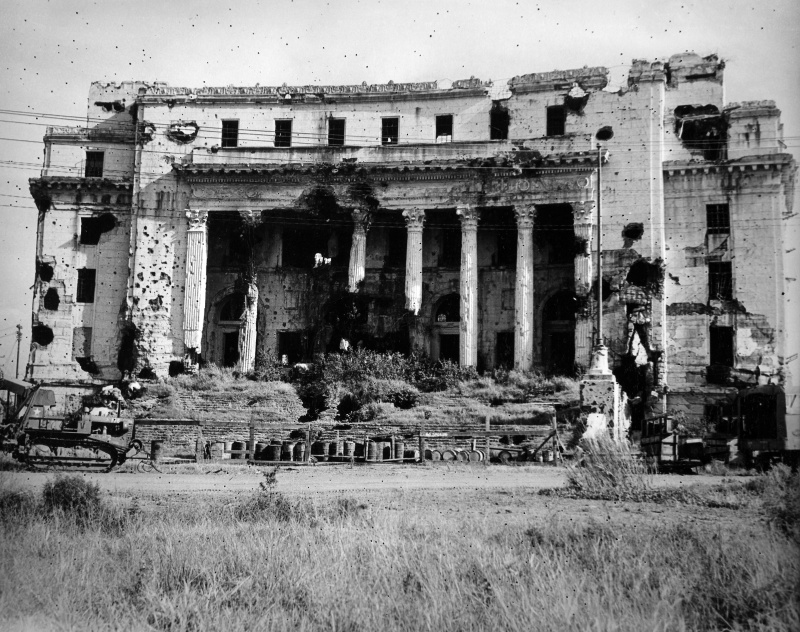
Cover image: War Damaged Agriculture and Commerce Building in Manila, Philippines (via Harry S. Truman Library & Museum)
Timothy Esau is a first-year MAGIC student who is interested in the South Asian diaspora and its relation to ethnogenesis, particularly in the East Asian context. He previously obtained a Bachelor’s of Business Administration at the Chinese University of Hong Kong.
 The Footnote