
Patrick Grey
Last week on Sunday, February 1, Bad Bunny became the first artist to win the Grammy Award for Album of the Year for his record sung entirely in Spanish. His sixth studio album, “Debí Tirar Más Fotos,” discusses many themes such as Puerto Rican culture and diaspora, the island’s struggle with gentrification driving out locals, and a nostalgic call to keep our memories close. In his acceptance speech – also delivered in Spanish – Bad Bunny dedicated his award “to all the people who had to leave their homeland, their country, to follow their dreams.”
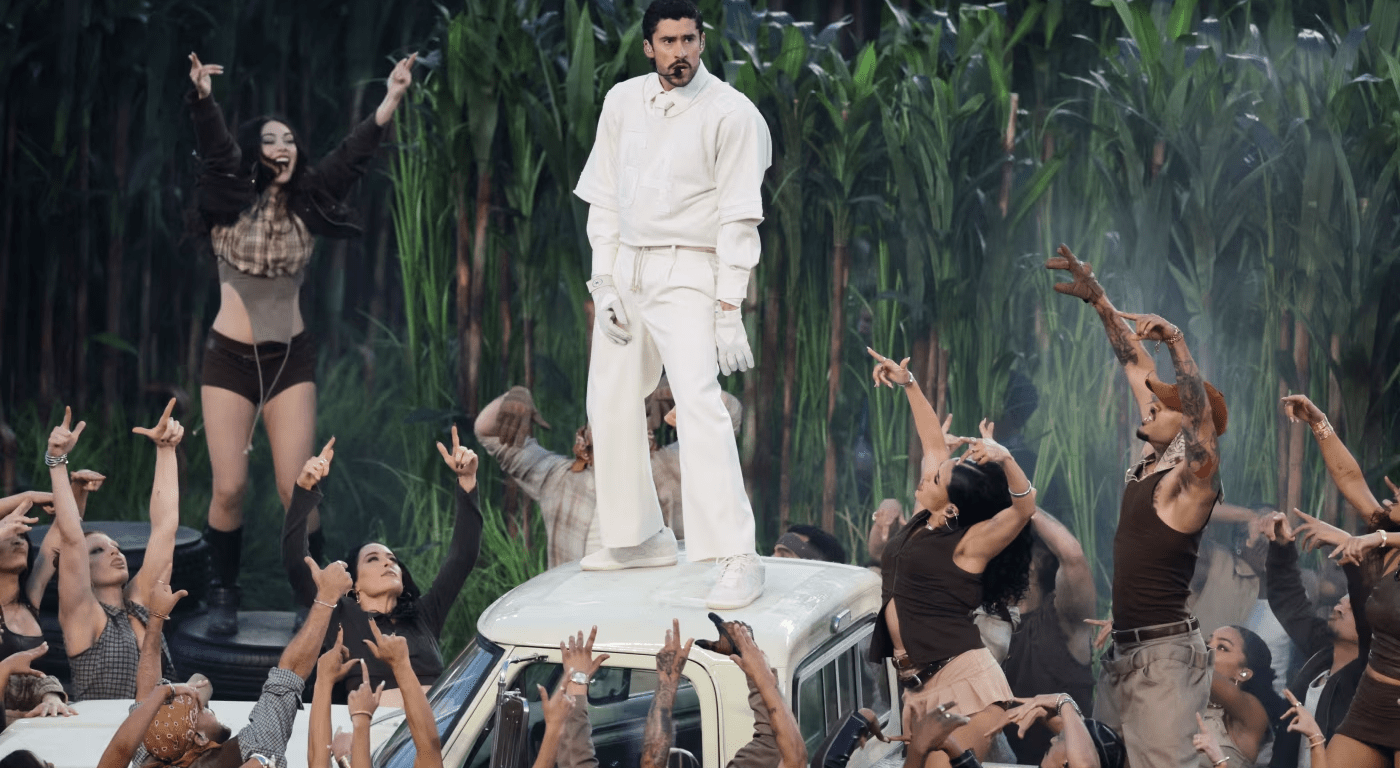
Last night, Bad Bunny, whose birth name is Benito Antonio Martínez Ocasio, headlined the halftime performance for Super Bowl LX in Santa Clara, California. After his thirty-one-show residency in San Juan, Puerto Rico, and his subsequent world tour, the halftime show marks his return to a US stage in almost two years. In September 2025, Bad Bunny told i-D Magazine that he chose not to take his world tour to the US out of concern over potential raids by immigration enforcement. The NFL selected Bad Bunny for the halftime performance in part because “the league has been focused on growing its Latino audience, inside the U.S. and in Latin America,” who largely speak Spanish. At the same time, however, in Santa Clara, where “nearly half of residents were born outside the US,” fear was building as one of the world’s most-watched sporting events was approaching.
In September 2025, in the case of Noem v. Vasquez Pérdomo, the US Supreme Court signaled its support for immigration enforcement’s use of racial profiling in immigration policing – including allowing immigration officials to stop individuals who are “speaking Spanish or speaking English with an accent” under the basis of “reasonable suspicion.” Although NFL and state officials assured that there would be no immigration enforcement tied to the Super Bowl in Santa Clara, the politicization of Spanish speakers is nothing new. These policies target a large proportion of the population of the US. According to the Pew Research Center, over 40 million Latinos speak Spanish in the United States today. Additionally, over 12 million bilingual Spanish speakers reside in the US, making the US the second-largest Spanish-speaking country in the world after Mexico.
These contemporary statistics, though, omit the longer history of Spanish speakers in the US. Spanish has been a political language in what is now the United States since the early sixteenth century. Originally driven by colonization, Spanish explorers made permanent settlements in San Juan (1521), St. Augustine (1565), and Santa Fe (1610). Between Puerto Rico, Florida, and much of the American Southwest, Spanish was a colonial, immigrant, and indigenous language within different contexts and historical periods. In her analysis of the history of Spanish in the US, historian Rosina Lozano looks at the 1848 Treaty of Guadalupe Hidalgo and the acquisition of Cuba and Puerto Rico after the Spanish-American War of 1898 as crucial turning points for the language and its speakers. Lozano claims that “the changes moved Spanish increasingly from a regional language of politics to a language with political implications for the United States.” During this period, the Rio Grande became the border between Texas and Mexico, dividing communities who had been speaking Spanish for centuries prior to the formation of the border. By the twentieth and twenty-first centuries, immigrants from Latin America, like myself, significantly contributed to the growth of the Spanish-speaking community in the United States.
English, however, would not simply overtake the use of Spanish in these communities. Lozano analyzes how these American political institutions functioned and constructs her narrative using literary records, such as Spanish-language election ballots, political speeches, court proceedings, and schools, as well as translators and civil protections for Spanish speakers in the nineteenth century. These sources give us two key insights: the United States and its institutions operated bilingually before (and still can!) and that Spanish-speakers are deeply rooted in American history. But, given recent immigration policies, since when was speaking Spanish considered political?
Scholars of race and language, like sociolinguists Nelson Flores and Jonathan Rosa, studied how language constructs identity, reinforces power hierarchies, and perpetuates racism in different forms. Jonathan Rosa defines the process by which race and language are rendered mutually perceivable as raciolinguistic enregisterment. In other words, these processes create racial categories and linguistic forms which are jointly constructed, linking specific ways of speaking to racialized bodies and identities. The culmination of this process of racialization results in individuals coming to look like a language and sound like a race. For instance, many criticized the NFL for booking Bad Bunny to headline the Super Bowl halftime show, citing the need to hire talent to perform an “All American halftime show”; some have even called for his deportation. Bad Bunny, a native of Puerto Rico, is a US citizen, and ironically enough, is being perceived as an outsider. The racialization of Spanish and its speakers in the US has a longer and non-linear history that has yet to be explored.
For historians, though, a raciolinguistic perspective allows for new interdisciplinary ways to recover histories of Latinos in the US. Rosa describes the opportunities of this methodological framework: “a raciolinguistic perspective must be informed by a theory of change that is focused on reconstituting or eradicating systems of domination.” This perspective can better inform the ethnic and linguistic boundaries we place on ourselves. A raciolinguistic perspective can also tell us more about processes of marginalization, such as racial capitalism, white supremacy, and the normative modes of colonial subject formation and subalternity. Though this framework cannot tell us everything about the unique processes of racialization of Spanish and Spanish speakers, it may provide crucial links between the recent past and contemporary immigration policy in the US.
Latinos have not sat idly in spite of these anti-Spanish-speaking policies which are also working class struggles. As early as the 1930s, a coalition of labor and civil rights leaders, under the direction of Guatemalan-American labor organizer Luisa Moreno, formed El Congreso de Pueblos de Habla Española (the Spanish-Speaking Peoples’ Congress) – the first national Latino civil rights conference in the US. Since the 1980s, scholars like Vicki L. Ruiz pioneered oral history as a method to uncover the histories of racial, gender, and labor discrimination in the US. More recently, in her twenty-one-page dissenting remarks in the case of Noem v. Vasquez Pérdomo, Justice Sonia Sotomayor wrote: “We should not have to live in a country where the Government can seize anyone who looks Latino, speaks Spanish, and appears to work a low-wage job.” Former California state representative Dean Florez summarized Sotomayor’s dissent, stating, “If the Constitution no longer speaks for millions of brown, Spanish-speaking workers, it no longer speaks for anyone.” Injustices like these demand our attention, and the racial profiling of non-English speakers in the US by the federal government must end.
This past week has been momentous for Bad Bunny and the Spanish-speaking world. But now more than ever, it is important to understand and fix the political implications of speaking Spanish and recognize the longer history of Spanish speakers in the US. Prior to accepting his Grammy Award for Album of the Year, Bad Bunny spoke in solidarity with the very immigrants who are increasingly becoming targets for deportation operations by the US federal government. “We’re not savages, we’re not animals, we’re not aliens,” Bad Bunny said, “we are humans, and we are Americans.” At the end of his halftime performance, Bad Bunny made it clear: “We’re still here.”
Cover image: Jeenah Moon (photographer). “Bad Bunny performing at the Super Bowl LX Halftime Show.” February 8, 2026. Reuters.
Patrick Grey is a second-year PhD student in the Department of History at Georgetown University. His research centers on the histories of the African diaspora in the Americas, particularly those of fugitivity, marronage, and resistance to enslavement in the Atlantic world. He is Editor-in-Chief of The Footnote.
 The Footnote