
Madi Campbell
Geopolitical tensions in international sporting events are not uncommon. From 1980 Lake Placid to 2025 Boston, geopolitics have historically boiled over in ice hockey, and this year’s Milan Olympics have been no exception.
Even casual hockey fans know the story of the 1980 “Miracle on Ice” between the United States and the Soviet Union—especially as it became part of the mythos in the history of the Cold War. Throughout the 1960s and 1970s, the Soviets dominated international hockey, outscoring the Americans by a substantial 117-26 in the twelve matchups played between the two nations leading up to the 1980 Olympics. In a Soviet-produced history of the hockey program, as quoted by John Soares, Soviet players were described as “ideological warriors” who played hockey “to give a decisive rebuff to the diversions of bourgeois ideology.”
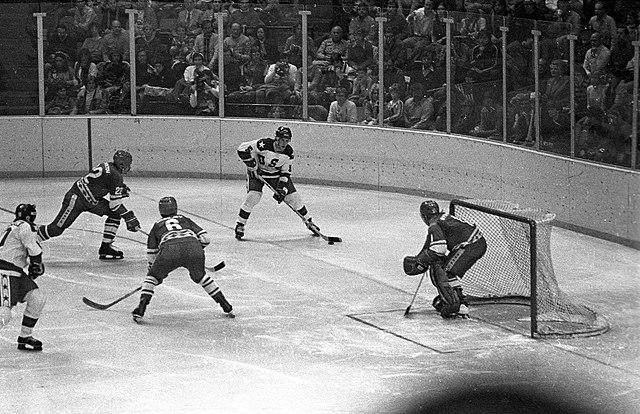
At the height of Cold War tensions, the two countries faced off at the 1980 Winter Olympics hosted in Lake Placid, New York. The United States’ unexpected 4-3 victory secured the eventual gold medal for the Americans over the Soviets. This victory became a Cold War-era morale booster for the United States at an otherwise fraught geopolitical time. After a decade marked by the Vietnam War, the Iran Hostage Crisis, and the Soviet invasion of Afghanistan in December 1979, the United States’ victory provided a moment for nationalistic pride on the global stage.
The continuing tensions of the Cold War led the United States and over 60 other nations to boycott the 1980 Summer Olympics held in Moscow in response to the Soviet invasion of Afghanistan and as a boycott of Communism. (Note: Until 1994, both the winter and summer Olympics were hosted in the same year, every four years.) Sports historian Chad Seifried goes so far as to insist that the Cold War “can be said to constitute one of the important organizing frameworks for the presentation of international sports in North America,” especially as the battle on the ice represented a substitute for a real war that always seemed a possibility.
The rising geopolitical tensions this year are a sign of how much has unraveled just one year into the second Trump presidency. For instance, the Valentine’s Day game between Denmark and the U.S. stood out amid the continuing crisis over the sovereignty of Greenland. With the United States heavily favored to win gold relative to the Danish hockey team, an underdog Danish victory would have certainly been a Danish Miracle on Ice, defeating the superior team of the threatening superpower. The United States’ easy victory over Denmark, however, could be interpreted as a reaffirmation of the United States’ position as a serious threat both on and off the ice.
For decades, the hockey rivalry between the United States and Canada has been contained primarily to the ice. Last year’s Four Nations Faceoff brought geopolitics front and center, however, against the backdrop of President Trump’s outspoken desires to make Canada the 51st state and his repeated threats to levy economy-destroying tariffs on the country.
Hosted in February 2025, the Four Nations Faceoff saw teams from Finland, Sweden, the United States, and Canada competing in a first-of-its-kind international tournament played in Boston and Montreal. The mounting tensions between the United States and Canada were palpable even before the puck dropped, seen as Canadian fans booed the United States National Anthem at the first game played between the nations in Montreal. This act of protest was not confined to the Four Nations tournament, as Canadians also booed the National Anthem at NBA and NHL games played in Canada for weeks following the tariff announcement.
The rivalry carried into the matchup, as three separate fights broke out in the first nine seconds of the game between American and Canadian players. For many Canadian fans, the fighting was representative of their frustrations with their long-standing ally. Just like in 1980, the battle on the ice once more represented a nation’s frustrations with another nation. As the tournament returned to Boston for the championship game between the United States and Canada, tensions remained high as the Canadians eventually won in overtime. After Canada’s win, then-Prime Minister Justin Trudeau quickly took a jab at President Trump on social media, writing, “You can’t take our country — and you can’t take our game.”
The extent to which Canada’s win at the Four Nations Faceoff has been explicitly likened to its own Miracle on Ice remains to be seen. What is clear, however, is that the victory presented a morale boost at a time of great geopolitical uncertainty, akin to that of the United States in 1980. Given how deeply hockey is embedded in the culture of the nation, the win also allowed both casual and devoted Canadian hockey fans to celebrate national pride at a time when their nation’s very sovereignty was being questioned.
Less than one year after tensions flared at the Four Nations Faceoff, the United States and Canada met in not one, but two gold medal ice hockey games at this year’s Olympics. In both games, the United States won the gold medal over Canada in overtime, marking the first time in history that the women’s and men’s hockey teams won gold at the same Olympics. During Sunday morning’s game, broadcasting was rife with comparisons to the 1980 Miracle on Ice on its 46th anniversary—only this time, the United States did not enter the game as the geopolitical underdog. After the game, the official White House X account replied to former Prime Minister Trudeau’s aforementioned post from last year with an AI image of an eagle attacking a Canadian goose, immediately ensuring that the geopolitical strain remains at the forefront of the victory.
The gold medal matches come against the backdrop of even deeper tensions between the two nations. Just before the start of the Olympics, President Trump threatened to stop the opening of a new bridge between Detroit and Windsor, Canada—ironically named after Canadian hockey player Gordie Howe—in response to Prime Minister Mark Carney’s fiery speech at Davos in January. In the speech, Carney sent a message to the United States that Canada was prepared to go its own way on the global stage. Prime Minister Carney had been invited to attend President Trump’s Institute of Peace conference this weekend in Washington, DC; however, the invitation was rescinded following Carney’s Davos speech, marking a further escalation in tensions between the United States and Canada.
Broadcaster Al Michaels’ announcement, while said in Lake Placid in 1980, can be applicable 46 years later, as the United States and Canada take the ice once more at a time of continued geopolitical uncertainty: “What we have at hand is the rarest of sporting events, an event that needs no buildup, no superfluous adjectives. In a political or nationalistic sense, I’m sure this game is being viewed with different perspectives, but manifestly, it is a hockey game.”
Image: USA – Soviet Union match, Winter Olympics 1980. via Henry Zbyszynski on Wikimedia Commons.
Madi Campbell is a first-year MAGIC student originally from the Chicago suburbs. Before coming to Georgetown, she completed her undergraduate studies at Northeastern University, majoring in History and minoring in German and Cultural Anthropology. Her research interests center on the rise of fascism in interwar Austria and the post-war Vergangenheitsbewältigung (coming to terms with the past). Outside of the History Department, she enjoys baking, bar trivia, and crying over her Chicago sports teams.
 The Footnote
