
Gavin Dunsby
For scholars of 20th-century Spain, newspapers are an important source of information on the country’s rapid developments from the Spanish Civil War to the political violence of terrorist organizations that rocked Spain during the latter part of the century. Newspapers covered all of these events, even when threats of censorship, expulsion, or criminal prosecutions loomed over them. During the Franco regime (1939 to 1975), a peculiar development occurred where, under his policies of repression and censorship, some of the most accurate reporting on the country’s internal developments came from foreign press correspondents. The freedom of speech given to the foreign press was not a random quirk of Franco’s policies, but part of efforts to moderate the dictatorship by the United States and other countries.
Francisco Franco Bahamonde rose to power through the Spanish Civil War (July 1936-April 1939) that saw a coalition of military, monarchist, conservative, and fascist factions rebel against the democratic Spanish Second Republic. While not the initial leader of the rebellion, Franco soon rose up to be its leader and took on the title of Caudillo. During and after the war, Franco pursued a campaign of violence against all those who opposed his authoritarian, fascist, nationalist, and Catholic view of Spain. One factor for his victory in the war was his alliance with other fascist leaders such as Hitler and Mussolini. When Franco assumed total leadership of the country in 1939, he swiftly enacted harsh policies that saw those speaking out against the regime imprisoned, tortured, executed, or exiled. For such actions and his alliances with Germany and Italy, most countries chose to virtually isolate Spain from the global stage, only maintaining the bare minimum of diplomatic operations with them.
After Germany and Italy were defeated by the Allies in 1945 and Spain’s economy continued to decline, the mismanagement and inadequacies of Franco’s economic policy became clear. For comparison, Spain’s industrial and economic output was still below 1935 levels. This economic dilemma was amplified by a food crisis that same year, which saw millions starve. When the regime tried to address the famine, few countries were willing to assist as they doubted Franco’s ability to repay loans. These internal conditions caused much grievance, resentment, and frustration amongst the population, and contributed to a series of sabotage, strikes, and protests conducted throughout Spain from 1945 to 1951. Another factor was that the Allied victory in World War II reinvigorated republicans and leftist organizations in Spain. Suddenly, the atmosphere of fear and violence Franco had cultivated since the Spanish Civil War was challenged, and his control was threatened.
In concurrence with these events, the United States began an attempt to moderate Franco’s regime. The hope was that the U.S. could leverage its newfound post-war economic and diplomatic power to make Spain more friendly to U.S. interests, economic and moral. A series of exchanges between Ambassador to Spain Norman Amour and Secretary of State Cordell Hull from 1945 details these attempts, but they were met with frequent resistance from the Spanish government. Franco himself, as relayed by Spanish diplomats, was not opposed to bettering U.S.-Spain relations and made frequent efforts to do so himself. Most notably, when interviewed by foreign newspapers such as the Associated Press, Franco made efforts to downplay his relationships with the fascist regimes of Italy and Germany. Nevertheless, despite his interest in improving Spain’s global standing, the official position of the regime was that no foreign power should intervene in its internal affairs. By the end of the ambassador’s stay in Spain, he expressed frustration over the failure to compel the regime’s moderation with one exception—the foreign press.
In 1945, Franco agreed to U.S. and British requests for foreign press to operate in Spain with greater freedom of speech than previously allowed. As a result of this concession, when protests broke out across the country that year and in the years to follow, the few sources that were able to publish on the regime’s violence were large foreign publications like The New York Times. For Franco, allowing this freedom was likely an easier option than denying all requests to moderate. First, it avoided possible international incidents if foreign journalists were harshly punished for their reporting. Second, it allowed the regime to reaffirm its staunch position against foreign involvement but established that there were matters that it was willing to negotiate on. The other benefit for Franco was that the press served as a means of propaganda for foreign audiences.
That aforementioned Associated Press interview took place in 1946, and in it, not only does Franco downplay his connections to Hitler and Mussolini, but he also says that, above all, he is eager to stress his desire for good relations with the United States. What is most shocking for readers both now and then is that the dictator also claims his true objective is to bring absolute democracy to Spain. This narrative of protecting democracy was not new, as Franco repeatedly asserted that his actions and regime were meant to protect Spain and all of civilization from communism, which he framed as a threat to democracy and order.
Allowing foreign media outlets to have such freedom further spreads the misconception that Franco was interested in democratic principles. Being able to present himself as a potential American ally was vital, as renewed trade with the U.S. could hopefully improve Spain’s dire economic situation. Franco’s hopes paid off by the end of the 1950s: by then, Spain was considered to be a major ally of the U.S. and eventually a tourist destination. In 1951, Spain was even promised millions in aid and all Franco gave in return was a looser grip on the foreign media. As Spain’s economy stabilized following its global reintegration, however, it strengthened its restrictions on the press. As The New York Times reported in January 1970, foreign journalists faced the constant threat of expulsion. Further, news articles had to be submitted to the Spanish State for censorship four hours before publication. In 1970, during the trial of sixteen accused Basque nationalists for the murder of a police officer, an American journalist was banned from reporting from the court for being too sympathetic towards the accused.
After Franco’s death in 1975, new media companies formed in Spain with greater freedoms and political perspectives. Franco’s successors, King Carlos and Prime Minister Adolfo Suárez, began a campaign of moderation, which allowed for greater political beliefs to be expressed in print and in public. These freedoms later became enshrined in the 1978 constitutional referendum which formally established Spain as a constitutional monarchy. Although better than under the Franco regime, censorship persists as an issue within Spain: for decades, public discussion of the regime was taboo, and today Spain is frequently criticized for its restrictive laws on public speech.
The history of the foreign press in Spain demonstrates how the sources historians use are part of larger political dynamics and history. For those especially interested in more recent history, it is a call to evaluate the production of the news itself as part of historical analysis. The relationship between Franco and the press deserves greater exploration—in particular from an American perspective, as American papers were initially harsh critics that later quieted their opposition once Spain was a U.S. ally.
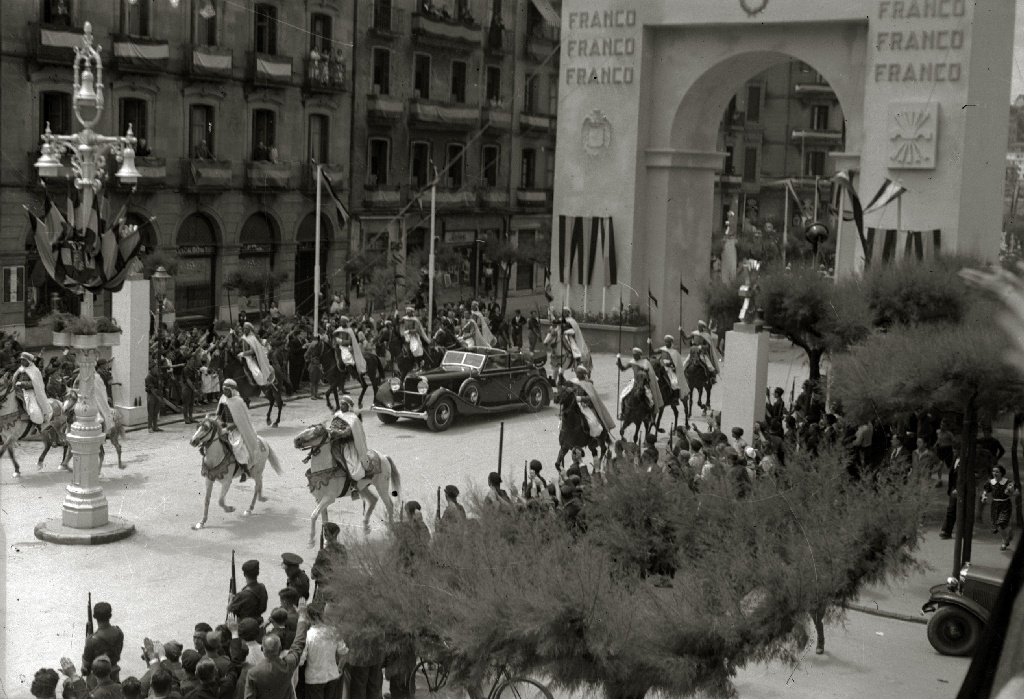
Image: Dictator Franco parading in Donostia (San Sebastián) in 1939 via Gure Gipozkoa on Wikimedia Commons
Gavin Dunsby graduated from Florida Atlantic University with a double concentration in History and Spanish. He is currently a first-year graduate student in Georgetown’s Master of Arts in Global, International, and Comparative History Program. His research focuses on Basque nationalism and the Franco regime in Spain.
 The Footnote
