
Jack Hill
In the year 1868, the United States of America—scarcely recovered from its Civil War and barely able to call itself “united”—was a nation of fewer than 35 million souls, and around twelve percent of them bore the indelible mark of Africa in their ancestry. Slavery had been abolished in name, if not entirely in substance. In most of the country, Black Americans were still denied the ballot, and women were kept out of politics altogether with an efficiency that would have impressed the medieval clergy. Reconstruction, that noble experiment in postwar justice, had entered its Congressional phase—a euphemism, as it turned out, for occupation and betrayal. Ulysses S. Grant, fresh from slaughterfields, was about to take the oath of office. And while America was licking its wounds and feebly attempting to stitch itself together, the imperial powers of Europe were sharpening their knives for a second orgy of colonial gluttony in Africa and Asia.
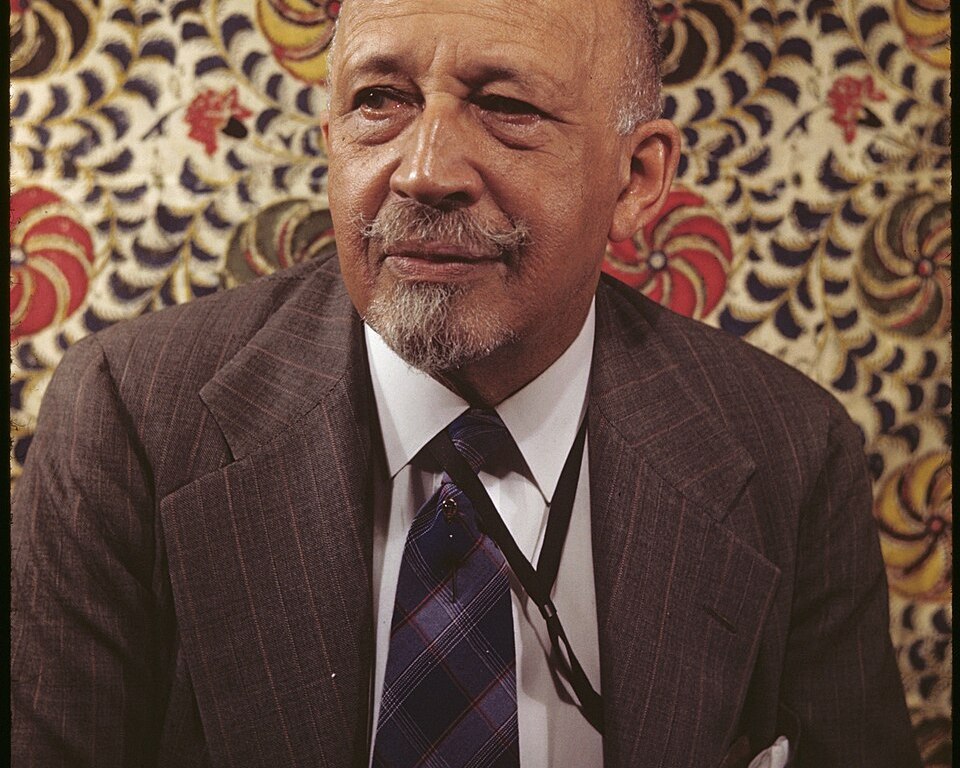
Between these two Americas stood William Edward Burghardt Du Bois, born in 1868, a man who refused to be a subject of history and instead insisted on shaping it. Scholar, agitator, exile, prophet, and scold, Du Bois was that rarest of creatures: a man of letters who also demanded action, and a man of action who took ideas seriously. He saw the problem of the twentieth century as “the problem of the color-line”—and then, refusing to be merely prophetic, he spent his long life attempting to redraw it.
His was a Promethean odyssey, and it began, famously, with heartbreak. A valentine spurned by a white girl in Great Barrington, Massachusetts—a trivial slight, one might think—left a scar that he would transmute into a lifetime of rebellion. But what a rebellion it was! Du Bois swam against every prevailing current. When the prevailing opinion was that Black people should content themselves with industrial education and manual labor, he spoke instead of building “a name in science, a name in literature.” When Booker T. Washington counseled accommodation and gradualism, Du Bois dissented with fury and precision. While Social Darwinism whispered its foul gospel of hierarchy and racial predestination, Du Bois called instead for revolution in the name of reason.
He did not merely dissent—he documented. As a scholar, he was astonishingly productive. His Philadelphia Negro was a pioneering sociological study, and the Atlanta University papers he coordinated are invaluable. Most influential of all was Du Bois’ Black Reconstruction in America, which shattered the prevailing mythology—that Reconstruction was a failed carnival of Black incompetence—and restored agency and dignity to the newly freed. Without Du Bois, Kenneth Stampp’s Reconstruction might have appeared a decade too late. He redefined the past in order to reclaim the future. But he was not content to write in the cloister. In 1899, after seeing the charred knuckles of Sam Hose displayed in a shop window—lynching, meet capitalism—Du Bois left the lab for the streets. His child had recently died, denied decent treatment by a segregated health system, and suddenly, research was not enough. “One could not be a calm, cool, and detached scientist while Negroes were lynched,” he wrote. Thus was born the activist-scholar, a new category in American letters.
He was not alone in his defiance, but he was often lonelier than he should have been. Where Jack Johnson fought with his fists, and Paul Robeson with his voice and frame, Du Bois wielded words like thunderbolts. He was cerebral, aloof, perhaps even elitist. His “Talented Tenth” doctrine could sound suspiciously like noblesse oblige. But he never forgot the people in whose name he fought. He taught in the dusty schools of the rural South. He lived in the ghettos he later anatomized. And always, he remained “Dr. Du Bois,” schoolmaster to a nation that never quite passed his final exam.
As for Marcus Garvey, Du Bois despised him, and one can see why. Garvey was a demagogue, a charlatan, and a poor businessman, but he could move the masses as Du Bois could not. Where Du Bois offered theory, Garvey offered catharsis. His “Back to Africa” fantasy was quixotic, and his dalliances with the Ku Klux Klan were grotesque. Yet he illuminated a vital truth: ideas do not move people unless they resonate emotionally. The NAACP, for all its legal brilliance, never quite knew what to do with a pissed-off porter or a maid who just wanted to vote.
And yet, over time, it was Du Bois’s method—reasoned agitation, moral clarity, intellectual rigor—that prevailed. The Communists tried to co-opt the anger of Black Americans, but without Du Bois’s ethical core, they failed. A. Philip Randolph spoke to the workplace; Du Bois spoke to the soul. Integration versus separation, race pride versus cosmopolitanism—these were not abstract debates for Du Bois. They were the ground he walked every day.
To the end of his life, Du Bois wrestled with the double-consciousness he had so famously described: being Black and being American. Eventually, he concluded that the contradiction was irreconcilable. And yet, in that struggle, he personified the central dilemma of America itself. For what is America, if not a battleground between its soaring ideals and its sordid realities?
That life did not end in triumph. Indeed, it ended in exile, a continent and a world away from the country he never ceased trying to improve. Late in life, Du Bois embraced communism—an allegiance that, with the full retrospect of the gulags, famines, and show trials, is difficult to defend. But it is not difficult to understand. As historian David Levering Lewis aptly notes, Du Bois’s principled impatience with American hypocrisy drove him into the paradox of defending tyranny in the name of justice. It is the classic tragedy of the intellectual: to believe that the right theory, if only applied with enough force, can redeem the wrong people.
The wars—especially the global ones—threw these contradictions into stark relief. In World War I, Du Bois urged his fellow citizens to “close ranks,” only to be betrayed by a nation that refused to honor their sacrifice. By World War II, he had learned better. The hypocrisy of fighting for freedom abroad while denying it at home became too obvious to ignore. It was not benevolence that changed American race policy, but geopolitics. The Cold War forced a reckoning. America, suddenly the leader of the “free world,” could no longer afford to be a segregated embarrassment.
But even the international spotlight needed domestic fuel. Without the ceaseless protest of Black Americans, there would have been no pressure to reform. The Communists could not have raised the issue credibly; Black America forced itself into the global conscience. And they did so not just through marches and boycotts, but through something as radical as voting. The Great Migration changed the arithmetic. Suddenly, Black voters mattered. Roosevelt may have been the most progressive president of his time, but his policies followed the numbers more than the nobility. Politics, not platitudes, made the New Deal as inclusive as it was.
Du Bois, in his later years, revisited the ancient question: integrate or separate? His answer changed with time and circumstance. He was a Pan-Africanist before the term was fashionable. Cultural kinship, however, was not enough. Identity, it turned out, was more complicated than ancestry.
Which brings us to the question that haunted Du Bois and still haunts the republic he tried to redeem: Who are we? Are we a creed or a tribe? A country of laws or of bloodlines? Justice Brewer’s insidious aside that America is a “Christian nation” represents, in a single phrase, everything Du Bois spent his life opposing. For if America is only for some, then it is not America at all. Du Bois knew this. He knew that pluralism is not easy, that democracy is not natural, and that the Declaration of Independence is not self-executing. But he also knew that the line of history bends—ever so slowly—toward inclusion. His was not a life of unbroken victories. But without it, the victories we have would likely be fewer.
Image: Kodachrome photo of W. E. B. Du Bois by Carl Van Vechten taken on July 18, 1946 via Wikimedia
Jack Hill is a writer, journalist, and Historian. He teaches History in Cambridge, MA
 The Footnote
