
Victoria Korotchenko
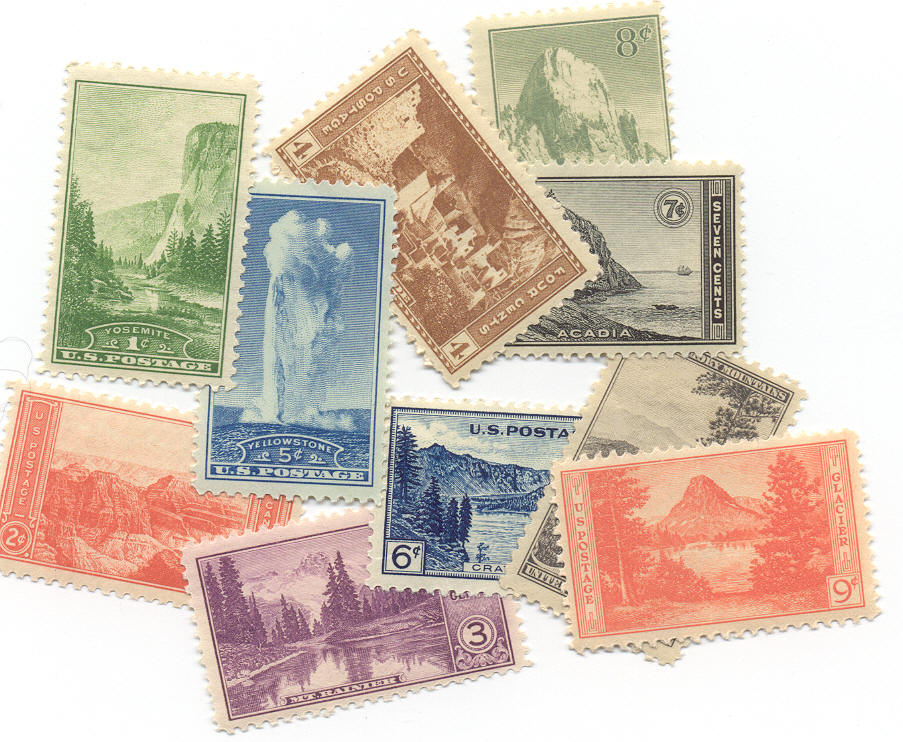
When people think of the National Park Service, they often conjure images of Yosemite or Yellowstone. When I mention that I intern with the service, I often hear about people’s memorable family vacations or their favorite hikes. Some even tell me about their bucket-list goal to hit up all 63 national parks. Sometimes I don’t have the heart to tell them that there are actually over 430 national parks. (433, if we are being exact—that’s enough to dash the wind in anyone’s sails.)
Over the past year and a half, I’ve gotten to know over 100 of them through my time working on their respective Unigrids. The over 430 park sites—with designations from National Park to National Historical Park to National Seashore—each have a brochure given to the visitor upon entry, outlining the features of the park, planning information, and natural or historic background on the site. All of this information lies within a “comprehensive graphic design system that standardizes formatting and production” (hence the “Unigrid” name—it’s a sin to call it a brochure, technically), designed by the same man who created the graphic identity for the New York City subway. I am no designer, though—my job was to tackle the text element of the Unigrid, such as copyediting existing ones and writing for new Unigrids. This has also meant a lot of research on a bunch of sporadic topics, including how the Mescalero Apache Tribe roasts agave near the Guadalupe Mountains in Texas and how Harriet Tubman led a Union raid on the Combahee River in the early days of the Civil War.
In that same time, I have also begun my PhD in History at Georgetown, in the largely unrelated field of Russian and Eastern European history. Anyone who has existed within the sphere of a history PhD will know this is not a small hustle. It requires time, dedication, and perhaps the sacrifice of a few hobbies. Of course, my two “jobs” overlap occasionally—I loved feeling useful when I corrected the timeline of Soviet leaders featured on Minuteman Missile National Historic Site—but that was a rare occasion. So why, amidst too many books to read and too much knowledge to synthesize, keep up the time-consuming, often bureaucratic work with the park service? Because, as cliché as it may sound, my time interning in the park service has taught me lessons often neglected in the classroom. It has continuously reoriented me towards making my research accessible to a broader audience, from my students to my future readership—in a moment when public discourse desperately needs an infusion of historians.
Making history accessible is an idea that is often discussed as a pressing need amongst historians of all fields, but one that is still largely neglected. The jokes are still made that, besides Americanists, very few people outside academia, save professors and unwilling undergraduates, will read our monographs. The research we spend five to six years on is published by academic presses with limited marketing budgets and behind unattractive covers and prices.
Beyond such anecdotes, our writing and language do not make our work all that alluring, either. I was trained as a copyeditor in undergrad, and the examples we learned from were often theses and dissertations that my professor had accumulated. Long sentences, unclear referents—we academics love using “This shows” at the beginning of the sentence, even though the reader has long lost track of what complex idea “this” or “that” is standing in for. (Once you notice it, you will never unsee it.) I once participated in discussions over how to make Unigrids accessible to follow Section 508 guidelines, where the idea to limit sentences to a maximum of 25 words was proposed. While this regulation was eventually rewritten because it was far too prescriptive, I sat in these meetings thinking, this would absolutely kill all historians and even grad students. Of course, such generalizations gloss over the fact that the park service and historians are writing for completely different audiences. Yet at the same time, I am left wondering why it’s such a known, even accepted, fact of life that academic research rarely pervades public discourse—and that little attention is paid to making historians good communicators, not just good researchers.
Perhaps I am also still stuck on these concerns because I have witnessed how much we need the nuanced depth of historians’ work today. Much has been written about Secretarial Order 3431, entitled “Restoring Truth and Sanity to American History” after the executive order of the same name, and how it has promoted politicized rewriting of narratives on American history or the removal of exhibits highlighting more dark moments in our country’s past, even when they are factually accurate. From the inside, I can tell you these removals are not being ordered or orchestrated by rangers or historians—the directives come from a nebulous upper bureaucracy that leaves projects in limbo for months for the sake of “review,” while scorning staff for not meeting deadlines. While many of their changes are often inconsistent and frankly incorrect historically, this group does have control of the narrative—on a scale historians can only dream of. Around 20 million brochures are printed annually, and the entire park service system receives over 300 million visitors annually (and rising each year).
Can historians meet this reach? Likely no. We do not command a federal printing budget or a captive audience of millions arriving at carefully curated sites of memory. We cannot, and perhaps should not, aspire to the same kind of narrative authority that the National Park Service wields. What we can do, however, is take seriously the conditions that make the park service’s work so effective: clarity, intentionality, and an unwavering sense of an audience wanting to learn more.
Just as I prompt people’s family stories and historical hyperfixations when I mention I work with the service, the same phenomenon happens when I mention that I’m a historian-in-training. Yes, a lot of it is asking about Putin or the fall of the Soviet Union while I am jetlagged taking an Uber home, but there is always a curiosity. There is a desire to engage with the history there—and my knowledge of it. And I know I am not the only one with such experiences. What if we use this to change our assumptions towards our potential audience? What if we cease with the jokes about our tiny readership, and instead assume there are many people who actually do want to hear from us?
I’m not asking us to abandon the monograph or to fully turn towards public history. The depth of research that defines our field remains essential, but depth and accessibility are not mutually exclusive. If anything, the stakes of the present moment demand that they be pursued together. This might mean writing courses tailored for history students or encouraging students to participate in events outside the university or academic conferences—or even just having historians practice speaking or writing to diverse audiences about their research.
Such steps are small in the grand scheme of political chaos and the cacophony on social media. But my year writing for the National Park Service has made me a more deliberate writer—one who thinks more carefully about how a reader encounters a sentence, a paragraph, a historical narrative. All I am suggesting is that we historians—present and future—consider how much attention we devote to rhetoric—to our language, our audience, and our impact outside the academy. In the end, what I’ve learned most from my time with the park service is that, despite every attack and disagreement, there exists the quiet assertion of an audience ready to listen to history’s lessons and tiniest details, if we care enough to meet them where they are.
Victoria Korotchenko is a History PhD student at Georgetown University, specializing in the history of the Russian Revolution and the 1920s. She also works as a freelance copyeditor and as a writing-editing intern with the National Park Service’s Harpers Ferry Center.
 The Footnote
