
Rae Neville
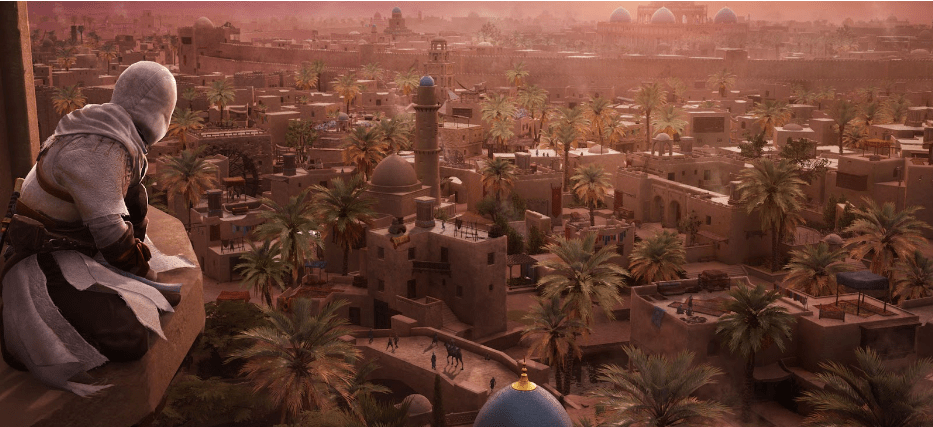
This Thursday, the popular video game studio Ubisoft will release the latest installment in the Assassin’s Creed franchise: Assassin’s Creed Mirage. Set in Baghdad in the year 861, the game will feature a world rich with art, culture, and knowledge. Players will follow the story of Basim, a “cunning street thief with nightmarish visions seeking answers and justice,” as they explore and cut their way through the medieval city in the Islamic Golden Age.
Like its predecessors, Assassin’s Creed Mirage is an open-world rpg (role-playing game) characterized by parkour and stealth-oriented gameplay, as well as a rich narrative grounded in historical research. The core narrative of the franchise spans millennia, with past iterations featuring stories in settings from ancient Egypt to the American Revolution. In 2017, alongside Assassin’s Creed Origins, set in ancient Egypt, Ubisoft released a new feature: the Discovery Tour. This feature allowed players to immerse themselves in a detailed and engaging historical setting “curated by historians, professors, and experts, the Discovery Tour covers a wide variety of topics, ranging from art and architecture to philosophy, politics, and religion.” Ubisoft’s Discovery Tours now allow players to explore the worlds of Ancient Greece, the Viking Age, and, in the near future, 9th-century Baghdad.
Despite its vivid and exquisite historical settings, with its well-researched and skillfully rendered buildings, geography, and clothing, the franchise has been criticized for being “history porn” that transforms historical figures and events into nothing more than a backdrop for violent gameplay. In their review of the series, Aris Politopoulos, Angus A. Mol, Krijn Boom, and Csilla Ariese, question whether players “engage in meaningful play with the past, or are simply assassinating [their] way through history.” While other’s question the historical accuracy of the games because of the areas where the studio has taken creative liberties. (See Simone de Rochefort’s article on the accuracy of Notre Dame in Assassin’s Creed Unity.) Critiques aside, historical video games provide the public a platform to immerse themselves in past events.
But how accurate of a picture can players form of the past when playing historical games largely centered on a fictional narrative arc? Eve Stirling and Jamie Wood explored this in their paper: “‘Actual history doesn’t take place’: Digital Gaming, Accuracy and Authenticity.” They focus on player perceptions of place “in historical computer games and how their playing of such games affected their broader engagement with history.” They conclude that while players largely viewed historical accuracy in games as subjective and limited by the story, their perceived engagement with “an ‘authentic’ historical ludic situation is partly dependent on some level of perceived representational accuracy.” In other words, the broader details within a historical game must align with a player’s own view of what the past should look like for them to feel engaged with its setting and story. Michal Mochocki explores this relationship between player immersion and authentic heritage experiences using strategic experiential modules (SEMs), that is the player’s ability to sense, feel, think, act, and relate with the space. Through this model, a player’s perception of historical authenticity is not only linked to their own knowledge of history but is also “…interconnected with the feeling of game immersion/incorporation as they have the same experiential components…” In this way, playing historical video games is similar to visiting heritage sites because it is the player themself whose personal history resonates with the history in the game.
This of course means that there is no singular answer to the question of whether Assassin’s Creed leans more towards “history porn” or digital heritage, since it is largely dependent on each player. Regardless, Assassin’s Creed Mirage will provide a space for players to engage with the rich history of the Islamic Golden Age, including important historical figures and events such as Ali ibn Muhammad and the Zanj Rebellion of 869.
Image: Ubisoft, Assassin’s Creed Mirage, 2023
Rae Neville is a first-year graduate student in the MAGIC program. They graduated in 2020 with their BA in History from Berea College in Kentucky and have been in DC since July of this year. They came to Georgetown to research prostitution’s relationship to power dynamics in the 19th century.
 The Footnote