
Oscar Zhenhao Yu
Disability has been a burgeoning topic for historians in different fields. Considering disability in Chinese history, few works focus on disability, not to mention exploring the ontology of disability in its pre-modern context. This essay therefore situates disability, and deafness in particular, within pre-modern Chinese history (1644-1912). How did the Chinese perceive deafness before the twentieth century? What sources would be useful to contextualize deafness? Most essentially, why is deafness crucial for historians to study pre-modern China, and more broadly, other geographical regions? Answering these questions requires a close examination of deafness in Chinese medical texts, ghost tales, and personal memoirs written between the seventeenth and nineteenth centuries.
Deafness is a familiar term referring to bodily disorders in traditional Chinese medicine (hereafter TCM). At least since the first millennium, Chinese physicians have been theorizing pathologies and therapies to diagnose deafness. For example, the Inner Canon of the Yellow Emperor (Huangdi Neijing), which recorded the conversations between the mystical Yellow Emperor and his physicians, details how to treat deafness through acupuncture. The acupuncture method lies in the assumption that the human body is a map consisting of tributaries connecting different body parts. More significantly, a vibrant body balances the energy (qi) within itself; if one part lacks qi, another has a qi surplus. Based on this theory in the Inner Canon, acupuncturists use needles to navigate the qi flowing between the ring finger to the ear, which in turn balances the qi and cures deafness.
The Ming physician Zhang Jiebin (1563-1640), extends the qi theory, proposing one massages his finger to ensure that energy flows smoothly from the finger to the ear. In addition to the Inner Canon, Zhang pathologizes deafness as qi depletion in the kidneys. To complicate the qi theory, Zhang employs eyes, ears, nose, and tongue on the complexion to reflect the conditions of the visceral organs, including the liver, kidney, lung, and heart. Zhang thus argues that qi depletion in the kidney might result in ear infections, and to cure deafness in the ear is to replenish qi in the kidney. As such, Zhang is a pivotal figure in TCM who provides a hermeneutical lens to analyze the classical Inner Canon and adopts the qi theory to cure deafness.
Zhang’s treatises were not only prevalent in his contemporary age but also inspirational to physicians in the next few centuries. One telling example is Wang Qingren (1768CE-183CE), who disagrees with Zhang but adopts the qi theory to explain his herbal medicine. Wang notes that as a patient’s brain shrinks in size, it prohibits qi to flow to the ear. In contrast to qi depletion in the ring finger and kidney, Wang maintains that the brain transmits qi to the ear. Based on this assumption, his prescription “Smooth the Qi Powder” (Tong Qi San) promises a brain resurgence that no longer blocks qi flowing to the ear. From a survey of Inner Canon, Chinese physicians Zhang Jiebin and Wang Qinren reached a consensus that deafness is a ubiquitous symptom associated with qi depletion, and incorporating therapies to cure deafness in their repertoire is crucial.
To examine deafness from medical treatises looks promising, but it is equally problematic because when physicians diagnosed, pathologized, and eventually medicalized deafness, they also relegated deafness as a disease in pre-modern China, or, as Michel Foucault puts it, deafness never escapes from the doctor’s gaze. Consequently, it requires Disability historians to salvage deafness from bottomless medical prescriptions, analyzing it in another framework, such as literature.
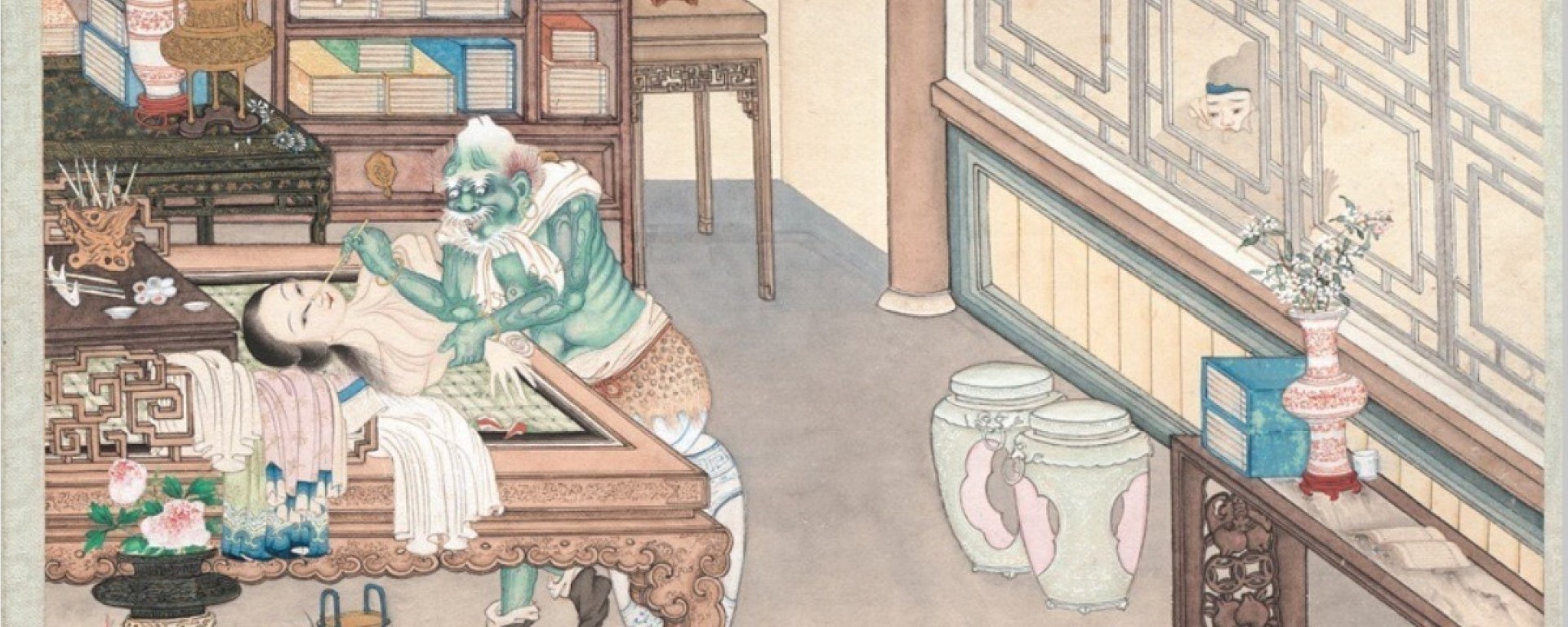
The way to contextualize “deafness” in literature is controversial. On the one hand, literature is fictitious, especially in the case of Pu Songlin’s Strange Tales from Liaozhai, which includes stories about goblins, fox spirits, and other mythical creatures. On the other, it vividly captures how the Chinese literates perceived deafness, which alludes to a mockery of charlatanism and more profoundly, a demonology of ear-related diseases.
In “Man in the Ear,” the author Pu recounts a scholar who was obsessed with the Daoist regimen (Daoyin). One day the scholar was meditating but suddenly heard a voice inside his ear murmuring “Lo and behold!” When the scholar opened his eyes, he saw a dwarf wandering around his house, and soon after he fell into madness. Not until half a year of steadfastly consuming medicine did he start to recover. In this bizarre case, Pu exhorts readers that a wise person should abstain from the Daoist breathing exercise, inasmuch as the quackery guaranteeing longevity only leads the man to madness. Many historians would agree that Pu’s “The Man in the Ear” is allegorical because it advises readers to consult the Daoist regimen seriously, yet it reveals something more provocative.
Though Pu did not mention deafness (long) in “The Man in the Ear,” the story nevertheless insinuates a subtle relationship between the ear and disease. Once the dwarf who lived inside the scholar’s ear absconded, the scholar was severely mad. The dwarf is therefore indispensable to the scholar, who might suspect that the dwarf is either stealing his secret Daoist regimen or the dwarf itself is a part of his wholesome body. From this assumption, who was the dwarf referring to? Why did it reside in the scholar’s ear? How does one explain the scholar’s madness, especially after the dwarf’s fleeting? Could it be possible that Pu was inspired by his contemporary cases of hearing loss, notably auditory hallucinations, or even sensorineural deafness? Again, the random selection of literature does not suffice to study deafness in pre-modern China. Further investigation is important to analyze the relationship between the ear and madness.
The last section focuses on the case study of a deaf teacher He Shitai (1546-1629), who was prohibited from entering his local school once he was diagnosed as deaf in the 1570s. According to the official document, He was deaf in his twenties and thereafter “wasted.” This succinct biography hints that at least from an official perspective, discrimination against the deaf prevailed in pre-modern China. He, however, did not abandon his study. Since he already acquired the capability to learn Chinese characters, He continued his scholarly journey by perusing a plethora of Confucian classics and later opened a private studio to teach his neighboring students. He’s story is exceptional because no one would imagine a deaf person learning by himself, much less entering into a teaching career.
Fortunately enough, He detailed the way he taught students in his memoir The Account of Hearing (Sicong Lu). The phrase sicong etymologically means hearing in Chinese. As such, the title already presents a nuanced view of He’s unique “hearing”—hearing is not restrained to sound but also thoughts in the mind—He befriended other literary men by expressing ideas in his writings. In the preface, a prestigious scholarly gentleman (shi dafu) complimented He, stating: “People thought [deafness was] your sickness while I would say it’s your fortune!” This compliment sounds awkward, but when situating it in late sixteenth-century China, it sounds more cogent.
China at that time was in turmoil, both financially and ethically. On the financial side, the Ming court was entangled in monetary issues. With enormous silver inflow from Spanish America, inflation skyrocketed in local markets, impoverishing the rural populace. On the ethical side, the sudden impoverishment galvanized a pursuit of frugality, if not escapism from the tumultuous society. This resonates with He’s personal story because his deafness allows him to escape from contemporary issues including rampant corruption, factionalism, and boisterousness (emphasis added). He’s teachings, which centered on quiet sitting and a plain diet, were increasingly attractive to a specific audience who valued quietism and asceticism.
What does it mean to be deaf in late imperial China? This article is a touchstone to study deafness in Chinese medicine, literature, and memoirs, arguing that deafness was seen as either a chronic disease or a possession of demons. In rare cases, a deaf person managed to express his own ideas, but most deaf people were less fortunate, often buried in the silent sea of countless archival sources. I hope this essay sheds light on disability history and how non-Western regions perceive deafness on their own terms.
Image: Sohu, Peering the Monster through Window, 2023.
Oscar Zhenhao Yu is a second-year master’s student in the Global, International, and Comparative History program at Georgetown University. His research interests involve welfare systems, particularly granaries, soup kitchens, and foundling houses in pre-modern East Asia. Oscar’s current project is about deaf education co-founded by Americian Presbyterian missionaries and Chinese educationists in the Shandong peninsula, northern China.

