
Megan Huang
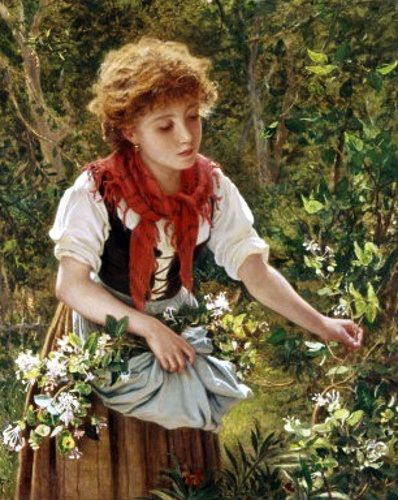
During the start of the 2020 COVID-19 pandemic, the world saw the rise of what became known as “cottagecore.” Given a name in 2018 by Tumblr users (because who else?), this Zillennial lifestyle aesthetic consisting of sunny days, rolling flower meadows, and flouncy dresses represented an idyllic, bucolic fantasy of young womanhood. When the real world was flooded with daily news updates about overcrowded hospitals, rising death tolls, and shuttered businesses as billions of people were required to stay home, cottagecore naturally appealed to many people as an escape.
Speaking as someone who has entertained cottagecore fantasies more than once in her life, I get it. There’s something comforting about imagining your life as something else, or you as someone else. Your home was no longer an urban apartment that you couldn’t leave, but a pretty stone cottage surrounded by green fields and trees where forest animals visited. Your 9-to-5 was not answering emails and attending meetings over a patchy Zoom call, but setting the table for afternoon tea and petting baby lambs while they dozed in your lap. Romanticization of a rural, slower lifestyle was the key to its allure.
Cottagecore hasn’t gone away now that the pandemic is over. It’s just now one of many other “cores” and aesthetics that have flooded the internet–balletcore, Barbiecore, cabincore. Dark academia, light academia. Take your pick. Some people may roll their eyes at the newest trend that pops up, but it’s really just a way for people to find some joy at a time when the world seems increasingly dark and full of existential dread.
While aesthetic subcultures like cottagecore have found their popularity in recent years, the idea of them is nothing new and has a longer history in the world. Perhaps the most iconic example, however, isn’t from the United States.
Kawaii culture is ubiquitous in Japan. “Kawaii” is usually simplistically translated as “cute,” but the word belies a broader concept. Embracing the adorable, childlike, gentle, and sweet is indeed core to it, but it also has implications of helplessness and needing to protect something. It has its roots in the postwar period when Japan rapidly recovered, urbanized, and underwent rapid social transformation. As the fruits of these efforts bore fruit in the 1970s and 1980s and Japan’s economy boomed, kawaii found its stride. Young people were the ideal target amid commercial growth, and companies sought their pocketbooks by designing goods with cute designs and characters. Stationery was a key locus, and female middle and high school students who snapped these products up adopted a kawaii-style handwriting. Featuring rounded characters that girls decorated with little hearts and stars, kawaii handwriting was, apparently, nearly illegible, which led schools to ultimately ban its usage. However, such efforts hardly curbed the determination of these young people, for it was a nationwide practice by 1975 that had five million adherents by 1985. Moreover, as popular idols like Seiko Matsuda caught onto kawaii, it became too big to be contained.
It’s not just children who are consumers of kawaii. Adults do as well, either actively or passively, through how kawaii continues to manifest itself in daily Japanese life. The mascot is one of the most prominent forms. Japan’s public broadcaster is represented by Domo, but even the police departments for each prefecture have mascots–ones that look, from a Western perspective, like they would be more in place in a toddler’s picture book than on law enforcement buildings. The impossibility of imagining institutions like the Metropolitan Police Department in DC adopting mascots and adorning their offices with them highlights just how ingrained kawaii is in everyday Japanese life.
A number of companies have built their fortunes in part or entirely because of kawaii: San-X has Rilakkuma and Pokemon has Pikachu. Kawaii things don’t have to be exclusively Japanese in origin either. Cute characters from the West have found massive success as well–there’s an entire museum dedicated to Snoopy in Tokyo, as well as Winnie the Pooh cafes. In fact, not being Japanese was an important part of establishing the novelty kawaii goods (and also an interesting inversion on orientalism?).
Without a doubt, though, Sanrio is possibly the greatest purveyor of kawaii in the world, thanks to its star character, Hello Kitty. She was first designed in 1974 by Sanrio illustrator Yuko Shimizu, and a year later the first product with Hello Kitty’s likeness on it, a clear vinyl coin purse, was launched. Hello Kitty herself was an instant phenomenon.
Her charm isn’t hard to understand. Described in official lore as a golden-hearted girl just five apples tall, hailing from suburban London, and a lover of baking, Hello Kitty is the perfect embodiment of the kawaii ideal: sweet, lovable, and so cute and innocent you want to just put her in your pocket and protect her from the harsh reality of life (and thanks to the merchandise that has exploded around her, you can). Fifty years on from the release of that coin purse, Hello Kitty remains a powerful and iconic symbol of “cuteness culture” worldwide, one who appeals as much to children as she does to adults.
Again, I speak from experience. When I was growing up, the Sanrio store was a must-visit spot whenever my sister and I went to the mall and I can’t even begin to recount how many of its products we had. Off the top of my head, though: purses, bags, clothing, pencil pouches and pencils, pillows, plushies, calendars, pin boards, figurines, Christmas ornaments, journals, stickers, boom boxes, phone charms, jewelry and jewelry boxes, alarm clocks–Sanrio has the range. One of the greatest moments of my childhood was to fly in the Hello Kitty airplane. The boarding pass and pillow had Hello Kitty on them. The flight attendants all wore pink aprons with her face across the front. Even the in-flight meal’s dessert came with a pink Hello Kitty-shaped spoon–details I can still remember because of how much I loved it. To this day, I own a number of character-branded items and love using them. Some people might wonder why someone my age is still fooling around with “kids’ things,” but to borrow a phrase–I just think they’re neat.


Hello Kitty and kawaii merchandise, past and present (author photos)

Hello Kitty Airbus (Wikimedia Commons)
It’s certainly interesting that both kawaii and cottagecore came out of periods of social transformation. There is the suggestion of a yearning for simpler times in them alike, especially when it’s perhaps jaded adults who are partaking in the culture–to surround yourself with things that won’t deliver you doomsday-like news headlines or to imagine yourself living somewhere peaceful and full of life. It’s founded on a perspective that is in many ways inherently framed around the past–a nostalgia for a life once had, or maybe even one never had, but just dreamed of. It’s certainly a valid response to current events and is, a lot of the time, innocuous.
At the same time, the past can be a powerful tool for good or bad, particularly in periods of social stress and evolution. It doesn’t seem likely that kawaii or cottagecore followers are going to end up on the Senate floor giving speeches about legislation anytime soon. It is fascinating, though, that for all the bad rep history gets in the eyes of the general public–that no one cares about it and is the most boring subject in school–people are quick to pull on the past, and feelings that evoke an earlier time, for their own purposes, whether it is harmless fun like decorating a bedroom or attempting to enact social change.
Cover Image: Wikimedia Commons
Megan Huang is a second year MA student in the Global, International, and Comparative History program. Her research is centered around the American Revolution, utilizing the history of emotions to examine how women used sentimental language for political expression. She graduated from the University of St Andrews with a degree in Modern History and enjoys reading, writing, and cross-stitching in her spare time.


.jpg)
