
Umber Rashid
For generations, marijuana has been tied to elements of our counterculture since the 1960s. Draped in the imagery of rebellion, antiwar protests, and the scenes of different genres of music, this historical narrative turned cannabis into a symbol of personal freedom tied with cultural dissent. This, however, gives a limited picture of how marijuana functions in modern U.S. history, as it misses a far more consequential story. The history of marijuana reveals how it functioned as a powerful instrument through which the American carceral state has racialized crime, justified proliferating its surveillance apparatus, and expanded a sprawling carceral system that disproportionately targets and immobilizes Black and Brown communities. More importantly, marijuana and the government’s shifting response to it cannot be sufficiently understood without the inextricable link of the carceral state and racial capitalism.
The rhetoric that marijuana’s criminalization was simply done in the interest of public health had no legitimate basis to its claims. While cannabis was regulated since the late nineteenth century as one among many potentially dangerous substances, it transformed into a uniquely vilified drug in the twentieth century as a result of the political agenda, not science. Early regulatory frameworks treated cannabis alongside substances like opium and arsenic, reflecting generalized concerns about safety and misuse rather than a moral panic. Yet, by the 1930s, this relatively mundane status dramatically shifted; as Adam Rathge states in his essay “Pondering Pot,” federal officials like Harry Anslinger orchestrated a campaign that linked marijuana use to racialized fears that particularly targeted Mexican immigrants and Black communities. This would cast marijuana as the engine for violence and social disorder.
This shift was not incidental. It marked the moment when marijuana became racialized as a social threat, enabling the state to frame certain populations as inherently dangerous. The resulting policies, including the 1937 “Marihuana” Tax Act and subsequent sentencing laws, didn’t just regulate a substance. Instead, they helped construct a racialized system of control. By the mid-twentieth century, harsh penalties for marijuana possession were firmly in place, thus laying the blueprint for the carceral state’s punitive expansion, immobilization of Black and Brown bodies, and, as Ruth Wilson Gilmore termed, extraction of their one and only non-renewable resource: time.
From the 1970s, this expansion of carcerality became integral to what scholars like Gilmore describe as the “carceral geography” of the United States. As Gilmore and others have delineated in their research, incarceration is not simply a response to crime. The carceral state, and the practice of incarceration, necessitates land, labor, and capital to sustain itself. Drug enforcement, such as policing marijuana, became the primary mechanism for feeding this system. Low-level drug offenses provided a steady stream of arrests, ensuring the continued economic growth of jails, prisons, and the bureaucracies that depend on them. Here, we begin to see how the legal shift towards marijuana becomes contingent on racial capitalism.
The expansion of the carceral state and its reliance on the racialized criminalization of marijuana is relegated mostly in Black and Brown neighborhoods. Families living in these communities have been broken apart and destabilized by the carceral state’s intervention. Despite comparable rates of use across all racial groups, they have borne the brunt of marijuana enforcement. In a 2019 report from the Data Collaborative for Justice titled “Marijuana Enforcement in New York State, 1990-2017,” Black and Hispanic individuals consistently faced higher rates of arrest for misdemeanor marijuana possession compared to Whites. These racial disparities in arrest rates widened over the study period. Of course, this is not an unintended consequence; this is an organizing principle and feature engineered into the carceral state, relying on a system that has historically used criminalization as a tool to control populations deemed surplus or threatening. As these carceral institutions grew, they became embedded in local economies and political structures, creating powerful incentives to maintain high levels of policing and incarceration. Jails and prisons, as Gilmore argues, are not passive institutions; these jails and prisons actively reshape landscapes and lives, extracting time, labor, and resources from the communities they target. Once again, the state’s shifting attitude toward marijuana and its strategic use to control and immobilize Black and Brown bodies becomes contingent on racial capitalism.
What was it about the drug itself that rendered it so crucial to the proliferation of the carceral state? It was ubiquitous and relatively easy to police. Its criminalization provided law enforcement with broad discretionary power, enabling officers to stop, search, and arrest individuals ostensibly for “drug enforcement.” However, these encounters (framed as “minor” or “routine”) served as entry points into a much larger system of control. What once began as a marijuana charge can quickly escalate into fines, incarceration, and long-term surveillance, perpetuating continuous cycles of disadvantage. Controlling, immobilizing, and profiting on bodies are a necessary facet to the American carceral state.
Even as public attitudes toward marijuana have changed in recent years and have led to waves of legalization, the legacy of its criminalization remains deeply entrenched. Legal markets have emerged alongside persistent racial inequalities, with many of those harmed by prohibition excluded from the economic benefits of legalization. Meanwhile, the infrastructure of the carceral state, built in part on decades of marijuana enforcement, continues to operate, sustained by new forms of criminalization and control.
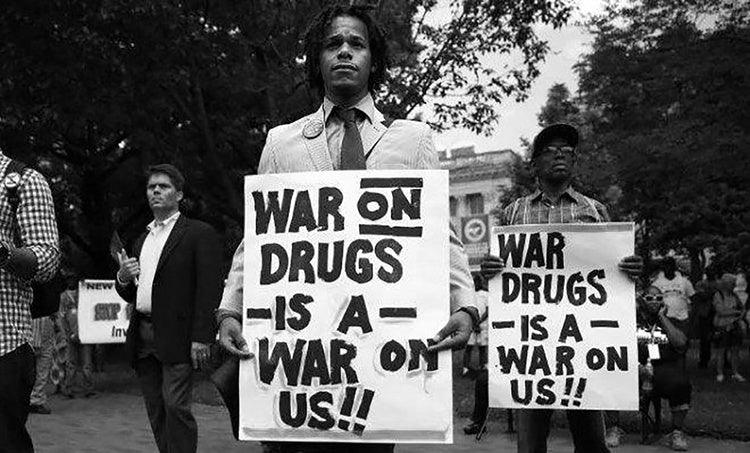
To relegate marijuana as a symbol of counterculture is reductionist and obscures its role in a much larger political project of the state. The history of cannabis in the U.S. reveals how drug policy has been used to racialize social problems, justify punitive governance, and expand the reach of the carceral state into marginalized communities and family structures. Recognizing this history is not merely an academic exercise. Rather, it is essential to understanding the enduring inequalities of the present. Therefore, if there is any meaningful reckoning to be done with the War on Drugs, it must be that criminalizing marijuana was never really about marijuana. It was about power, who has power, how it is exercised, and whose lives the carceral state deemed profitable and expendable in the process.
Image: Protestors at an anti-War on Drugs march. | Dublin City University
Umber Rashid is a PhD student at Georgetown University studying twentieth century U.S. history. Her interests focus on racial inequality, the history of education, the carceral state, and empire. She is specifically researching the role of state sanctioned violence in the sphere of public education through the intersection of the school-to-prison and school-to-military pipelines. In her free time, she is either stress baking, reading, or hiking.

