
Stewart Huntsman
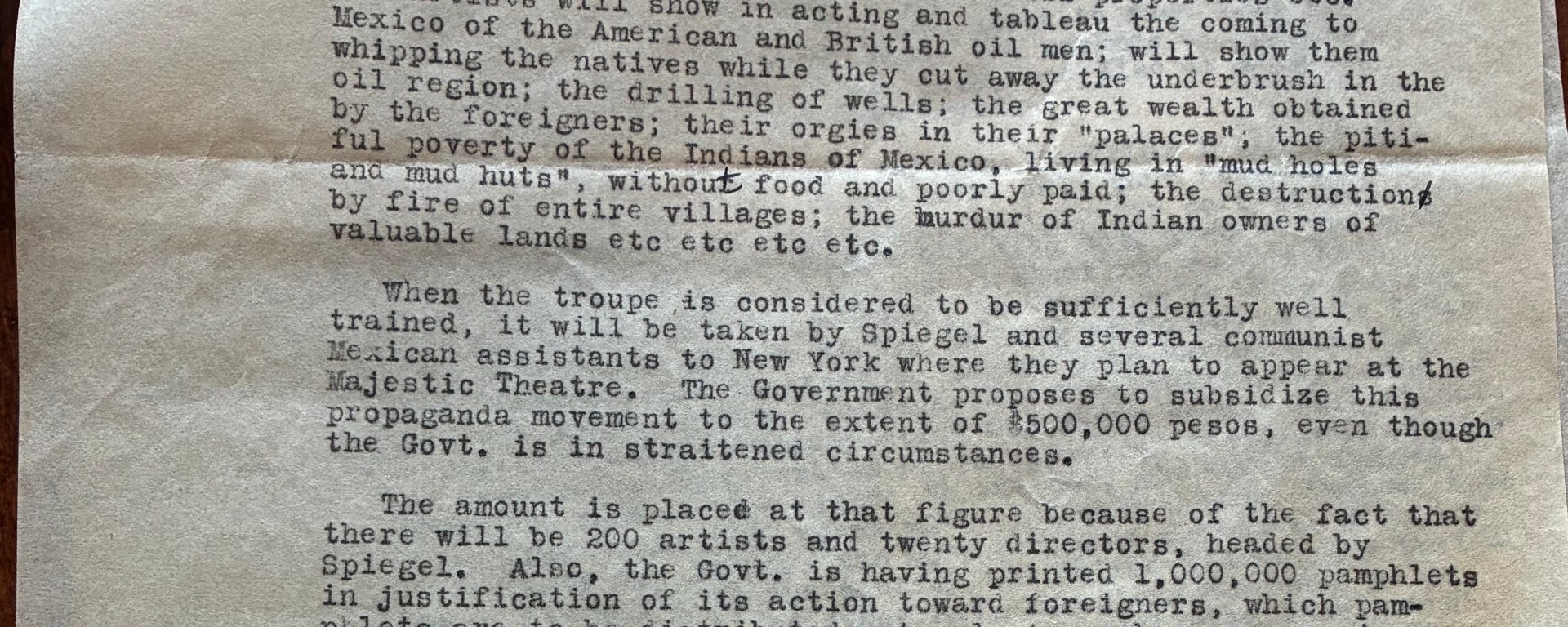
On March 1, 1939, an agent of the Sinclair Oil Company sent his superiors a warning of a dastardly conspiracy. “What I shall report herein will sound fantastic,” he wrote, “it IS the plan of the people here.” The report was forwarded by air mail to the Shoreham Building in Washington, DC, where it was reviewed by Sinclair officials, among them former Secretary of War Patrick Hurley (Anonymous report to Thomas E. Madden, March 1, 1939). Upon leaving office, Hurley had been retained as a high-powered lawyer by Sinclair and was presently engaged in fighting with the Mexican government over its expropriation of Sinclair’s oil properties the year prior.
What was this conspiracy, which caught the attention of so many powerful men? According to the informant, one “Spiegel (Jew)” was gathering “200 dancing girls (Mexican)” to create a grand propaganda performance. With the help of “communist Mexican assistants,” Spiegel would train the girls to perform in a choreographed display that would, through “pantomime, tableaux, dances, etc.,” tell a tale of villainous oil companies exploiting a helpless Mexico. Worse, the informant warned, this would all be done in secret. The version of the show which would premiere in Mexico would be without any anti-oil propaganda, lest they “create suspicion as to their real intentions.” But then, as soon as the show traveled to New York, the dastardly anti-oil messaging would be restored, just in time to brainwash innocent American audiences arriving for a showcase of Mexican culture. All of this was being done with subsidies from the Mexican government and the personal sign-off of Mexican president Lázaro Cárdenas (Report to Madden).
What the informant had actually come across was one of Mexico’s contributions to the 1939 World’s Fair. It was a musical revue which began life as “Upa y Apa” and eventually came to Broadway as “Mexicana”. It was indeed a showcase of Mexican culture, but the finished product included no elaborate interpretive dance pieces inveighing against the evil of the oil companies. According to a favorable review in The New York Times, the performance was a mixture of dance showcases and comedy sketches, including one about baseball and another about Gandhi on hunger strike. The baseball sketch, in the opinion of the Times reviewer, was better. “This means,” the Times reviewer wrote, “either Mexico is richer in dance comedy than Broadway, or else knows how much better how to handle it.”
Hurley knew better. Instead of realizing that the report sounded fantastic because it was fantastic, or noting that the reported collusion between a Jewish puppet master and communist functionaries echoed the Judeo-Bolshevik conspiracy which weighed so heavily upon Nazi fantasies, he took it seriously. The former Secretary of War tracked the progress of Mexicana, clipping newspaper reports on its progress. “See report on propaganda,” he scrawled next to one such clipping from The New York Times celebrating the arrival of the dancers in New York (“Mexican Show Girls Join Easter Parade” New York Times, April 10, 1939).
Unfortunately, Hurley’s papers do not recall if he ever saw Mexicana, though any opinion he had on the Mexican portrayal of Gandhi would doubtless have aged poorly. The show soon left Broadway; the next year Sinclair broke with its fellow oil companies and settled with the Mexican government. By the fall of 1940, the man who had suspected Mexico of a great dance conspiracy was a guest at the inauguration of Cárdenas’s successor Manuel Avila Camacho. The Mexican government, in Hurley’s view, was only a sinister participant in a Communist conspiracy until business could be resumed on acceptable terms.
This raises the question of what about the alleged Mexicana conspiracy captured Hurley’s attention. Sinclair’s other agents in Mexico showed no interest in it, and with one exception, none bothered to include it in their reports. That exception was Erby Swift, a lawyer Hurley had engaged to represent Sinclair in Mexico—he saw the show when it was still “Upa y Apa” and remarked to Hurley it was a good children’s show and he hoped it would make it to New York (Erby Smith to Patrick Hurley, March 23, 1939). Sinclair’s other agents were focused on more serious matters, such as how to leverage Mexico’s financial position, the state of the oil industry there, and Sinclair’s chances for recovering its holdings. They were not concerned with the possibility that a Mexican dance was going to brainwash Americans into supporting the expropriations en masse.
Sinclair’s agents in Mexico were not a professional intelligence organization; they were amateurish and clubby, though in areas like the oil industry they often brought genuine expertise. As a consequence, the reports Hurley and his associates at Sinclair received were of wildly mixed quality. And yet, amidst all the information he was receiving, Hurley was willing to take the idea of a Mexican dance conspiracy seriously. He did not leave any explanation of why he decided to do so—only the traces of his interest.
The key may lie in the greater context of the time. Hurley and Sinclair, like many other oil companies, perceived a Communist conspiracy in the expropriation of their Mexican properties (Larson, Knowlton, and Popple, New Horizons: History of the Standard Oil Company (New Jersey). Leon Trotsky’s (or “Mickey Mouse of International Intrigue” as one reporter called him) presence in Mexico only added fuel to the fire (Fred Paisley “‘Cárdenas? Never Met Him’ Insists Trotsky” Daily News January 8, 1939). At the same time, shadowy deals to sell Mexican oil to Nazi Germany provoked conspiracy theories that it was, in fact, the Nazis who were secretly running Mexico (For example, R.L and R.P. Martin “Hitler Rules Mexico” New York Enquirer, August 14, 1938). Amidst the swirl of conspiracy theories, combined with Sinclair’s own machinations and the heady stream of raw intelligence Hurley was consuming, it is perhaps unsurprising that Hurley fell for a conspiracy theory as ludicrous as the anti-oil propaganda dance.
Image: Patrick J. Hurley via Los Angeles Times, July 17, 1935 via Wikimedia
Stewart Huntsman is a PhD Candidate at Georgetown University, studying oil and fascism in the lead-up to WWII. He previously worked as a researcher at the Atlantic Council.


