
By Jessica Dickinson Goodman
In 1967, the U.S. had 31,255 nuclear warheads and the U.S.S.R. was racing to catch up; by 1986, Moscow had 40,159. By 1986, the world had 70,300 acknowledged nuclear warheads. But today, the world is down to 12,187.
What changed? And what could it mean for nuclear competition with China?
How did the U.S. and U.S.S.R. Start Nuclear Arms Control Then?
How did the U.S. and U.S.S.R. come to the series of arms control treaties that pulled the world back from the nuclear brink between 1968 and 2010? The answer involves 42 years and 6 nuclear arms control treaties.
As context, below is a map of all of the acknowledged nuclear stockpiles, from the very first Trinity test in 1945 to today:
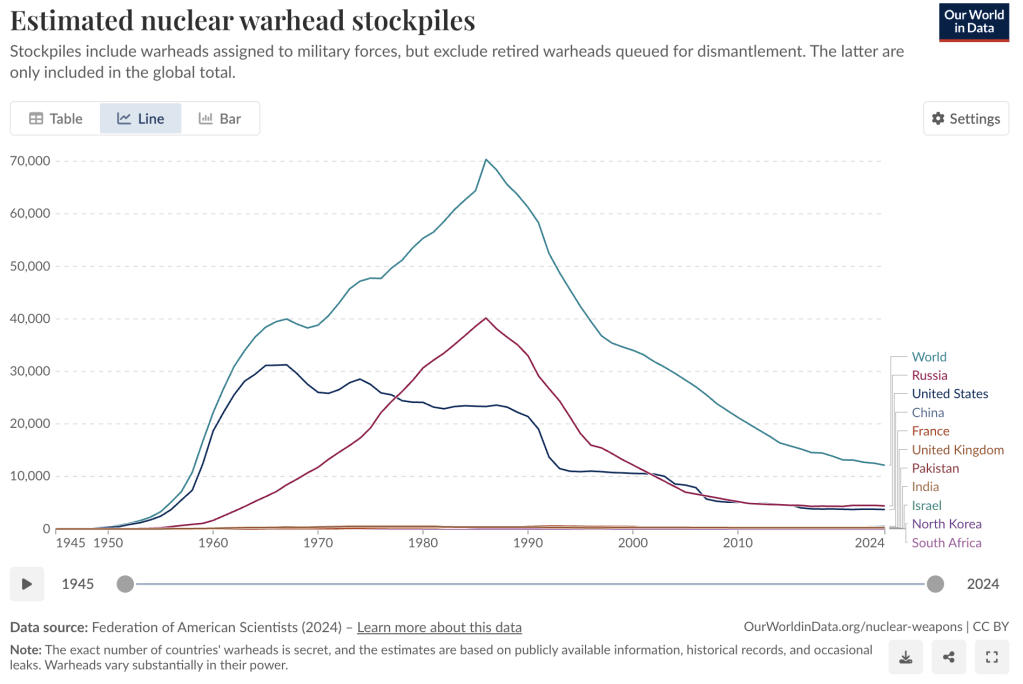
Figure 1. Our World in Data graph of estimated nuclear warhead stockpiles 1945 – 2024, using data from the Federation of American Scientists.
That massive and steady decline in the global nuclear stockpile was the direct result of bilateral and multilateral treaties. These negotiations spanned across nine American administrations and eleven U.S.S.R. and Russian leadership transitions. But the U.S. Department of State and the U.S.S.R. and Russia’s Ministry of Foreign Affairs kept the process running, adding the weight of bureaucratic momentum to these high-stakes, tense, but ultimately successful approaches. These negotiations were not easy or simple. They took thousands of diplomats, complex negotiations, and concessions, plus multiple rounds of Senate ratifications. But they fundamentally reshaped the global nuclear order and helped to keep the Cold War cold.
Through those treaties, the U.S. and the U.S.S.R aligned their stockpiles. They implicitly accepted the others’ ambitions for comparative global power as well as their fears of the others’ military might. At the same time, they set strict, public, and mutually accountable boundaries on how far those ambitions and fears could endanger the planet.
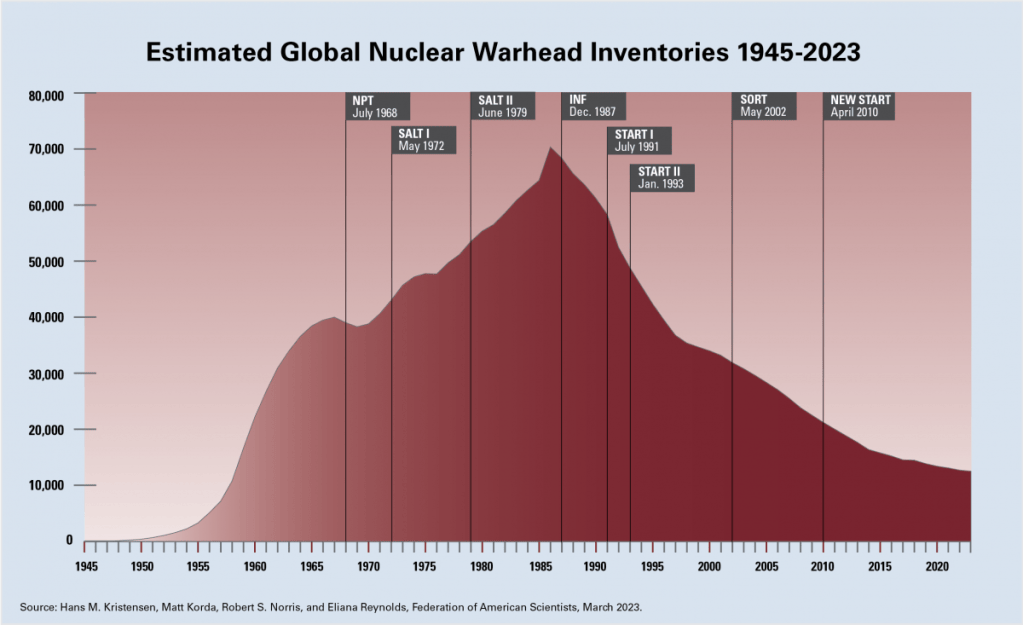
Figure 2. Graph of global nuclear stockpiles from 1945 to 2023 from the Arms Control Association.
The treaties began with the Non-Proliferation Treaty in 1968, continuing through SALT I (1972), SALT II (1979), INF (1987), START I (1991), START II (1993), SORT (2002), and NEW START (2010). NEW START expired in February 2026 without a replacement treaty in place.
Each treaty in this list built on the past and aimed for the future. Decades of painstaking, bilateral nuclear arms control talks attended by generations of diplomats successfully pulled the U.S. and the U.S.S.R. back from the brink of what could have been a planet-extinguishing nuclear apocalypse. This triumph of diplomacy, science, and martialed military and political power gives us a blueprint for a potential new round of bilateral nuclear arms talks between the U.S. and China.
Non-Diplomat and Non-State Actors
While the anti-nuclear movement’s role in this change is not the focus of this article, I do wish to note it briefly, as many of the leaders are still living and still celebrating each new non-proliferation treaty:
[YouTube embed: https://www.youtube.com/watch?v=xkuVT6iIr6I]
As famed feminist, anti-war, and anti-nuclear folk singer Peggy Seeger says in the 2021 video above, “there are lots and lots of people battling this.” Though it is perhaps a rare moment that Peggy Seeger and former Secretary of State and National Security Advisor Henry Kissinger share a position, in 2007 he, George P. Shultz, William J. Perry, and Sam Nunn did just that in their 2007 Wall Street Journal op-ed, “A World Free of Nuclear Weapons”:
Nuclear weapons today present tremendous dangers, but also an historic opportunity. U.S. leadership will be required to take the world to the next stage — to a solid consensus for reversing reliance on nuclear weapons globally as a vital contribution to preventing their proliferation into potentially dangerous hands, and ultimately ending them as a threat to the world.
Nuclear weapons were essential to maintaining international security during the Cold War because they were a means of deterrence. The end of the Cold War made the doctrine of mutual Soviet-American deterrence obsolete. Deterrence continues to be a relevant consideration for many states with regard to threats from other states. But reliance on nuclear weapons for this purpose is becoming increasingly hazardous and decreasingly effective.
The four men behind this op-ed were in many ways the architects of U.S. nuclear weapon growth and reduction policies for as long as those weapons have existed. That they came to share the beliefs of a famous folk singer speaks to the complexities of this issue and human – and national – capacity for change.
That capacity may be sorely needed soon, as may the same methods of diplomatic engagement that leashed the nuclear arms race in the late twentieth century.
Chinese Nuclear Arms Control (Dis)Engagement
China has tripled its nuclear warheads in the past five years. There has been a real evolution of its nuclear posture in the past 10 years, alongside the new “wolf warrior” diplomacy expectations from President Xi. That is when we began to see Chinese stockpiles rising, nuclear research bases spreading out, and the public rhetoric heating up. Japan has not meaningfully reduced its 44.4 ton plutonium stockpile. There have been slow-simmering but real nuclear concerns in the Pacific.
But it appears something major has changed in China’s nuclear posture in the past year. On February 6th, 2026, United States Undersecretary of State for Arms Control and International Security Thomas DiNanno said: “Today, I can reveal that the U.S. government is aware that China has conducted nuclear explosive tests, including preparing for tests with designated yields in the hundreds of tons.”
This appears to be a follow-up to President Trump’s October 29th, 2025, social media statement, posted minutes before he met with President Xi, which indicated he believed China was conducting secret nuclear weapons tests, building concerns about a new nuclear arms race.
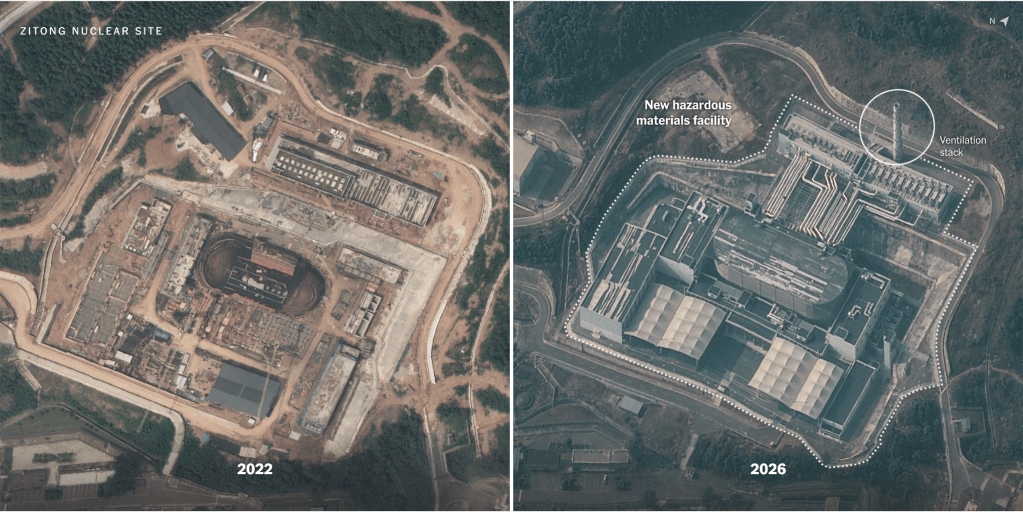
Figure 2. Expansion of the Zitong nuclear development and testing site, from New York Times, “Deep in China’s Mountains, a Nuclear Revival Takes Shape,” February 15, 2026.
These statements are not without a factual basis. The figure above is from a deeply researched New York Times article detailing the intense growth in China’s nuclear weapons production capabilities. The article opens: “In the lush, misty valleys of southwest China, satellite imagery reveals the country’s accelerating nuclear buildup, a force designed for a new age of superpower rivalry.” It goes on to detail the ways in which their satellite imagery shows massive changes to a nuclear production facility and what that could mean for their wartime capabilities.
Of course, it is difficult to tell without access to classified information, but from these bare hints in the open source reporting, we can see: the nuclear temperature is rising in the Pacific.
History here gives us vital context, as always: for most of its nuclear history, China has had no Soviet-style history of nuclear arms reduction treaties with the U.S., Russia, or anyone else. In April 1956, Chairman Mao had noted to the Politburo, “Not only are we going to have more airplanes and artillery, but also the atomic bomb. In today’s world, if we don’t want to be bullied, we have to have this thing.” China tested its first nuclear weapon in 1964. It has maintained a “no-first-use” policy for decades, stating in 2015, “China will unconditionally not use or threaten to use nuclear weapons against non-nuclear-weapon states or in nuclear-weapon-free zones, and will never enter into a nuclear arms race with any other country.”
China began signing onto nonproliferation and nuclear arms control treaties in 1989 with the Convention on the Physical Protection of Nuclear Material, but it took until 2010 for China to become party to the Nuclear Nonproliferation Treaty. To date, they have not ratified the Comprehensive Test Ban Treaty.
China and the Soviet Union have fundamentally different approaches to the nuclear weapons issue. China has not traditionally sought to be known as a nuclear power or make these weapons central to its grand strategy, in contrast with the Soviet Union. While China did not have nuclear weapons to threaten Tibet with in 1950, it does not routinely use nuclear threats against Taiwan. It does not appear to have threatened nuclear weapons in its regular border skirmishes with India either. On the other side of the lever, China also does not seem to be deterred by the U.S. nuclear power in the region and regularly makes other kinds of threats.
Compare that with President Putin’s now-routine threats of nuclear strikes against Ukraine. And as tension with Japan rises and falls, China may change its rhetoric to match its newly increased stockpile.
Conclusion
The history of Great Power nuclear arms growth and reduction is the story of negotiation, complex interactions between nations, leaders, and individuals, and a changing understanding of these hellish weapons’ role in our international relations. Diplomats worked for decades to keep the Cold War cold; it is left to the next generation of foreign affairs professionals to decide if they will do the same.
Jessica Dickinson Goodman is a graduate student in both the Foreign Service and the Global, International and Comparative History programs at Georgetown University. She is also a co-founder of Citizen Historians for the Smithsonian, a volunteer-led organization documenting all of the public exhibits at the Smithsonian as a backstop against White House pressure (citizenhistorians.org).

