
By Mackenzie A. Jones
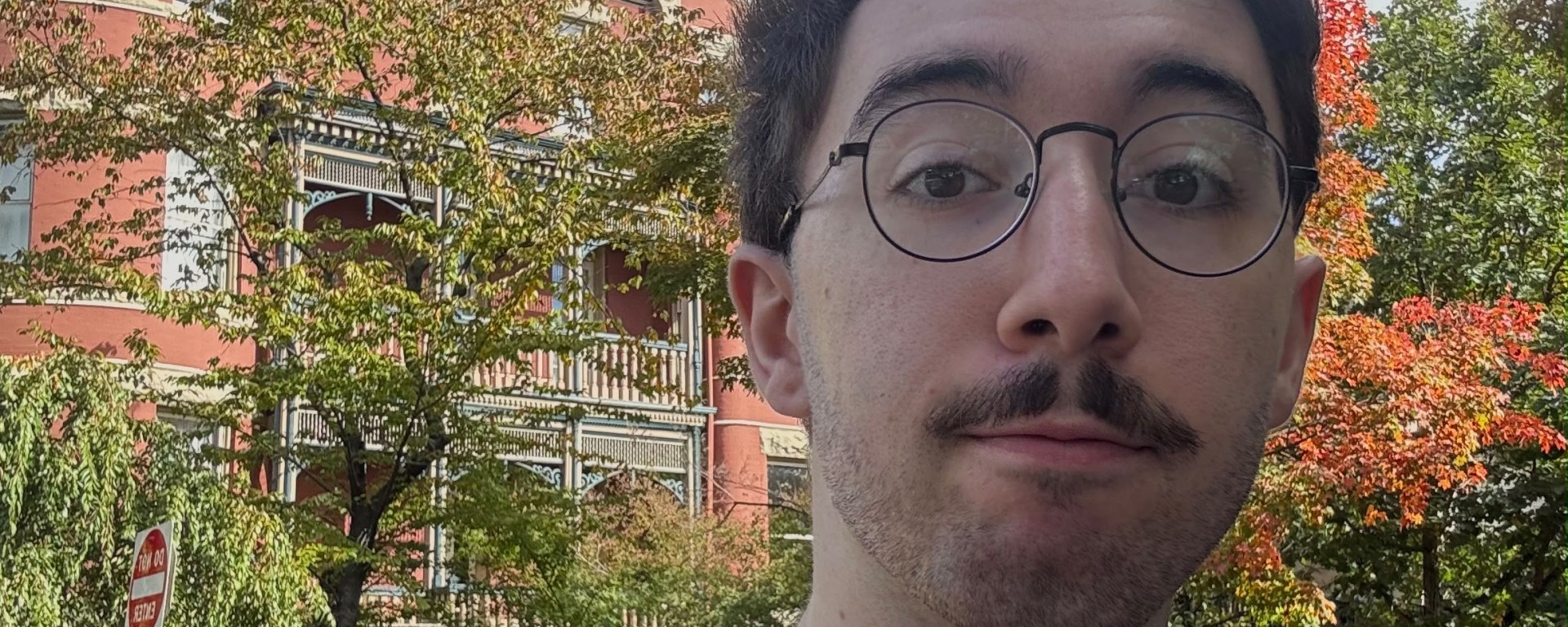
Andrew Bielecki is a first-year History Ph.D. student focusing on the early modern Ottoman Empire and environmental history. He is particularly interested in Islamic understandings of natural disasters as they relate to regions that constitute modern-day Turkey (Türkiye), Greece, and Bulgaria. However, Andrew’s journey to his research topic has been anything but linear.
Andrew began his academic career with the intention of being a historian of the Americas. Yet, during his undergraduate studies at the University of Massachusetts Amherst, he was exposed to several regional and linguistic areas, including Latin America and China. After taking a course on Mongol and Turkic Empires, his interest shifted to the Islamic World. Andrew recalls that the fall semester of 2022 was pivotal in his intellectual development:
“I took courses in Islamic art history, politics, the history of Islamic thought, these sorts of, like, related subjects. And then I ended up taking Arabic later on, but I think it was that one kind of semester where I was seeing the Islamic world from all these different angles that really made it clear to me that, like, I valued the subject, and it felt like something I could do long term. I like the history of Latin America. I like the history of China as well. I did take Chinese for a semester. But I felt like, in comparison to those subjects, Islamic history really spoke to me in a way that other subjects weren’t. And I felt like I could contribute something new to the field, whereas other subjects, I feel like, I was interested but couldn’t really say anything new.”
While completing his bachelor’s degree in anthropology and history, Andrew found new ways to integrate his newfound interest in the Islamic World into his standard coursework. The summer before his senior year, he studied abroad at the University of Oxford. While there, he took courses on international law, art history, and British post-imperial identity, which allowed him to further examine contemporary issues and legal culture in Turkey and Greece, as well as gain a deeper understanding of Islamic presence in the United Kingdom.
After obtaining his bachelor’s degree, Andrew went on to complete a master’s degree in Islamic Studies at Columbia University, where he began to fully realize his regional focus. “My undergrad really shaped my connection to the Islamic world, but my master’s really shaped my connection to Ottoman history specifically. I was trained in Arab studies for a while, and then I kind of pivoted to more, like, the Turkish-speaking, and also kind of Persian-speaking world. But now I’m really committed to just kind of, like, one region [the northern regions of the Ottoman Empire],” he said.
Given that his research interests lie at the intersection between environmental history and regional studies of the Middle East and North Africa, Andrew chose Georgetown to continue his graduate studies with Gábor Ágoston and Dagomar Degroot. The history department’s collegiate and interdisciplinary atmosphere has been conducive to his research and has supported his multifaceted interests. During his first semester, Andrew is taking intensive elementary Turkish, alongside three history seminars — including a colloquium course with Professor Anna von der Goltz, Ottoman History with Professor Gábor Ágoston, and Ways of Knowing with Professor Gregory Afinogenov.
According to Andrew, one of the main challenges in entering a Ph.D. program has been developing an effective reading strategy.
“[For my classes], it’s a ton of reading. I’m learning how to manage that. When I was doing my master’s, I read every single word, every single page. I don’t do that anymore. Because I feel like now it’s important for me to strategize and understand what is important in each text instead of just absorbing the text. I’d say in comparison to my master’s, it was actually more article-based […] where it was like, you’d have four articles a week, and you’d have to understand them separately […] Whereas here it’s very book-based and understanding one full text of like 300 to 400 pages. It’s a different strategy, and I’m learning how to manage that. And I’m also learning how to manage my own research interests, especially because I have like 3 final papers, and I’ve been learning to read like months in advance and kind of absorb it slowly instead of rushing.”
Looking beyond his first year, Andrew hopes to travel to Istanbul, Turkey, next summer to continue his language training and visit archives.
Outside of academia, Andrew enjoys trying Mediterranean, Middle Eastern, South Asian, and East African restaurants around Washington, D.C.
Mackenzie A. Jones is a first-year Ph.D. student. Her research examines the wartime experiences of Soviet Jews and Soviet prisoners of war during the Holocaust. She is also an Outreach Coordinator for The Footnote.

