
By Victoria Korotchenko
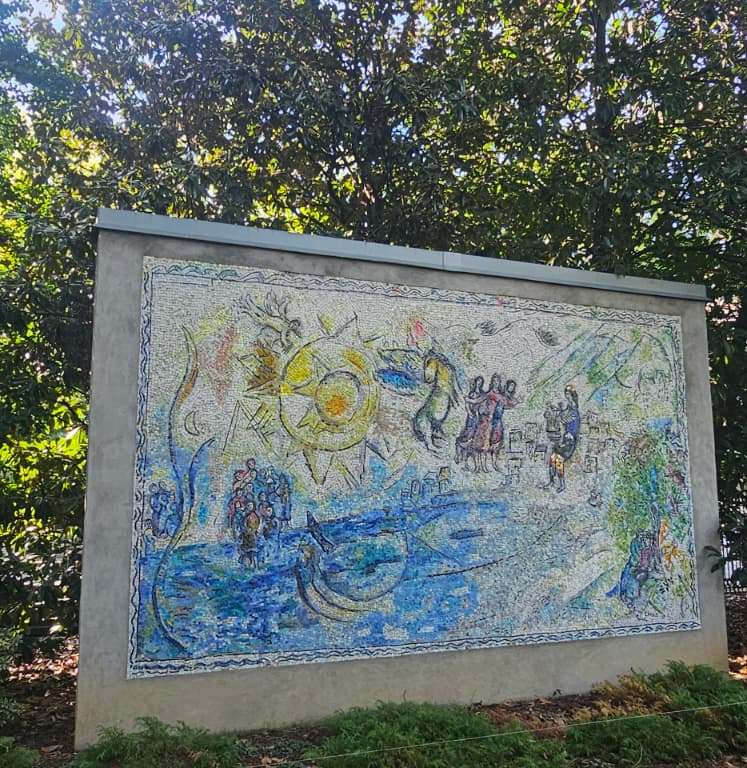
Tucked behind shrubbery and overgrown trees, the lively mosaic that was once the pride and joy of a beloved Georgetown home is now just one of many pieces within the National Gallery of Art’s Sculpture Garden. You would think the name-brand recognition of its artist or the bright blue and yellow tiles might attract crowds, but Marc Chagall’s Orphée stands secluded and separate from the rest of the collection, hidden behind the garden’s cafe. While still part of a preeminent collection, Orphée’s place within this collection does not reflect the central place of honor it once held in its first setting—in the home of economic historian John U. Nef and his wife and fellow lecturer, Evelyn, in the Washington, DC, neighborhood of Georgetown.
Thankfully, the archives shine more than just leaf-dappled light on Orphée and the story it tells of transnational friendship and decades-long academic and artistic scholarship. While researching the provenance of Chagall’s works owned by the National Gallery of Art (NGA) for my dissertation, I was given Orphée’s files. After hours spent looking through similar files on other Soviet avant-garde pieces, I expected the same story I had seen in the files on Vassily Kandinsky’s Improvisation 31, Alexej von Jawlensky’s Portrait of a Young Woman, and Chagall’s other work in the NGA, Houses at Vitebsk: a story of both painting and artist flung across the world as a result of revolution and war in the 20th century, only to end up in the hands of collectors long-separated from the original artist.
This would not be surprising for Chagall or one of his works. Born in 1887 on the periphery of the Russian Empire in Vitebsk (modern-day Belarus), Chagall’s artistic career perpetually traversed the tightrope between repression and acceptance, by the state and audiences alike. He was a Jew in the Russian Empire and then the Soviet Union, so he faced anti-semitism throughout his life, from being one of the few Jewish students to attend a secular Russian school to being threatened by fellow leftist artists that Red Square is where “they’ll hang the lot of you,” as he describes in his memoir My Life. At the same time, however, Chagall managed to rise within the modernist artistic community, traveling to Paris in 1911 and exhibiting in Berlin in 1914, as well as within Soviet cultural leadership. The Commissar of the Enlightenment, effectively the head of the department of culture and education in the Soviet Union (Narkompros), Anatoly Lunacharsky offered Chagall the role of visual arts director within the department, which he refused. Instead, he became commissar of arts for his native Vitebsk. After being ousted for artistic and political disagreements, Chagall and his family returned to Paris in 1923, never to return to the Soviet Union. He and his wife, Bella, attempted to transport paintings from place to place, but some, like those sold from under Chagall in 1923 by an art dealer in Berlin, never made their way back to the artist. From then on, Chagall would relocate across the world, from Paris and the rest of France to Palestine and New York, chasing artistic work and recognition. Despite a tumultuous trajectory, he certainly would receive both in the latter half of his life—evident in his commission to repaint the ceiling of Paris’s Opéra Garnier and to create the memorial Peace Window at the United Nations headquarters.
Orphée, however, is unique from both the early works that were separated from the artist and the later commissions he took for major institutions: it was motivated by dear friendship. Chagall and his second wife, Valentine “Vava” Brodsky, had first met John U. Nef, a University of Chicago economics professor, when Nef invited Chagall to speak at a Committee of Social Thought symposium in the 1950s. After John married Arctic Studies scholar and author Evelyn Stefansson (née Schwartz), the Nefs and Chagalls forged a decades-long family friendship, often summering together in the south of France, where the Chagalls made their primary residence. This transnational friendship would manifest itself in a multitude of correspondence, often featuring doodles by Chagall signed “pour les amis Nef,” and in 1969, the mosaic now known as Orphée.
This mosaic was custom-built to decorate the Nefs’ backyard of their Washington, DC, home, located at 2726 N Street in the historic neighborhood of Georgetown. As Evelyn would later recount, Chagall first visited their new home in 1968 and wanted to give them something of a housewarming gift, saying, “Nothing for the house. The house is perfect as it is. But I will do something for the garden.” That gift was a 10-by-17-foot mosaic weighing over around 1,000 pounds and requiring a custom-built 30-foot brick wall to frame and house it in the professors’ backyard. Despite many initial difficulties in assembling and reconstructing the backyard to fit the mosaic, it was installed in 1971. Until Evelyn’s death in 2009, many passersby would often try to sneak a peek through the backyard fencing to catch a glimpse of the mosaic, which depicted a scene mixing imagery from Greek mythology and references to Chagall’s and the Nefs’ own lives. In the center right, the titular Orpheus plays a lyre for characteristically Chagall animals and for three muses. The center left features a bright yellow sun warming a huddled mass of people crossing vibrant blue water, which might allude to Chagall’s own experiences of immigration following WWII. And in the bottom right corner, tucked right about Chagall’s signature, lie two embracing lovers beneath green trees. According to NGA records, “Evelyn asked the artist if the figures depicted her and John; Chagall replied, ‘If you like.’”
Upon Evelyn’s death in 2009, the mosaic and much of the Nef’s Chagall collection was bequeathed to the National Gallery of Art, which disassembled, restored, and moved the mosaic to the sculpture garden, where it went on view in 2012. This was always the plan, even before John or Evelyn’s death. As The Washington Post magazine wrote in an interview with Evelyn in 2002, “The garden will lose its defining element, its spirit. But the public will gain a priceless artwork inspired by a long bond of friendship.”
I research Chagall within the context of his complex movements across the world, from the Soviet Union to Western Europe to the United States and many places in between. I do so to understand how such movement affects artists’ complicated attitudes toward nationality and concepts of homeland. Among my artists of study, Chagall was particularly mobile—he went all over the place—so imagine my surprise to learn, some fifty years later, that one of those many places to which he traveled and in which he formed a community was my own neighborhood. This was a lovely archival surprise, a joyful experience for a historian more often marred by accounts of war and revolution. But after going through the archival files and the correspondence between les amis Nefs and Chagalls, Orphée stands as a reminder to consider the local and the ordinary—like a forged friendship—when it comes to tracing the history and inspiration behind a great work of art.
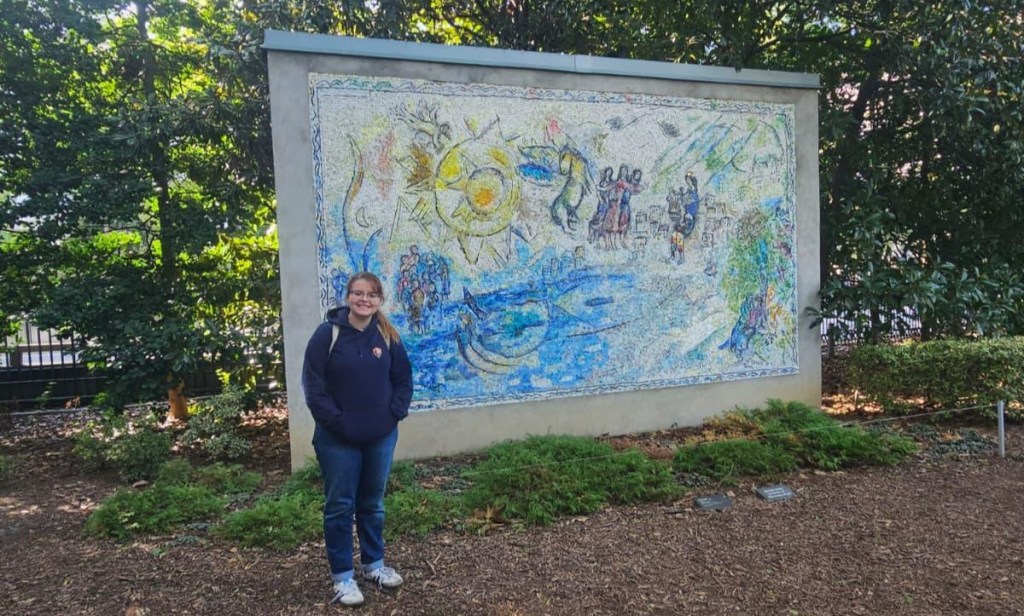
Victoria Korotchenko is a History PhD student at Georgetown University. Her work explores the transnational exchange of artworks and artists following the 1917 Russian Revolution and their display in Western museums up to the present. She is also the current co-editor-in-chief of The Footnote.

