
By Rafael Jovel
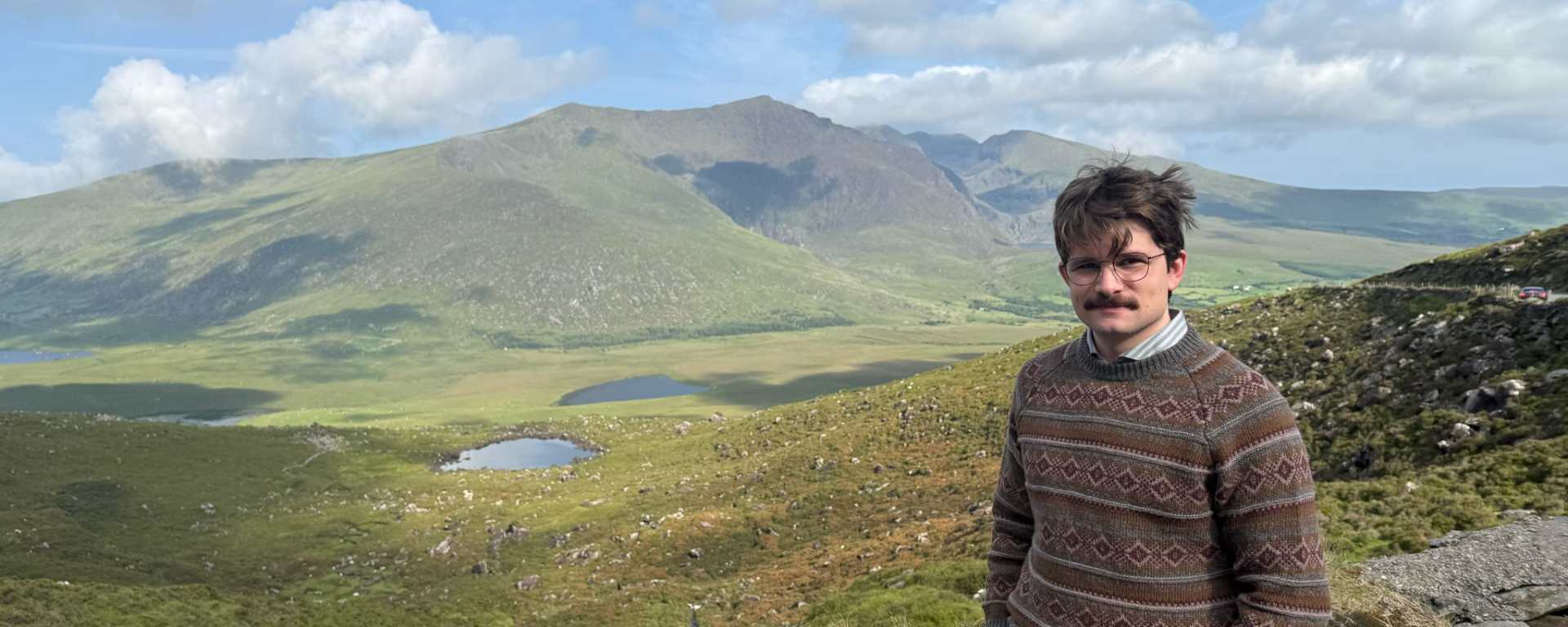
Jackson Moore is a first-year student in the Master’s program in Global, International, and Comparative History (MAGIC) at Georgetown University. He studies early modern cultural history, particularly in the English Atlantic world. He grew up in Pasadena, near Los Angeles, California, and went to college at the University of Colorado Boulder. This interview was conducted in the back hallway of our beloved lounge in the History Department in the Intercultural Center on Wednesday, November 18th, 2026, around 2:30 pm.
Jackson first got into history when he was in elementary school with a World War II picture book. Despite describing himself as “not [a] great reader” when he was young, he developed an enthusiasm for the subject that has followed him ever since; it is an interest that he has continued to build throughout his life. He says his principal area of interest today is the 17th century and the Restoration. He described how:
“a lot has been talked about the revolutionary periods of the Glorious Revolution, [English] Civil War, and interregnum, but [he] found that little buffer zone of people…reevaulting everything and trying to just find a new sense of norm and calm within the chaos since those revolutionary years were still very infant and in development before any successful form of government could be developed.”
He further explained that there were so many “weird” cultural events in this period, like the burning of papal effigies and the many affairs and illegitimate children of Charles II, that he could not help but have his interest piqued. Beyond that, he found the period of the tension and anxiety that led to a time of conspiracy with cultural and social venting in the form of “pomp and performance to be fascinating.”
Jackson chose to pursue graduate school because he was not quite sure what else to do, but he had always been curious about it. After taking a year off from school and working as a bartender, he explained that he was starting to get bored and was thinking about how much he had already been thinking about going back and appreciated that it could create new career opportunities. He also noted it would look good on a resume, be something he would genuinely enjoy doing, and would build important skills in any case. As for his time after the MAGIC program, he described at this early moment that he has “concepts of a plan.”
“I haven’t really wanted to commit to a PhD yet because once I do that I am locked in for life. But then career-wise, I feel like there are a lot of options I feel like I could see myself doing…Maybe working at the State Department as a diplomat, maybe go into museum work, archival, maybe administrative somewhere.”
He further said that he would be interested in teaching, but if he sets his sights on that, he likely would go down the PhD route. He thinks he would enjoy it.
In terms of the archival work he’s done, most of his experience has been with digital archives thus far. He talked about convincing European archives to scan items and send them to him in Colorado while writing his undergraduate thesis. In particular, he would like to give a special shout out to the Spanish embassy in Belgium for their haste and general easygoing attitude in sending over their archival materials. Still, he went to an archive on his undergrad campus seeking documents from a particular decade that had to do with England, and he could immediately tell something was slightly off with the documents he was seeing.
“Printing was illegal unless you had a special permission from the crown, and you had a special stamp. These did not have that. So that’s either they had to be imported/smuggled from Amsterdam or they had to be printed illegally by these small…one page at a time printing press they would hide in the back of a shop…like I found one source that said ‘I overheard what was probably a printing machine in the back of the wool shop.’ And you could tell it was… paper that was reused. You could see…old letters, like smashed together, a lot of spelling mistakes they would cross out, and there were coffee stains all over it.”
Separately, though, Jackson also mentioned finding one source that was just photos of 19th-century pet cats, though his favorite thing was a diary entry that said:
‘Oh, I’m gonna go out with some friends tonight and maybe we’ll celebrate Elizabeth’s accession day’ and the following morning all he had in the diary was ‘Head hurt. Ale probably did it.’
which we shared a good laugh about before closing out our interview with one last question about his life beyond the history department.
When asked what he likes to do beyond the Department, Jackson jokingly struggled initially with “But I’m just so history-pilled…” but in reality, he talked about how he loves video games and loves to read—though reading has gone by the wayside a bit with all the reading he does for the program. He touched a bit on his past life in the esports scene playing Rainbow Six Siege, and how though he was good at it, he didn’t particularly enjoy the game. His real preferences for games are strategy games and, especially, management games—a particular favorite sees the player building a little medieval village in 13th-century Germany, and Jackson said he has been playing that for a while and seeing its community growing since he started. He loves using these management games to unwind. Jackson also said he loves movies and musical theater; his favorite musical is Fiddler on the Roof.
Rafael Jovel is a second-year PhD student in the Department of History and a Co-Event Coordinator and Editorial Assistant on the Footnote Staff. He studies the transnational diaspora of the Salvadoran community in Washington DC, and how they are shaped by interactions with U.S. empire. In his spare time, he loves to go to concerts and hang out with friends!

